












Full Face Shield
- Products
- About us
Face Shield: Transparent Face Protection for Hygiene, Safety and Professional Applications
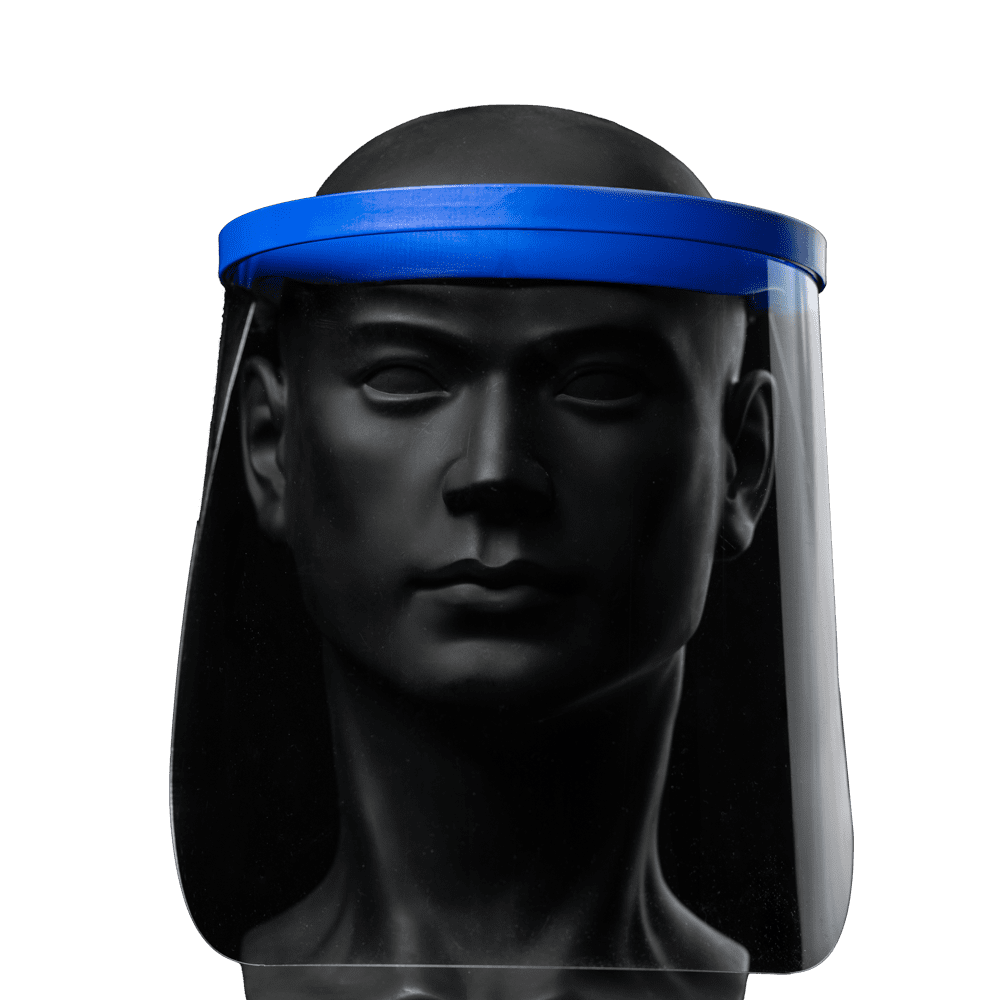
A face shield – also referred to as a facial protection shield or face protection shield – is a transparent protective device that shields the entire face from external influences. It generally consists of a clear visor positioned in front of the eyes, nose and mouth and securely fixed in place with a headband.
- What is a face shield?
- Design, material and functionality
- What advantages do face shields offer?
- Face shield vs. other protective solutions
- Areas of application for face shields
- Important purchasing criteria for face shields
- Standards, labelling and safety
- Product recommendations
- FAQ on face shields
What is a face shield?
A face shield is a clear, stable protective cover that protects the entire face from splashes, particles and other external influences. It consists of a transparent visor positioned in front of the face, fully covering the eyes, nose and mouth. It is worn with a headband that ensures a secure and comfortable fit.
Unlike a conventional face mask or FFP mask, a face shield does not primarily protect against inhaled particles, but against direct external impacts. These include in particular:
- liquid splashes, e.g. in medical or cleaning environments
- droplet contact, e.g. during close interaction with people
- coarse particles or contamination
As a result, the face shield fulfils an important function as part of personal protective equipment (PPE). PPE refers to all equipment designed to protect users’ health in the workplace.
A key feature is the large, unobstructed field of vision. Unlike safety goggles, face shields cover the entire face without significantly restricting visibility. At the same time, facial expressions remain visible, which is particularly beneficial in customer-facing or care-related professions.
Modern face shields – such as those listed in the AMPri range under the “face shields” category – often feature additional properties such as replaceable visors, resistance to disinfectants or heat-resistant materials.
In practice, face shields are often used as a supplement to other protective products, for example in combination with face masks or protective clothing. They are therefore an important element of comprehensive hygiene concepts in sensitive working environments.
Design, material and functionality
A face shield has a functionally simple design, yet its construction is decisive for protective performance, comfort and durability. The combination of transparent visor, stable holder and ergonomic fastening ensures that the entire face is reliably shielded while maintaining unrestricted visibility.
Visor materials explained simply
The central element of every face shield is the transparent visor. In professional applications, plastics such as PETG (polyethylene terephthalate glycol) are usually used.
PETG is characterised by several properties:
- high transparency for clear visibility
- good impact resistance, shatter-resistant in everyday use
- resistance to many disinfectants
These material properties are particularly important in areas such as medicine, care or laboratories, where face shields must be cleaned and disinfected regularly. The AMPri range, for example, includes face shields with PETG visors that are specifically designed to meet these requirements.
Headband, fit and wearing comfort
In addition to the visor, the fastening on the head plays a crucial role. Elastic headbands are commonly used, as they can be flexibly adjusted to different head sizes.
Important aspects for wearing comfort:
- even pressure distribution on the head
- secure fit even during movement
- quick to put on and take off
Especially during longer periods of wear – for example in everyday care work or food processing – an ergonomic design is essential. A poorly fitting face shield can cause pressure points or impair protective performance.
Replaceable visors and replacement shields
A clear advantage of high-quality face shields is the option to replace the visor. Instead of replacing the entire product, only the transparent shield can be changed.
This offers several advantages:
- cost-effective use thanks to a longer service life
- hygienic safety through quick replacement when soiled
- more sustainable use of resources
The AMPri range, for example, includes replacement shields for existing systems, specifically matched to the respective holders.
How it works in use
The protective effect of a face shield is based on a simple but effective physical barrier: the visor keeps direct splashes and droplets away from the face before they can reach the eyes, nose or mouth.
One decisive advantage remains:
Air can circulate at the sides, meaning breathing is not restricted – unlike with tight-fitting masks.
It is important to understand:
In many cases, a face shield does not replace respiratory protection, but usefully complements it. In sensitive areas in particular, a combination of face shield and face mask is therefore frequently used.
What advantages do face shields offer?
Face shields are an established component of modern hygiene concepts because they combine several protective and comfort-related advantages. Especially in professional use – for example in medicine, care, food processing or cleaning – they provide a practical supplement to other protective measures.
A key advantage lies in the broad protection of the entire face. While many protective products only cover individual areas such as the mouth or eyes, a face shield protects the eyes, nose and mouth simultaneously against direct impacts such as splashes or droplets. This significantly reduces the risk of contamination, particularly during activities involving close personal contact or liquids.
Another benefit is the unrestricted field of vision. Thanks to the large, transparent visor, visibility remains clear and wide, enabling precise work. Unlike safety goggles, there is no “tunnel vision”, and orientation is maintained even during quick movements. High-quality materials such as PETG also support distortion-free visibility.
Wearing comfort also plays an important role. As face shields do not sit tightly over the mouth and nose, breathing is not restricted. This makes them particularly comfortable during longer periods of use. At the same time, less moisture builds up compared with masks, improving the subjective wearing experience.
An often underestimated advantage is visible facial expression. In many working environments – such as customer contact, care or education – it is important to be able to recognise facial expressions. Face shields enable communication without fully covering the face and therefore contribute to greater trust and understanding.
In addition, many models offer practical features for everyday working use:
- Reusability thanks to robust materials
- Resistance to disinfectants for hygienic reprocessing
- Replaceable visors for a longer service life
These features make face shields not only hygienic, but also economically practical. Systems with replaceable components – such as those available in the AMPri range – enable flexible and sustainable use in daily operations.
Despite all these advantages, the following applies: a face shield does not replace other protective measures in every case, but often achieves its full effect in combination with supplementary personal protective equipment.
Face shield vs. other protective solutions
Face shields are often considered in connection with other protective products. To make a well-founded purchasing decision, it is important to understand the differences and when each solution is appropriate. After all, no single product meets every requirement at the same time – rather, the various types of protection complement one another.
Face shield vs. face mask
The greatest difference between a face shield and a face mask lies in the direction of protection:
- A face mask, e.g. a surgical mask, is primarily designed to filter particles and droplets when exhaling and inhaling.
- A face shield, by contrast, mainly protects against direct external impacts, such as splashes or droplets hitting the face from the front.
In practice, this means:
A face shield alone does not provide complete respiratory protection, as air can flow in and out at the sides. However, it additionally protects the eye area and large parts of the face.
Particularly in sensitive areas – such as medicine or care – the combination of face mask and face shield is therefore a common solution.
Face shield vs. safety goggles
A clear difference in coverage is also evident when compared with safety goggles.
| Criterion | Face shield | Safety goggles |
|---|---|---|
| Coverage | Entire face | Eye area only |
| Field of vision | Very wide | Restricted |
| Splash protection | High, broad coverage | Localised |
| Wearing comfort | High, no sealing required | Close-fitting |
Safety goggles provide very targeted eye protection, especially against fine particles or lateral hazards. Face shields, by contrast, are ideal when broad protection and a clear field of vision are the priority.
When does a combination make sense?
In many professional applications, a single protective measure is not sufficient. Instead, combined solutions are used to achieve a higher level of safety.
Typical combinations include:
- face shield + face mask, e.g. in medicine and care
- face shield + safety goggles, where there is an increased risk from particles and splashes
- face shield + additional PPE such as gowns or gloves
These combinations follow the principle of a multi-stage protection concept: each component performs a specific function and complements the others.
A face shield often acts as the outer protective barrier, intercepting direct impacts before they reach other protective layers.
Areas of application for face shields
Face shields are used wherever the face needs to be protected from splashes, droplets or particles without significantly restricting the field of vision or communication. Thanks to their versatile properties, they are suitable for a wide range of sectors – both in professional environments and in everyday use.
Medicine and care
In medicine and care, face shields are an important item of personal protective equipment. They are primarily used for activities where contact with bodily fluids or secretions is possible.
Typical applications:
- patient care and nursing
- emergency and rescue services
- diagnostics and sample collection
Here, the face shield often serves as an additional protective layer in combination with a face mask or other PPE components.
Laboratory and research
In laboratory environments, face shields protect against:
- chemical splashes
- biological samples
- unpredictable reactions
The large visor maintains visibility for precise work while also ensuring broad protective coverage.
Food industry
Face shields also play a role in food processing. They help protect products from contamination while supporting compliance with hygiene standards.
They are particularly relevant:
- when processing exposed food products
- in quality control
- during activities involving close contact with products
In this area, importance is often placed on materials that are easy to clean and resistant to disinfectants.
Cleaning and hygiene
In the field of cleaning and facility services, face shields protect against:
- splashes from cleaning agents
- chemical substances
- contaminated liquids
Especially during intensive cleaning work, broad facial protection is useful for protecting the skin and mucous membranes.
Customer-facing and service-oriented sectors
In sectors involving direct customer contact – such as retail, cosmetics or hospitality – face shields provide a combination of protection and visible communication.
Advantages in these areas:
- facial expressions remain recognisable
- friendly and open communication is possible
- hygienic distance protection is supported at the same time
Industry and skilled trades
Face shields are also used in industrial applications and skilled trades, particularly when:
- liquids are being handled
- grinding or spraying processes take place
- additional protective measures are required
Here they are often combined with other protective equipment to ensure a comprehensive safety concept.
Overall, face shields are suitable for use across sectors and can be flexibly integrated into existing protection concepts. Their strength lies particularly in the combination of large-area protection, good visibility and high wearing comfort.
Important purchasing criteria for face shields
Anyone wishing to buy a face shield should consider not only the price, but above all quality, area of use and practical properties in everyday working life. Especially in professional environments, small details determine whether a product can be used efficiently and safely over the long term.
Visibility quality and fogging behaviour
A central criterion is the optical quality of the visor. Only a clear, distortion-free field of vision enables precise work.
What you should look for:
- high transparency without streaks or distortion
- a surface that is as scratch-resistant as possible
- reduced fogging during longer use
Materials such as PETG offer a very good combination of clarity and stability in practice and are therefore widely used in professional environments.
Cleaning and resistance to disinfectants
In hygiene-sensitive areas, face shields must be cleaned regularly. It is therefore important that the material is resistant to disinfectants.
Key factors include:
- simple, quick cleaning
- no material alteration caused by disinfection
- smooth hygienic surfaces
Products explicitly suitable for use with disinfectants offer clear advantages in everyday practice.
Reusability and replaceability
A high-quality face shield should not be regarded as a purely disposable product. Systems with replaceable visors are significantly more economical and sustainable.
Advantages:
- lower follow-up costs thanks to replacement shields
- quick restoration of operational readiness
- less waste compared with disposing of the complete product
Especially in the B2B sector – for example in care facilities or industry – this point is often decisive when selecting a product.
Wearing comfort during long periods of use
A face shield is often worn for several hours. Wearing comfort is therefore an essential factor.
Important features:
- elastic, adjustable headband
- low weight
- comfortable fit without pressure points
An ergonomic design ensures that the shield remains stable even during movement and does not need constant readjustment.
Size and coverage
Not every face shield covers the face equally well. Ensure that the protective surface is sufficiently large to:
- fully cover the forehead, eyes, nose and mouth
- leave as little lateral exposure as possible
Generous coverage significantly increases the protective effect, particularly against splashes or direct contact.
Standards and labelling
Especially in commercial use, face shields should meet the applicable requirements. They are often classified as PPE (personal protective equipment).
Example:
- PPE CAT I: simple protection category for basic risks
This labelling shows that the product has been assessed for the intended use and meets basic safety requirements.
Conclusion:
A good face shield is convincing not only because of its protective function, but also due to its suitability for everyday use, durability and comfort. Those who take these criteria into account make a sustainable and economically sound purchasing decision.
Standards, labelling and safety
When selecting a suitable face shield, standards and labelling play an important role – especially in professional use. They provide guidance on the risks for which a product is designed and which basic requirements are met.
Personal protective equipment (PPE) explained simply
Face shields generally belong to what is known as personal protective equipment (PPE). This refers to all products intended to protect users from health risks in the workplace.
Typical examples of PPE include:
- gloves
- protective clothing
- masks
- face shields
It is important to note: PPE is always designed for a specific intended use. For example, a face shield protects against splashes and droplets, but not automatically against very fine particles or gases.
PPE categories, e.g. PPE CAT I
In Europe, PPE is divided into different categories depending on the level of risk:
| Category | Meaning, explained simply |
|---|---|
| PPE CAT I | Protection against minimal risks |
| PPE CAT II | Protection against medium risks |
| PPE CAT III | Protection against high or life-threatening risks |
Many face shields – including those in the AMPri range – are classified as PPE CAT I. This means that they are designed for basic protection requirements, for example against mechanical impacts or splashes.
CE marking
Another important feature is CE marking. It indicates that the manufacturer declares that the product complies with the applicable European requirements.
For users, this means:
- The product has been assessed and, where applicable, tested in accordance with the relevant EU regulations
- It meets the basic legal requirements for the intended use
- It may be sold and used within the EU
Especially in the B2B sector, CE marking is an important guidance criterion when selecting products, as it signals conformity with European requirements.
Limits of protective performance
Even though face shields make an important contribution to safety, it is essential to assess their limitations realistically.
A face shield:
- protects against direct splashes and droplets
- offers broad facial protection
- enables unrestricted breathing
A face shield:
- does not replace certified respiratory protection, e.g. FFP masks
- is not fully sealed against airflows
- should be combined with additional PPE depending on the application
This classification is particularly important for correct use in everyday work and for creating effective hygiene concepts.
Quality and tested standards at AMPri
AMPri places great importance on certified quality and products compliant with standards. The company works with a quality management system based on international standards such as:
- DIN EN ISO 13485, medical devices
- DIN EN ISO 9001, quality management
- compliance with the European PPE Regulation
These standards ensure that products – including face shields – are reliable, tested and suitable for the intended use.
Conclusion:
Standards and labelling are not an end in themselves, but provide important guidance on safety and quality. Anyone purchasing a face shield should therefore always ensure that the product is suitable for the planned use and classified accordingly.
Product recommendations
For professional use, it is advisable to select face shields that are both functional and economically convincing. The AMPri range includes solutions specifically developed for daily use in medicine, care, industry and hygiene.
SolidSafety face shield, item no. 02990
A proven system is the SolidSafety face shield with transparent visor.
Features and advantages:
- Transparent PETG visor for clear, distortion-free visibility
- Replaceable shield for economical use
- Suitable for disinfectants
- Elastic headband for a secure fit
- Autoclavable up to 134 °C, for high hygiene requirements
This model is particularly suitable for areas with increased hygiene requirements, as it is both robust and reusable.
Replacement shields for face shield, item no. 02991
Suitable replacement shields are available for sustainable and cost-efficient use.
Features and advantages:
- Suitable for existing face protection systems
- Quick replacement when soiled or worn
- Also resistant to disinfectants
- Supports hygienic working in continuous operation
The use of replacement visors reduces costs and waste in the long term, as the complete face shield does not need to be replaced.
Selection note:
The combination of a reusable carrier system and replaceable visors is particularly useful in the B2B sector. It enables flexible adaptation to different operating conditions while also contributing to greater sustainability in everyday working life.
FAQ on face shields
What is the difference between a face shield and a visor?
In everyday language, the terms are often used synonymously. Technically, the visor refers to the transparent sheet, while the face shield is the complete system consisting of visor and holder.
Does a face shield protect against viruses or bacteria?
A face shield protects against direct droplets and splashes that may contain viruses or bacteria. However, it does not replace respiratory protection, as air can flow in and out at the sides.
Can a face shield be worn on its own?
That depends on the area of use. In many situations – especially in medical environments – it is used in combination with a face mask to ensure more comprehensive protection.
Are face shields reusable?
Yes, many models are designed for multiple use. Suitable cleaning and disinfection are required. Systems with replaceable visors are particularly durable.
How do you clean a face shield correctly?
Cleaning is usually carried out using suitable disinfectants or mild cleaning agents. It is important that the material is designed for this purpose in order to avoid clouding or damage.
Do face shields fog up?
Compared with safety goggles, they fog up significantly less because they do not seal tightly. High-quality materials and sufficient distance from the face further reduce fogging.
Which sectors are face shields suitable for?
Typical areas of application include:
- medicine and care
- food industry
- laboratory and research
- cleaning and hygiene
- industry and skilled trades
Which standards should a face shield meet?
Many products are classified as PPE, e.g. PPE CAT I, and carry CE marking. These indicate that basic safety requirements are met.
How long can a face shield be worn?
This depends on the model and application. High-quality products with ergonomic headbands are designed for longer wearing periods and offer appropriate comfort.
When should a visor be replaced?
Replacement is advisable in the event of:
- visible scratches or clouding
- damage
- heavy soiling
Replaceable visors – as available in professional systems – make this process considerably easier.
Are face shields sustainable?
Compared with disposable products, reusable systems with replacement visors can be more resource-efficient, as only individual components need to be replaced.
Are there differences in quality?
Yes, particularly in terms of:
- material, e.g. PETG vs. simple plastics
- workmanship
- fit and comfort
- resistance to disinfectants
Especially in professional use, investing in tested quality is worthwhile.