















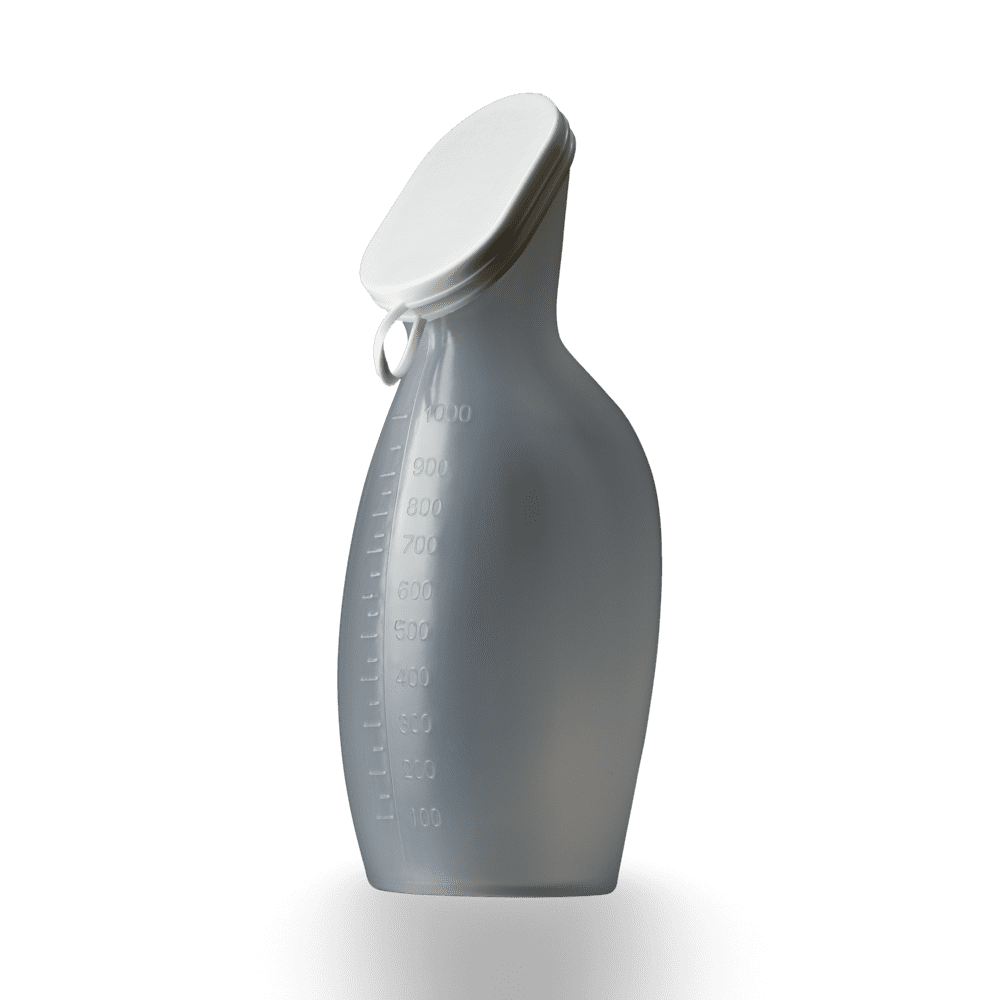

Urinal bottles for women — anatomically adapted, autoclavable and immediately available for hospitals, rehabilitation and care
A urinal bottle for women is a reusable collection container with an anatomically adapted, oval inlet opening that enables discreet and dignified urination while lying down. It is an integral part of ward and patient supplies in hospitals, rehabilitation facilities and outpatient care, complementing the care range with a hygienically safe, reusable aid that preserves patient dignity. In this category, AMPri offers professional, autoclavable PP urinal bottles for women (1 litre, Top-Comfort) as reusable care aids — available for immediate delivery from our German central warehouse through B2B wholesale for medical retailers, medical supply stores, care services and hospital procurement.
Table of contents
- What is a urinal bottle for women?
- Anatomical design of the women's urinal bottle
- Polypropylene (PP) — the clinical standard material
- AMPri urinal bottle for women — an example in detail
- Areas of use — hospital, rehabilitation, care, home
- Mobile use — patient transport, travel, car
- Application — how is the urinal bottle positioned correctly?
- Hygiene, cleaning and reprocessing
- Matching accessories
- Prescription, medical aids and reimbursement
- Procurement in B2B wholesale — ordering from AMPri
- Related AMPri categories
- Sources and further information
- FAQ urinal bottle for women
1. What is a urinal bottle for women?
A urinal bottle for women is a reusable, tightly sealing plastic collection container specifically designed for the female anatomy. It features a significantly larger, anatomically shaped inlet opening that allows a close, leak-resistant fit while lying down. In everyday care and in communication with patients it is colloquially also called a pee bottle, female urinal or ladies' urinal bottle — all referring to the same aid within professional ward and patient supplies.
In inpatient and outpatient care, the women's urinal bottle fulfils three central tasks: it enables independent urination while lying down, facilitates fluid balance recording in the care documentation and relieves nursing staff when handling excretions. A correctly used urinal bottle protects the patient's dignity, avoids unnecessary transfers to the bathroom and reduces the risk of falls or bedwetting.
1.1 Distinction from related care aids
For a correct procurement decision, a clear distinction from other aids in the area of excretion is essential. A urinal bottle for women is not a substitute for a bedpan or a urine drainage bag and performs a clearly defined function in the care process.
- Bedpans (plastic) and bedpans (stainless steel): Used to collect urine and stool, they are slid under the pelvis and have a large opening on the top.
- Urine drainage bag: Used in combination with a transurethral or suprapubic catheter and filled continuously. Designed as a single-use product for continuous drainage, not for occasional urination.
- Urinal bottle for women: Self-contained reusable container with scale and lid for discreet, occasional urination while lying or sitting, without permanent catheterisation.
- Urine bag holder: Used to securely attach urine drainage bags to the bed or frame — available from AMPri as a urine bag holder.
This distinction gives rise to the specific requirements for volume, closure, graduation and reprocessing that set a professional women's urinal bottle apart from improvised containers. In procurement for medical facilities, the clear separation of these product groups is standard practice.
1.2 Synonyms and search terms in everyday care
When purchasing for hospitals, care homes or outpatient care services, urinal bottles for women are searched for under various names. Colloquially — especially in patient communication and in care conversations with relatives — terms such as pee bottle, female urinal, ladies' urinal bottle and urine container for women are common. In tender documents and supplier catalogues, the technical terms urinal bottle for women or women's urinal bottle prevail. AMPri consistently uses the technical term in its catalogue and product communication and assigns the colloquial variants as synonyms to simplify your search in the B2B shop.
2. Anatomical design of the women's urinal bottle
A women's urinal bottle differs clearly in design from the men's variant. It features a significantly wider, anatomically shaped inlet opening and a flatter, oval bottle body that allows a close fit while lying down without the patient having to sit up. This design is the key prerequisite for a discreet, low-spill application in the lying position.
The difference from the men's variant is anatomically based and not interchangeable: men's urinal bottles have a long, angled neck with a small opening, designed for use while standing or sitting. Women's urinal bottles rely on a wide, oval contact surface with an adapted opening that rests directly against the perineum. Cross-use is not anatomically appropriate — on mixed wards, stocking both variants in parallel is therefore recommended.
2.1 Volume and leak-tightness
As standard, a professional women's urinal bottle holds 1,000 ml — sufficient for several voidings without intermediate emptying. It is closed with a push-on or screw-on lid that prevents accidental leakage during transport to the bedpan washer-disinfector or in the care trolley. High-quality models are designed to seal tightly, so that no soiling of the bed linen occurs even during supine transport in an ambulance or when changing position in bed.
The graduation on the outside allows the volume to be read without decanting — important for care documentation and medical fluid balance monitoring. For patients on diuretic therapy, with renal insufficiency or under postoperative monitoring, this visual check is a key advantage over improvised solutions.
2.2 Discretion and patient dignity
The women's urinal bottle is available in milky-white or transparent plastic. The milky variant offers increased discretion because the contents are not directly visible from the outside — a practical advantage in shared rooms and in everyday open care settings. Transparent models, on the other hand, are advantageous on wards where visual urine checks (colour, turbidity, admixtures) are part of routine care. Both variants are equivalent in terms of patient dignity and are selected according to the facility's profile.
3. Polypropylene (PP) — the clinical standard material
Polypropylene (PP) is the established clinical standard for reusable urinal bottles for women. The material is break-resistant, lightweight, chemically resistant to common cleaning agents and disinfectants and, above all, autoclavable up to 130 °C. PP thus meets the central requirements for a ward aid: reliable reprocessing, long service life and compatibility with the central sterile services department (CSSD).
Compared with other materials such as polyethylene (PE), polycarbonate (PC) or PVC, PP offers the best combination of cost-effectiveness, heat resistance and ease of reprocessing. For women's urinal bottles that are repeatedly reprocessed in the bedpan washer-disinfector and, where applicable, in a steam autoclave at 121 °C or 134 °C, PP is therefore the first choice.
3.1 Materials in comparison
The following overview compares the four plastics commonly used in the urinal bottle segment. Heat resistance is given as a temperature value, service life as approximate reprocessing cycles; break resistance, chemical resistance and weight are shown as relative ratings (1–5) and do not replace manufacturer specifications.
| Property | PP (polypropylene) | PC (polycarbonate) | PE (polyethylene) | PVC |
|---|---|---|---|---|
| Heat resistance | up to 130 °C | up to approx. 120 °C | up to approx. 90 °C | not heat-resistant |
| Autoclavable | yes | limited | limited | no |
| Break resistance | ★★★★★ | ★★★★★ | ★★★★☆ | ★★★☆☆ |
| Chemical resistance | ★★★★★ | ★★★☆☆ | ★★★★☆ | ★★★☆☆ |
| Weight (light) | ★★★★★ | ★★★☆☆ | ★★★★★ | ★★★☆☆ |
| Visual inspection | milky | transparent | milky | transparent |
| Service life (approx. reprocessing cycles) | several hundred | several hundred | approx. 50–100 | limited |
The white, tightly sealing plastic lid of the AMPri women's urinal bottle is chemically resistant and matched to the PP bottle body. In everyday inpatient use, this combination is a proven compromise between leak-tightness, handling and reprocessability.
4. AMPri urinal bottle for women — an example in detail
As a representative of the AMPri range, we present the PP urinal bottle for women, 1 litre, Top-Comfort as an example in detail. It combines the anatomically adapted design with the clinical standard material polypropylene and is designed as an autoclavable reusable product — available for immediate delivery through B2B wholesale for medical retailers, care facilities and hospital procurement.
➡️ PP urinal bottle for women, 1 litre, Top-Comfort
4.1 Technical data
The key specifications of the women's urinal bottle at a glance — compactly summarised for your tender or procurement documentation:
- Brand: Top-Comfort
- Volume: 1,000 ml
- Shape: Oval, anatomically adapted inlet opening for women
- Bottle body material: Polypropylene (PP)
- Lid material: Plastic, white, tightly sealing
- Colour: Transparent, milky shade — for increased discretion in shared rooms
- Autoclavable: up to 130 °C — CSSD-compatible
- Application: Reusable product for professional multiple use
- Sector suitability: Hospital, rehabilitation, inpatient and outpatient care
- Packaging unit (PU): 25 pieces
The combination of a robust PP bottle body and a tightly sealing lid has proven particularly effective in everyday inpatient care: the PP body withstands numerous autoclaving cycles, while the lid ensures a tight seal during transport to the bedpan washer-disinfector and between the patient room and the reprocessing area.
4.2 Use and availability
The women's urinal bottle is primarily designed as ward and patient supplies for hospital use and is employed in acute hospitals and rehabilitation facilities as well as in long-term inpatient care. AMPri delivers the women's urinal bottle from its German central warehouse in Winsen/Luhe to resellers, medical retailers, care facilities, medical supply stores and hospital procurement. Delivery is B2B only, exclusively to businesses, traders, freelancers and public institutions.
Relevant for procurement departments: AMPri has been active in the hygiene and care sector since 1995, is certified to ISO 9001:2015 and EN ISO 13485:2016 and carries around 6,000 articles covering hygiene, protective clothing and ward and practice supplies. The women's urinal bottle is part of the established ward supplies range and is usually available for immediate delivery from stock.
5. Areas of use — hospital, rehabilitation, care, home
Urinal bottles for women are used in a wide range of care situations — from acute and intensive care through rehabilitation to outpatient and home care. Each area of use places its own demands on the reprocessing route, graduation, discretion and procurement volume. The following overview matches typical B2B buyers with the appropriate requirement profiles.
5.1 Sector suitability in comparison
The following overview table shows the sectors in which the women's urinal bottle is typically used and which requirements dominate in each case. It serves as a guide for range planning in wholesale and medical retail.
| Sector | Requirement profile | Suitability of women's urinal bottle |
|---|---|---|
| Hospital / clinic | Autoclavability, CSSD compatibility, high quantities, robust repeated reprocessing | ★★★★★ primary field of use |
| Rehabilitation facility | Reprocessing in the bedpan washer-disinfector, long patient stays | ★★★★★ |
| Inpatient care | Robustness, patient dignity, simple reprocessing | ★★★★★ |
| Outpatient care | Immersion disinfection, transportability, low weight | ★★★★☆ |
| Home care | Easy cleaning in the household, discretion, durable reuse | ★★★★☆ |
| Patient transport / mobile | Tight closure, low weight, fall safety | ★★★★☆ |
5.2 Hospital, clinic and CSSD
In the acute inpatient environment, women's urinal bottles are an indispensable part of ward supplies. They are used on general wards, in postoperative care, in intensive care units and in the emergency department — wherever patients cannot leave their bed independently. The autoclavability of the PP women's urinal bottle allows integration into the central sterile services department (CSSD), provided the hygiene standards of the respective hospital require this. In facilities with decentralised reprocessing in the bedpan washer-disinfector, machine cleaning and thermal disinfection at up to 90 °C is the standard route.
5.3 Rehabilitation and long-term inpatient care
In rehabilitation and inpatient care facilities, women's urinal bottles are a permanently used part of the basic care equipment and are often in use for weeks or months. The robust design of the AMPri urinal bottles for women quickly pays off in this context compared with single-use alternatives.
5.4 Outpatient and home care
Outpatient care services and family caregivers use women's urinal bottles in the home environment. Here, easy cleaning in the bedpan washer-disinfector or by immersion disinfection with household products is decisive. Care services often order the women's urinal bottle through B2B wholesale as part of an initial equipment set together with a matching urinal bottle brush.
Procurement note: AMPri is a wholesaler and supplies intermediaries as well as larger end users with minimum order quantities. If you need our products in smaller quantities, please contact our partner portal team at Tel.: +49 (0) 4171 / 84 80-555 — we will be happy to help you find a reputable and reliable intermediary.
6. Mobile use — patient transport, travel, car
Beyond classic inpatient use, women's urinal bottles are increasingly in demand in mobile contexts — from patient transport and day care services to longer car journeys. In the consumer and outdoor context often colloquially searched for as a "travel pee bottle" or "travel urinal", the professional variant from the AMPri range is the hygienically sound solution here as well.
6.1 Patient transport and supine journeys
In qualified patient transport and emergency medical services, the women's urinal bottle is part of the basic equipment for caring for patients in the lying position. It is used both on longer transfer journeys between hospitals and on journeys home after inpatient stays. The tightly sealing women's urinal bottles are ideal here because they do not leak during sudden braking or on uneven roads. Patient transport companies typically order in larger quantities through B2B wholesale.
6.2 Day care and mobile care services
Mobile care services and day care providers often carry an emergency kit in their vehicles, which also includes women's urinal bottles. These are used in acute situations during home visits or during transfers between home and the day care facility. The robust PP design easily withstands the constant change between vehicle and facility.
6.3 Travel, motorhome and emergency equipment
On longer journeys with patients in need of care — for example on family trips, transfers abroad or in a motorhome — a professional urinal bottle is a considerable relief compared with improvised solutions. Medical supply stores and rehabilitation retailers therefore also stock the women's urinal bottle for sale to private end customers who want to keep their relatives in need of care mobile. It is also a worthwhile purchase as emergency equipment in private households for situations in which using the toilet is temporarily not possible.
7. Application — how is the urinal bottle positioned correctly?
The application of a women's urinal bottle requires some practice — both on the part of nursing staff and on the part of the patient. A correctly positioned urinal bottle enables urination while lying down without spillage, protects bed linen and skin and preserves the patient's dignity. In professional care, the application is usually taught as part of basic care training; for relatives providing home care, care services give a brief introduction.
7.1 Preparation
Before use, the urinal bottle is kept ready and the lid is opened. The patient should lie in a slightly elevated position (upper body slightly raised), ideally with knees bent. A bed protector or a water-repellent underlay is recommended, especially for the first application, until the routine is established. If required, incontinence underlays or absorbent compresses can also be provided — products from the patient hygiene range are also available from AMPri.
The following checklist has proven effective in everyday care as preparation for the application:
- Provide a clean, reprocessed urinal bottle — visual check for cracks, clouding and lid tightness.
- Water-repellent bed underlay or incontinence pad positioned under the pelvis.
- Inform the patient and protect privacy — draw the curtain, briefly inform fellow patients.
- Slightly raise the upper body (approx. 30°), bend the knees if mobility allows.
- Put on disposable gloves and perform hand disinfection in accordance with the hygiene plan.
- Place the urinal bottle within the patient's field of vision, lid open, inlet opening facing the direction of reach.
- Have toilet paper or cleaning wipes ready for aftercare.
7.2 Positioning and urination
The anatomically adapted opening of the women's urinal bottle is placed directly against the perineum so that the oval contact surface forms a close seal. The patient or an assisting carer holds the bottle from the front below. A slight tilt of the bottle is important so that the urine flows into the bottle body by gravity. The application works both lying down and in a semi-sitting position; to promote independence, the patient should hold the bottle herself whenever possible.
7.3 Aftercare and emptying
After urination, the urinal bottle is carefully removed, the lid is closed and the bottle is taken for reprocessing. In home care it is emptied into the toilet, in inpatient care into the bedpan washer-disinfector. The volume check for the care documentation is carried out before emptying using the graduation on the side. The women's urinal bottle is then cleaned and disinfected — details in the next section.
8. Hygiene, cleaning and reprocessing
Hygiene and reprocessing is the central hygiene step for a reusable women's urinal bottle. It determines how safe the product actually is in reusable use. Reprocessing always comprises two steps: cleaning removes dirt and visible soiling — and disinfection reduces germs to a hygienically safe level. Cleaning removes dirt but does not replace disinfection. Both steps complement each other and should be carried out in this order.
8.1 Machine reprocessing in the bedpan washer-disinfector
In everyday inpatient care, women's urinal bottles are usually machine-cleaned and thermally disinfected in the bedpan washer-disinfector. These devices operate with water temperatures of up to approx. 90 °C and, according to the recommendations of the Robert Koch Institute (RKI), achieve a sufficient reduction of vegetative pathogens [1]. The PP design of the women's urinal bottle is compatible with all standard bedpan washer-disinfectors. It is important to pre-empty the bottles before the wash cycle and to load them with the lid open so that the water jet can reach all inner surfaces.
8.2 Autoclaving at 121 °C or 134 °C
If reprocessing is carried out in a steam autoclave — for example in the hospital's central sterile services department — the PP women's urinal bottle, with its heat resistance of up to 130 °C, is compatible with sterilisation cycles at 121 °C (standard programme) and, with restrictions, at 134 °C. The lids are also heat-resistant but should be separated from the bottle body before autoclaving to ensure sterilisation of all surfaces.
8.3 Manual immersion and wipe disinfection
In outpatient and home care, reprocessing is carried out manually by mechanical cleaning with warm water and a urinal bottle brush. A VAH-listed immersion or wipe disinfection complements the mechanical cleaning — suitable disinfectants are available in the AMPri range.
Before each reprocessing cycle, a mechanical cleaning step with a dedicated urinal bottle brush is recommended to remove sediment and deposits from the bottle neck — see section 9 on matching accessories.
8.4 Replacement indicators and service life
The service life of a professional women's urinal bottle depends on the material, the frequency of reprocessing and mechanical stress. Visible cracks, clouding, deformation or leaking lids are clear replacement indicators. Bottles should also be replaced if odours persist despite proper reprocessing — usually an indication of micro-cracks in which biofilm forms. A general service life in months or cycles cannot be stated; the decisive factor is the visual and functional condition at each reprocessing. For economical stocking, it is advisable to keep a sufficient number of women's urinal bottles in stock so that damaged or unsightly bottles can be replaced immediately.
8.5 Disposal at the end of the service life
At the end of its service life, the women's urinal bottle is disposed of in accordance with the regulations of the local waste disposal authority. For unused or cleaned and disinfected bottles, the local disposal regulations specify the correct route. The respective recycling requirements of the Packaging Act apply to the packaging materials (cardboard, PE film). For bottles last used in an infectious context (suspected hepatitis A, multi-resistant pathogens and similar situations), disposal must be clarified in accordance with the facility-specific requirements for infectious contaminated material — typically within the framework of the facility's hygiene plan.
9. Matching accessories
The right accessories for urinal bottles for women make the difference in everyday ward use in terms of handling, hygiene and cost-effectiveness. For the women's urinal bottle, mechanical cleaning with a suitable brush is the most important accessory component. An overview of all supplementary items can be found in the AMPri accessories range.
9.1 Urinal bottle brushes for manual cleaning
A dedicated urinal bottle brush is indispensable for mechanical cleaning before disinfection. It reliably reaches the bottom and the neck of the bottle and removes sediment that can form during longer standing times.
➡️ Urinal bottle brush: Heat-resistant brushes, 37 cm long, matched to the interior of standard urinal bottles. Standard equipment in every professional reprocessing area.
10. Prescription, medical aids and reimbursement
In the B2B context, urinal bottles for women are classic ward and patient supply articles and, in home care, may be relevant as medical aids depending on the situation. Billing towards patients or health insurance funds is not handled through end-customer sales at AMPri, but through medical supply stores and rehabilitation retailers who purchase the women's urinal bottle from B2B wholesale and pass it on to end customers.
10.1 Prescription via medical supply stores
A medical prescription via a medical supply store may be possible depending on the care level and health insurance fund. AMPri urinal bottles do not carry a GKV medical aid number — listing in the German statutory health insurance (GKV) register of medical aids is not part of our B2B range. Settlement with the health insurance fund is handled directly by the medical supply store or pharmacy, not by AMPri.
10.2 Procurement in the professional context
Hospitals, rehabilitation facilities and inpatient care facilities procure women's urinal bottles as part of their ward and patient supplies from their own funds through B2B wholesale. What counts here is availability, volume discounts and the long-term availability of consistent quality. AMPri serves these facilities with proven top quality directly from the Winsen/Luhe warehouse.
11. Procurement in B2B wholesale — ordering from AMPri
Buying women's urinal bottles from AMPri means ordering from a professional B2B wholesaler with more than 30 years of experience in hygiene, protection and care products. Our women's urinal bottles are usually available for immediate delivery — ideal for resellers, medical retailers, medical supply stores, care services and hospital procurement looking to build up or supplement a reliable ward and patient supplies range.
11.1 Conditions for resellers and buyers
The AMPri B2B shop is reserved exclusively for businesses, traders, freelancers and public institutions — delivery to private consumers within the meaning of Section 13 of the German Civil Code (BGB) is excluded. Our women's urinal bottles are delivered in packaging units of 25 pieces; for hospitals, large care facilities and wholesale partners, carton and pallet quantities as well as individual volume discounts are available through the AMPri sales team. The most important procurement conditions at a glance:
- Target group: Businesses, traders, freelancers, public institutions (B2B, no private consumers under Section 13 BGB).
- PU women's urinal bottle: 25 pieces per packaging unit.
- Availability: usually immediately from stock.
- Shipping: established logistics partners or self-collection from Winsen/Luhe.
- Volume discounts: on request through the AMPri sales team.
- Private label: available for strategic resale partners.
Current prices and conditions can be viewed for each product in the partner portal. For even larger purchase quantities, please contact our sales team at sales@ampri.de.
11.2 Shipping, availability and service
AMPri ships from its central warehouse in Winsen/Luhe with established logistics partners and, on request, offers self-collection. In the regular care and hospital range, the women's urinal bottle is available for immediate delivery; during seasonal demand peaks or for very large quantities, advance ordering with a firm delivery date commitment is possible. The AMPri quality management system is certified to ISO 9001:2015 and EN ISO 13485:2016 by QS ZÜRICH AG [3] — your compliance and procurement documentation is thus secured at audit level.
11.3 Contact for individual procurement questions
If you need larger quantities, individual delivery schedules, private label solutions or specific advice on range selection for hospitals, rehabilitation or care, you can reach our sales team directly at Tel.: +49 (0) 4171 / 84 80-0 or by e-mail at info@ampri.de. We also support you with tender documentation and with putting together complete ward and patient supply packages.
12. Related AMPri categories
Customers who purchase urinal bottles for women from AMPri usually combine them with other articles from the ward and patient supplies range. The following categories usefully complement the range and can also be ordered directly in the B2B shop:
- ➡️ Urinal bottles for men — the anatomically matching variant for mixed wards, available in four materials (PP, PE, PC, PVC).
- ➡️ Urinal bottles — main category — overview of all material variants, accessories and special designs.
- ➡️ Urine & stool collection containers — bedpans, urine drainage bags, stool measuring cups and other collection containers.
- ➡️ Patient hygiene & patient supplies — absorbent compresses, bed protection, incontinence aids and supplementary care supplies.
- ➡️ Ward supplies — the complete overview for everyday hospital and care use.
Sources and further information
- Robert Koch Institute — recommendations on hospital hygiene and infection prevention (German)
- AMPri certificates — ISO 9001:2015 and EN ISO 13485:2016 by QS ZÜRICH AG
FAQ urinal bottle for women
We answer the most frequently asked questions about the urinal bottle for women compactly in the following overview.
The information provided here has been compiled with the greatest care and to the best of our knowledge and has been reviewed by our quality management. Nevertheless, errors or omissions cannot be ruled out. Liability for errors in content, omissions or for damage arising from the use of this information or from external links is excluded to the extent permitted by law.