















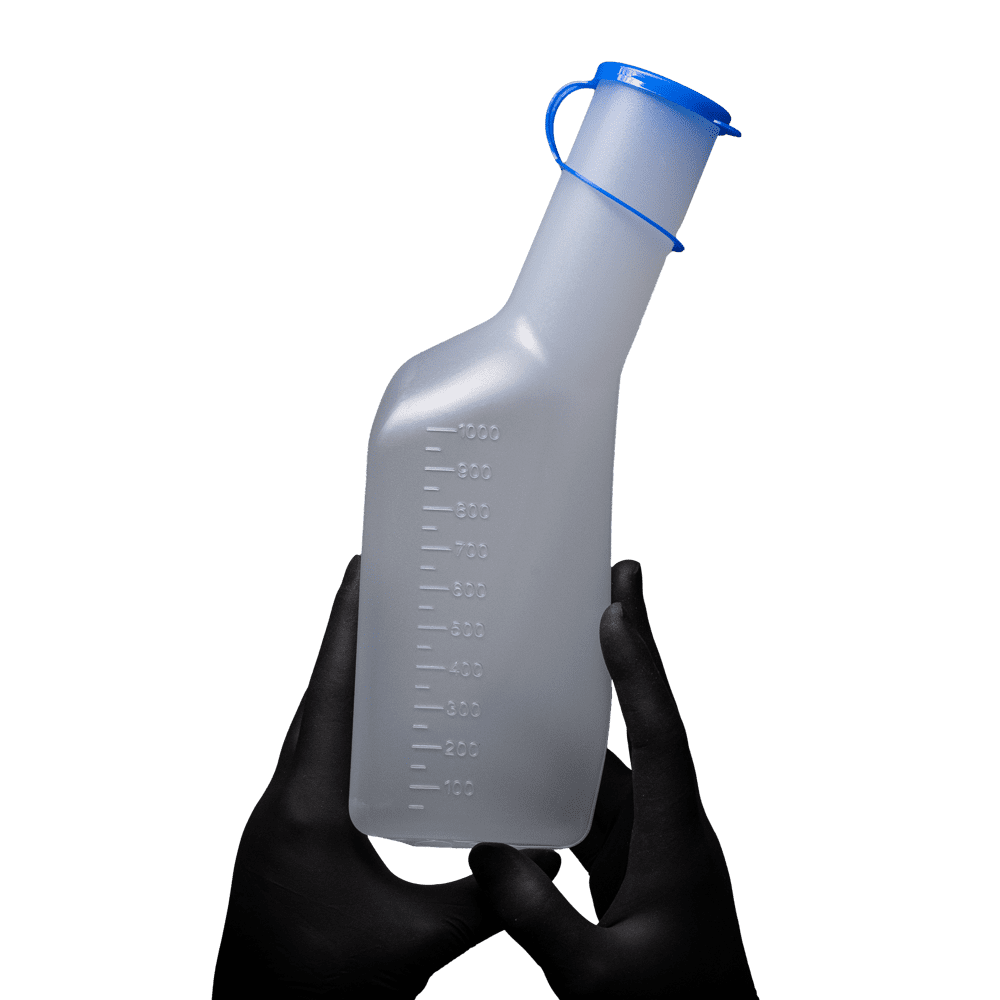

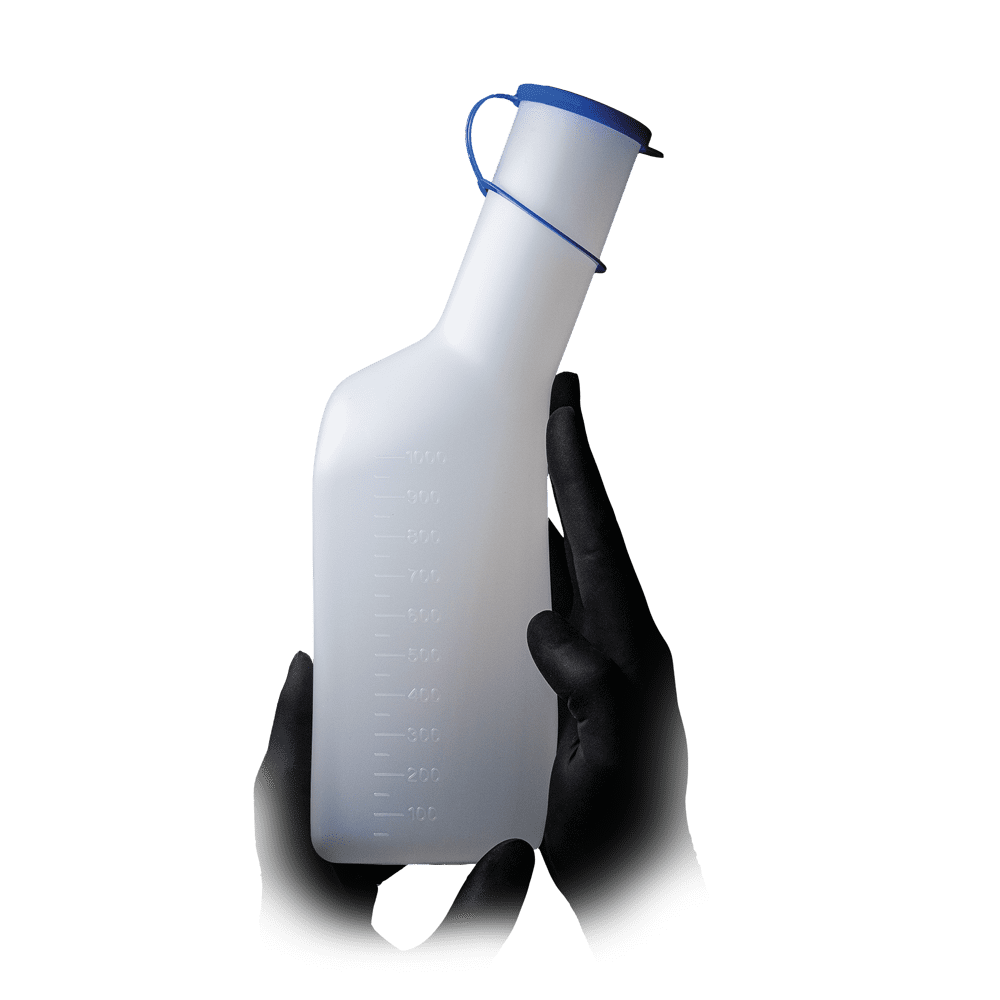
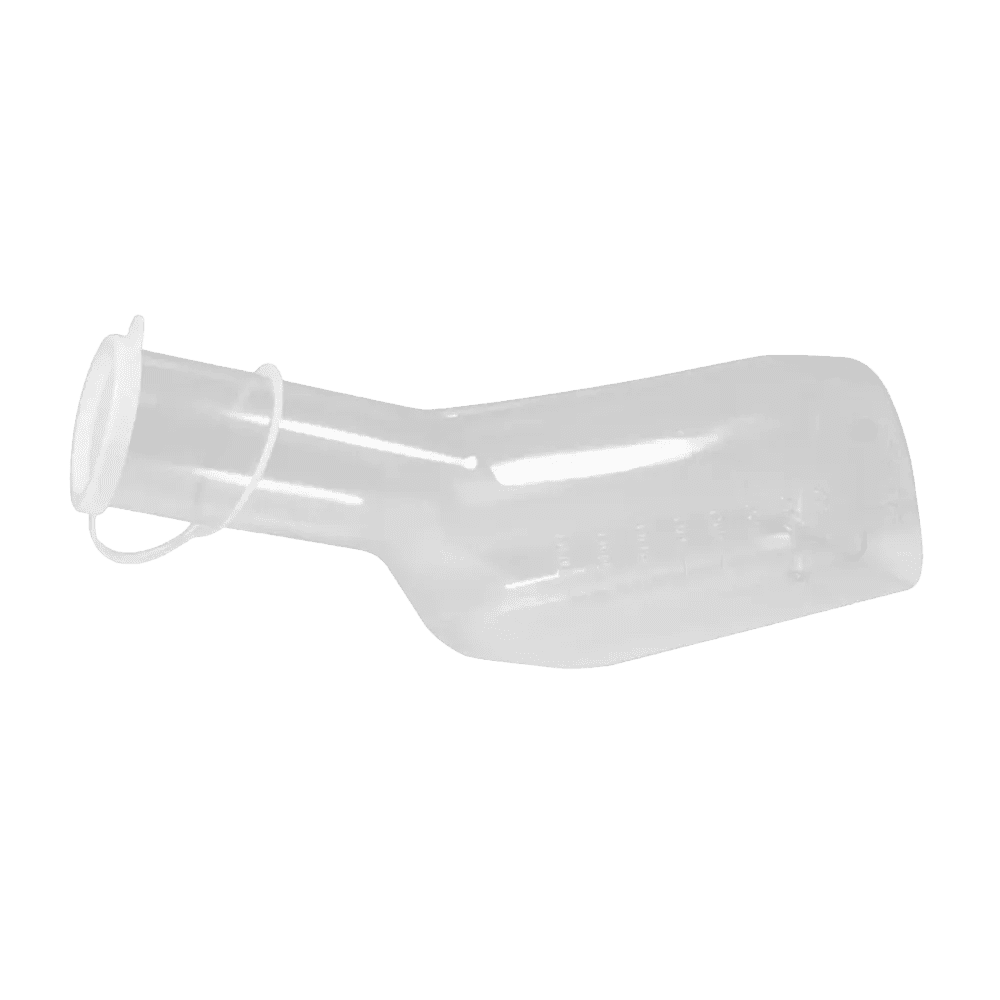
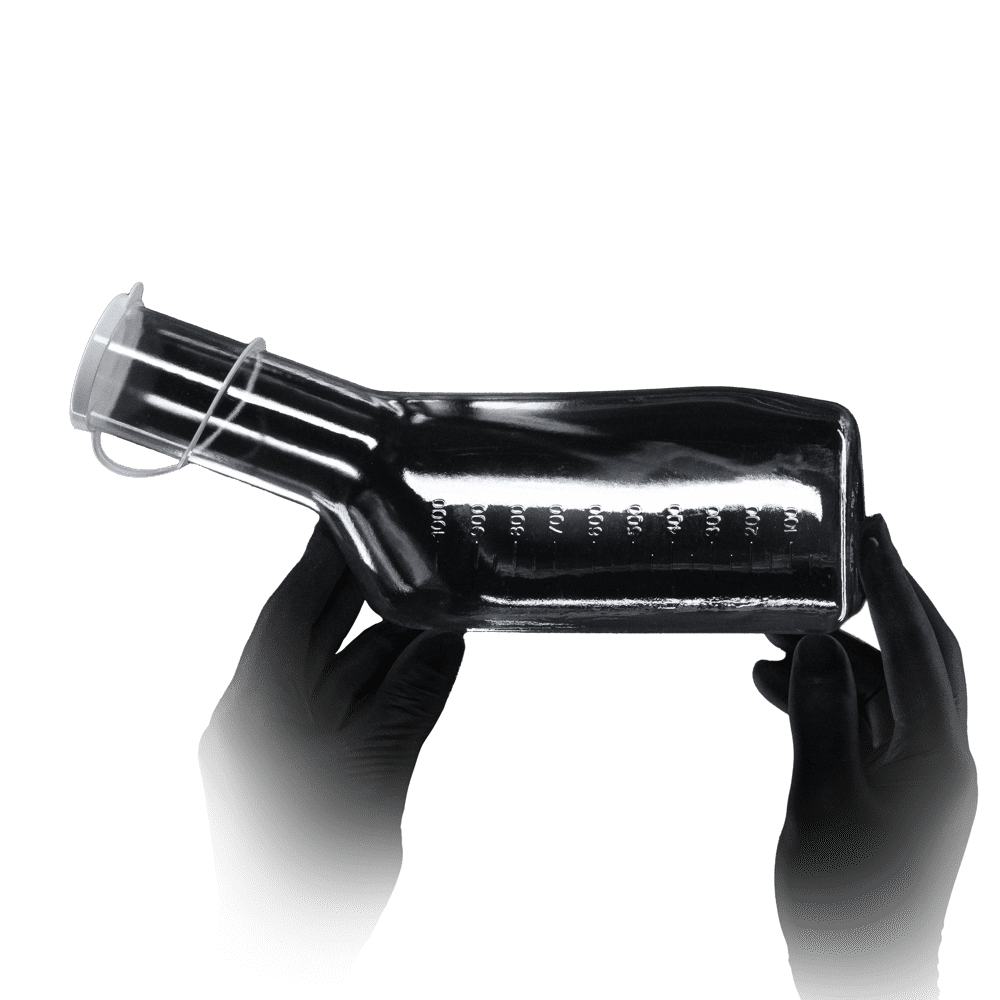
A male urinal bottle – in everyday care also colloquially called a urine duck or pee bottle – is a reusable aid for discreetly collecting urine directly at the bedside, in a wheelchair or on the move. It has an elongated neck with an anatomically suitable opening that makes use easier when lying down or standing. AMPri supplies male urinal bottles as professional ward supplies in four material variants – polypropylene (PP), polyethylene (PE), polyvinyl chloride (PVC) and polycarbonate (PC) – autoclavable up to 130 °C depending on the model and with volume discounts for the medical trade. All four models are available from stock; wholesale buyers benefit from tiered prices and transparent delivery times.
Contents
- What is a male urinal bottle? Definition, synonyms and differentiation
- Materials compared – PP, PE, PC and PVC
- Shape and anatomy – why male urinal bottles are shaped differently
- The four AMPri male urinal bottles in detail
- Areas of use – hospital, rehab, care, home and diagnostics
- Mobile use – on the move, patient transport, car and camping
- Application – how is a male urinal bottle applied correctly?
- Hygiene, cleaning and reprocessing
- Accessories – holder, replacement lid and cleaning brush
- Suitability by sector at a glance
- Procurement and prescription
- Sources and further information
- FAQ male urinal bottles
1. What is a male urinal bottle? Definition, synonyms and differentiation
A male urinal bottle is an elongated collection vessel with a lid, used in professional care to collect urine discreetly and hygienically at the bedside. The angled neck is shaped so that it can be applied safely when lying, sitting or standing. It is a reusable aid for ward and patient supplies that is reprocessed after each use and used again.
Colloquially – above all in everyday care and in patient communication – the terms urine duck, pee bottle or simply men's bottle are used in parallel. They always refer to the same aid. These synonyms appear frequently in search queries; in professional purchasing and documentation, however, the correct term remains „male urinal bottle“ or the corresponding article number.
It is important to distinguish it from closely related ward-supply aids. The bed pan serves to collect stool and urine in a supine position. The urine bag stays attached to the patient and is filled via a catheter. The urinal bottle, by contrast, is a free-standing, removable vessel that can be hung into a ➡️ urinal bottle holder on the bed frame when required. Confusing these terms risks incorrect orders – clear vocabulary saves time and money in ward-supply wholesale.
The male shape differs significantly from the ➡️ female urinal bottle, which has a wide, anatomically shaped opening. Facilities that care for both sexes should therefore always keep both variants in stock. The graduated 09271-M variant holds 1,000 ml; please refer to the respective product detail pages for the exact capacities of the other models. The capacity is sufficient for a complete bladder emptying and for the diagnostic measurement of larger urine volumes.
2. Materials compared – PP, PE, PC and PVC
The material of a male urinal bottle determines weight, breaking strength, reprocessing temperature and service life. AMPri offers four plastic variants, each covering a different usage profile. The right choice depends on how reprocessing is carried out (thermal or chemical), whether transparent visual control is needed and which unit price is to be achieved with volume discounts.
Polypropylene (PP) is the clinical all-rounder: light, dimensionally stable and autoclavable at 130 °C. PP therefore withstands thermal reprocessing in the bedpan washer without restriction. Polyethylene (PE) is cheaper and slightly softer; the AMPri PE model can be reprocessed up to 90 °C and suits facilities with moderate reprocessing temperatures. Polycarbonate (PC) offers crystal-clear transparency with full autoclavability up to 130 °C – ideal for diagnostic urine-volume measurement at the bedside. Polyvinyl chloride (PVC) is heat-resistant up to 60 °C and is therefore disinfected chemically; the crystal-clear PVC variant is used above all in outpatient and home care.
| Model | Material | Shape | Reprocessing | Lid | Transparency |
|---|---|---|---|---|---|
| 09281 | PP | angular | thermal up to 130 °C | blue (PP) | milky |
| 09282 | PE / PP lid | angular | thermal up to 90 °C | blue (PP) | milky |
| 09283 | PC / PP lid | angular | thermal up to 130 °C | white (PP) | crystal-clear |
| 09271-M | PVC / PE lid | oval | chemical (up to 60 °C) | white (PE) | crystal-clear |
The choice of material directly determines the hygiene strategy. PP and PC models withstand thermal disinfection in a washer-disinfector (WD) according to DIN EN ISO 15883 [4]. PE models are suitable for lower programme temperatures; PVC models are reprocessed chemically with VAH-listed agents from the ➡️ surface disinfection category [1]. For procurement this means: in a total-cost-of-ownership comparison, PP is often the most economical choice despite the higher unit price because it survives many reprocessing cycles. To compare the models directly, it is best to put the ➡️ 09281 PP male urinal bottle side by side with the ➡️ 09283 PC urinal bottle, transparent.
3. Shape and anatomy – why male urinal bottles are shaped differently
The shape of a male urinal bottle follows male anatomy: an elongated neck with a straight or slightly angled opening that allows a tight fit and reduces the risk of spillage. Three of the four AMPri models (09281, 09282, 09283) are angular – the flat base gives the bottle a secure stand on the bedside table or in bed and prevents it from rolling away. The fourth model, the ➡️ 09271-M PVC urinal bottle, crystal-clear, is oval and therefore sits especially comfortably in the hand.
Angular or oval – which shape is right?
The shape question is not only a matter of comfort but has a direct practical effect on accessories. The AMPri urinal bottle holders are designed exclusively for angular bottles (see section 9). Anyone who wants to hang a bottle securely on the bed therefore chooses an angular model (09281, 09282 or 09283). The oval 09271-M is designed as a hand-held bottle and does not fit these holders. This distinction prevents incorrect orders, which occur repeatedly in ward supplies.
All four male models have a lid that closes the contents securely. The angular models 09281 and 09282 have a blue PP lid, model 09283 a white PP lid, and the oval 09271-M a white PE lid. The colour coding of the lids helps to quickly distinguish materials and reprocessing routes in everyday ward use.
A tight closure is decisive in everyday care: the lid prevents spillage during transport to reprocessing and reduces odour at the bedside. For diagnostics, the graduation is also relevant – the oval 09271-M carries a printed scale on which the urine volume can be read directly without decanting. On the transparent models 09283 and 09271-M, the crystal-clear wall additionally supports visual control of the fill level, which makes timely emptying easier.
4. The four AMPri male urinal bottles in detail
AMPri offers four male urinal bottles that differ in material, shape and reprocessing temperature. All are reusable products and are supplied in steps of 25. Below, buyers and ward managers will find the key data for a quick selection.
09281 – PP male urinal bottle, angular (bestseller). The best-selling model in polypropylene, milky white, with a blue PP lid. Autoclavable up to 130 °C and therefore the first choice for thermal reprocessing in hospital operation. Robust, light and inexpensive with volume discounts.
➡️ 09281 – PP male urinal bottle, angular
09282 – PE male urinal bottle, angular. The economical variant in polyethylene with a blue PP lid, reprocessable up to 90 °C. Suitable for rehab facilities and care homes with moderate reprocessing temperatures and high volume requirements.
➡️ 09282 – PE male urinal bottle, angular
09283 – PC male urinal bottle, transparent. Crystal-clear polycarbonate variant with a white PP lid, autoclavable up to 130 °C. The transparent wall allows direct visual control of the fill level – ideal for diagnostics and urine-volume measurement.
➡️ 09283 – PC male urinal bottle, transparent
09271-M – PVC male urinal bottle, oval, graduated, Top-Comfort. Crystal-clear, oval PVC bottle with a white PE lid, 1,000 ml capacity and a printed graduation for reading the urine volume. Heat-resistant up to 60 °C and therefore designed for chemical disinfection. Popular in home and outpatient care.
➡️ 09271-M – PVC male urinal bottle, graduated, oval
Which male urinal bottle is the right one?
For hospital operation with machine thermal reprocessing, the PP variant 09281 is the standard choice. If a transparent scale is needed for diagnostics, the choice falls on the PC variant 09283 (autoclavable) or the graduated PVC variant 09271-M (chemically reprocessed). For price-sensitive procurement with high volumes and moderate reprocessing temperatures, the PE model 09282 is suitable. Anyone supplying several sites combines the models in a single bundled order.
5. Areas of use – hospital, rehab, care, home and diagnostics
The male urinal bottle is used across all levels of care – from the acute hospital to home nursing. In the hospital it is part of the practical care and ward equipment, complemented by a ➡️ urinal bottle holder on the bed frame. In rehab it supports patients during the mobilisation phase when the way to the toilet is still too uncertain.
Care facilities use male urinal bottles above all for night-time care to reduce the risk of falls during nocturnal toilet trips. In the home setting they are used by chronically ill, post-operative or mobility-impaired men; outpatient care services carry them as standard in the care case because they are discreet, light and quick to reprocess.
Diagnostically, the urinal bottle serves the quantitative measurement of urine volume – for example to monitor kidney function or for 24-hour collective-urine diagnostics. Here the transparent models 09283 (PC) and 09271-M (PVC, graduated) are the first choice because they allow direct visual control without decanting. In palliative care, too, male urinal bottles are valued for their discretion – combined with a ➡️ urine bag holder if an indwelling catheter is also in use.
For range planning the following applies: geriatric wards and urology departments have an above-average need for male urinal bottles, while mixed wards should keep male and ➡️ female urinal bottles in stock in parallel. A combined purchase of both variants usually improves the volume tier and lowers the unit price – an advantage for purchasing departments that want to consolidate suppliers.
6. Mobile use – on the move, patient transport, car and camping
The mobile urinal bottle – in the consumer and outdoor context often searched for colloquially as a pee bottle for on the go, urinal bottle for drivers or camping urinal bottle – goes beyond classic hospital use. It is used on long car journeys, in patient transport, while hiking or during outdoor activities when no toilet is reachable. For professional drivers and mobile personnel it is an established aid.
Mobile use calls for different properties than in hospital: a tightly closing lid, a small pack size and a break-resistant wall. For this AMPri recommends the transparent PC variant ➡️ 09283 urinal bottle, transparent: break-resistant, angular (easy to stow in the car) and with visual control of the fill level. For home and outpatient mobility, the light, graduated PVC variant 09271-M is an inexpensive alternative.
An important note on classification: a urinal bottle from the medical field is designed for professional care use and is not a classic outdoor item. The advantage lies in the robust, reprocessable design and the availability with volume discounts – in patient transport, volume tiers already apply from 50 units, delivered directly from the Winsen (Luhe) warehouse.
7. Application – how is a male urinal bottle applied correctly?
The correct application determines hygiene, comfort and patient safety. The procedure is divided into four steps: preparation, application, emptying and reprocessing. During preparation the urinal bottle is checked for cleanliness and integrity, the lid is opened and – if applied by the nursing staff – single-use gloves according to DIN EN ISO 21420 [5] are worn.
During application the penis is placed into the opening of the bottle neck so that a tight seal is created. For bedridden patients this is done in a side-lying position or half-sitting; slightly elevating the upper body makes drainage easier. The nursing staff should ensure discretion and provide a visual screen (bed sheet, curtain). Independent patients usually carry out the application themselves.
After emptying, the bottle is closed, removed and brought to reprocessing immediately. Spillage is to be avoided – ideally transport takes place in a splash-protection tray or directly in the ➡️ urinal bottle holder with lid (09280). Emptying is done in the bedpan washer or in a dedicated disposal sink, never in the patient washbasin.
Recurring application errors reported by the medical trade are applying too late, a leaky closure and a missed visual check of the fill level. To prevent overflow, the bottle should be emptied in good time before the fill limit is reached. A brief instruction of the nursing staff clearly reduces these errors; AMPri provides application notes to ward-supply customers on request – write to info@ampri.de.
8. Hygiene, cleaning and reprocessing
The reprocessing of a male urinal bottle is a critical hygiene step and, in hospital, follows the recommendations of the Commission for Hospital Hygiene and Infection Prevention (KRINKO) at the Robert Koch Institute [3]. There are two standard routes: thermal reprocessing in a washer-disinfector (WD) according to DIN EN ISO 15883 [4] and chemical disinfection with VAH-listed agents [1].
In everyday hospital use, thermal reprocessing dominates. The PP models (09281) and the PC model (09283) are autoclavable up to 130 °C, the PE model (09282) up to 90 °C. The graduated PVC variant 09271-M is heat-resistant up to 60 °C and is therefore disinfected chemically. The maximum reprocessing temperature is defined per model – anyone working in mixed operation should label the models clearly to avoid thermal overload of the PVC bottles.
For chemical reprocessing, agents from the ➡️ surface disinfection category are used. Decisive are the entry in the VAH list [1] and a suitable spectrum of action (at least bactericidal and yeasticidal). Contact times follow the manufacturer's specifications. Mechanical pre-cleaning with the ➡️ urinal bottle brush (09289) removes deposits and is a prerequisite for effective disinfection.
Full sterilisation is not required in routine operation: urinal bottles only come into contact with intact skin or external mucous membranes and are therefore considered hygienically non-critical. For patients with suspected infection – for example multi-resistant pathogens – the bottle is used on a patient-specific basis and discarded after discharge. This practice increases consumption considerably and is an argument for reliable availability and wholesale discounts, as offered by AMPri.
9. Accessories – holder, replacement lid and cleaning brush
The right accessories make everyday ward work easier and extend the service life of the urinal bottle. AMPri bundles them in the ➡️ urinal bottle accessories category. Three components are relevant for the male urinal bottles: the holder, the replacement lid and the cleaning brush.
Which holder fits which male urinal bottle?
The ➡️ urinal bottle holder is a PVC-coated metal frame that secures the bottle on the bed or patient-transport frame. AMPri offers two variants: the ➡️ urinal bottle holder with lid and chain (09280) and the ➡️ urinal bottle holder without lid (09280-ODK). Important: according to the manufacturer, both holders are designed for all angular urinal bottles made of plastic or glass – so they fit the angular male models 09281, 09282 and 09283. The oval variant 09271-M does not fit these holders for design reasons.
The replacement lid is a frequently needed consumable, as lids get lost over time or lose their tightness. The ➡️ PP lid for urinal bottles, blue (09284-B) is a round, autoclavable replacement lid (ring Ø 62 mm, cap Ø 58 mm). Its blue colour matches the blue lids of the angular models 09281 and 09282; it is intended as the blue replacement lid for these. In case of uncertainty about the exact fit for a specific model, the AMPri sales team will provide information.
The ➡️ urinal bottle brush (09289) made of polypropylene (37 cm length, brush Ø 55 mm) serves the mechanical pre-cleaning before machine or chemical reprocessing. It is heat-resistant and is part of the basic equipment of every reprocessing point. Care wards often order holder, lid and brush together with the urinal bottles as bundled ward supplies.
10. Suitability by sector at a glance
The suitability by sector of a male urinal bottle depends on the reprocessing options, the patient structure and the volume requirement. The following table assigns typical fields of use to the four models. All models are available from stock and with volume discounts for wholesale customers.
| Sector | Recommended model | Material | Reprocessing |
|---|---|---|---|
| Hospital / clinic | 09281 | PP | thermal 130 °C |
| Rehab facility | 09281 / 09282 | PP / PE | thermal 90–130 °C |
| Care / nursing home | 09282 | PE | thermal / chemical |
| Diagnostics / urine measurement | 09283 / 09271-M | PC / PVC | thermal or chemical |
| Home / mobile care | 09271-M | PVC | chemical (VAH) |
In the hospital sector the PP variant 09281 dominates because it is autoclavable up to 130 °C and is processed without problems in the bedpan washer. In rehab care a mixed order of PP and PE is well established. For diagnostics the transparent models 09283 and 09271-M are preferred because visual control makes urine-volume measurement easier. In home and mobile care the light, graduated PVC variant 09271-M is the economical choice. AMPri also supplies mixed orders of several materials in one delivery – useful for organisations with multiple sites.
11. Procurement and prescription
Anyone who wants to order a male urinal bottle has several routes in Germany: B2B wholesale via the medical trade (standard for facilities), the medical supply store with prescription billing, the pharmacy for small quantities and online platforms for private buyers. The choice depends on volume requirement, documentation requirement and delivery speed.
B2B wholesale is the standard route for hospitals, care homes, rehab facilities, outpatient services and patient-transport companies. AMPri delivers directly from the central warehouse in Winsen (Luhe) with tiered volume discounts from 25 units and short delivery times for stock items. The ➡️ complete male urinal bottles category can be viewed online; customer discounts are shown after login.
Is a male urinal bottle available on prescription?
Under a medical indication, urinal bottles can in principle be prescribed as an aid, provided the specific model is listed in the aids directory of the GKV-Spitzenverband [2]. Whether and in which product group a particular AMPri model is listed is clarified by the AMPri sales team on request. In practice, general practitioners or specialists (urology, geriatrics) prescribe the bottle in the case of a medical indication; the medical supply store or pharmacy delivers and bills the statutory health insurer. A private pee bottle for on the go without a medical indication, by contrast, is not an aid eligible for reimbursement and is bought freely.
For AMPri customers from the medical trade the following applies: direct ordering via the online portal or by phone with the B2B sales team, with availability information and binding delivery dates. The volume discounts are transparent and start from 25 units; for large orders a direct enquiry to info@ampri.de is worthwhile. The ➡️ ward supplies category bundles all relevant product groups for consolidated hospital procurement.
12. Sources and further information
The following sources are incorporated into the text and serve as professional substantiation. All external links open in a new tab.
- VAH (Association for Applied Hygiene): VAH disinfectant list. Available online at https://vah-liste.de
- GKV-Spitzenverband: Aids directory (Hilfsmittelverzeichnis). Available online at https://hilfsmittel.gkv-spitzenverband.de
- Robert Koch Institute (RKI): KRINKO recommendations on cleaning and disinfection. Available online at https://www.rki.de
- Beuth Verlag: DIN EN ISO 15883 – Washer-disinfectors. Available online at https://www.beuth.de
- Beuth Verlag: DIN EN ISO 21420 – Protective gloves, general requirements. Available online at https://www.beuth.de
13. FAQ male urinal bottles
Answers to the most frequent questions about male urinal bottles can be found in the FAQ section below. If your question is not answered, contact us at info@ampri.de – we are happy to help with selection, volume discounts and delivery dates.
A male urinal bottle is a reusable aid for ward and patient supplies with an elongated neck for discreetly collecting urine at the bedside, in a wheelchair or on the move. It is reprocessed after each use and used again.
AMPri offers four variants: polypropylene (PP, 09281), polyethylene (PE, 09282), polycarbonate (PC, 09283) and polyvinyl chloride (PVC, 09271-M). PP and PC are autoclavable up to 130 °C, PE up to 90 °C; PVC is heat-resistant up to 60 °C and is disinfected chemically.
The male bottle has an elongated neck with a narrow opening, the female bottle a wide, anatomically shaped opening for application. The capacity of 1,000 ml is identical.
Four models: 09281 (PP, angular), 09282 (PE, angular), 09283 (PC, angular, transparent) and 09271-M (PVC, oval, graduated). All are reusable.
The penis is placed into the opening of the bottle neck so that a tight seal is created. For bedridden patients this is done in a side-lying position or half-sitting. After use the bottle is closed and brought to reprocessing.
PP (09281) and PC (09283) are autoclavable up to 130 °C, PE (09282) up to 90 °C. The PVC variant 09271-M is heat-resistant up to 60 °C and is disinfected chemically with VAH-listed agents.
The AMPri holders 09280 and 09280-ODK are designed for all angular urinal bottles made of plastic or glass and fit the angular models 09281, 09282 and 09283. The oval 09271-M does not fit these holders for design reasons.
The graduated variant 09271-M holds 1,000 ml. Please refer to the respective product detail page for the capacities of the other models (09281, 09282, 09283). To prevent overflow, empty the bottle in good time before the fill limit is reached.
Yes. The PC variant 09283 is crystal-clear and allows visual control of the fill level; the PVC variant 09271-M additionally has a printed graduation for direct reading of the urine volume.
Under a medical indication, urinal bottles can in principle be prescribed as an aid, provided the specific model is listed in the GKV aids directory. Whether a particular AMPri model is listed is clarified by sales on request. A private pee bottle for on the go without a medical indication is not reimbursable.
AMPri delivers as a medical trade supplier directly from the Winsen (Luhe) warehouse with tiered volume discounts from 25 units. Orders are possible via the online portal or B2B sales.
In hospital operation thermally in a washer-disinfector (WD), alternatively chemically with VAH-listed agents. Mechanical pre-cleaning with the urinal bottle brush 09289 removes deposits before disinfection.
Die hier bereitgestellten Informationen wurden mit größter Sorgfalt und nach bestem Wissen erstellt und durch unser Qualitätsmanagement geprüft. Dennoch können Fehler oder Unvollständigkeiten nicht ausgeschlossen werden. Eine Haftung für inhaltliche Fehler, Auslassungen oder für Schäden, die aus der Nutzung der Informationen oder aus externen Links entstehen, wird – soweit gesetzlich zulässig – ausgeschlossen.