















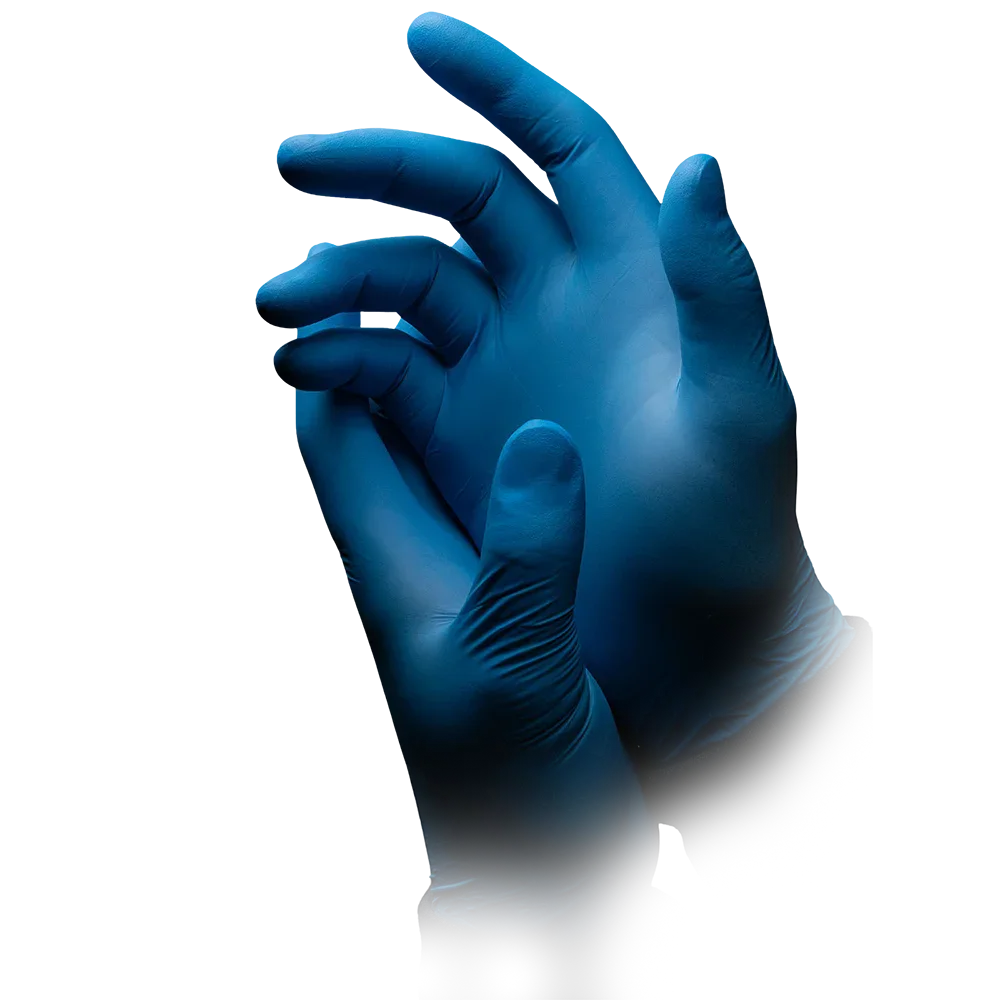
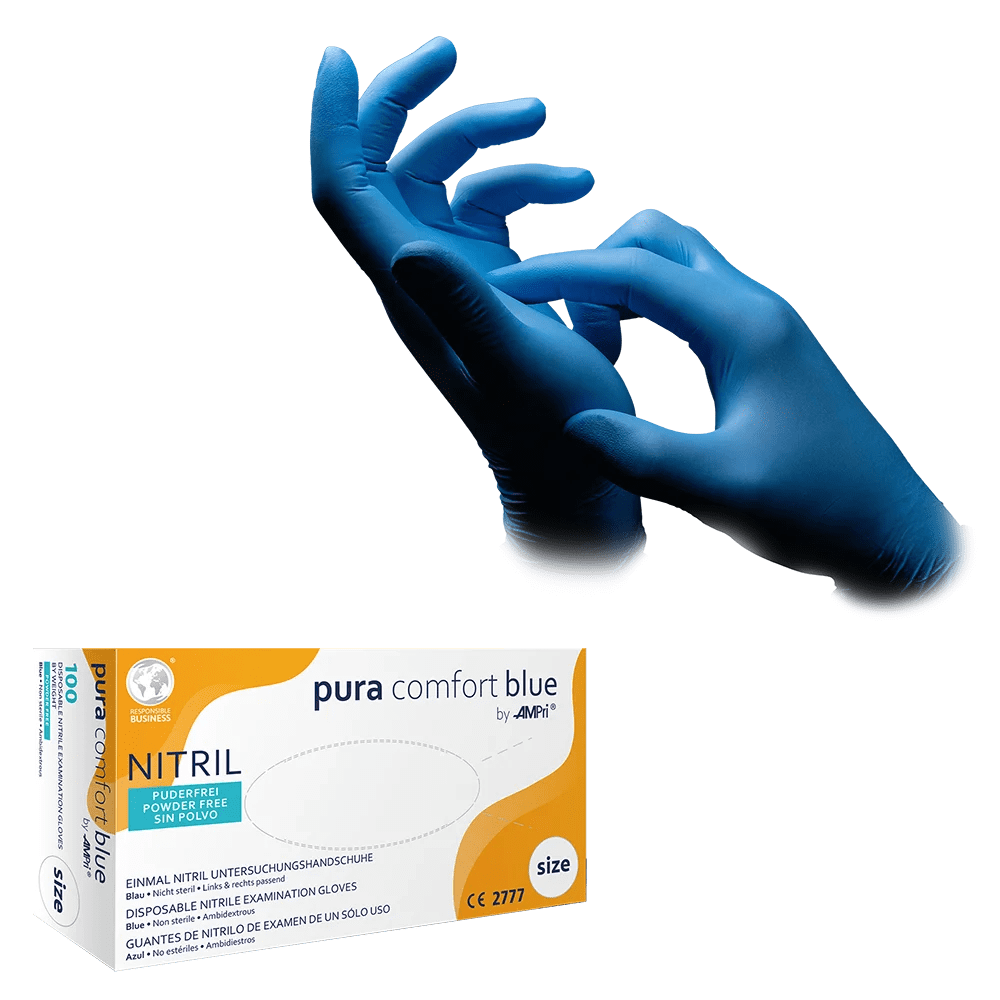

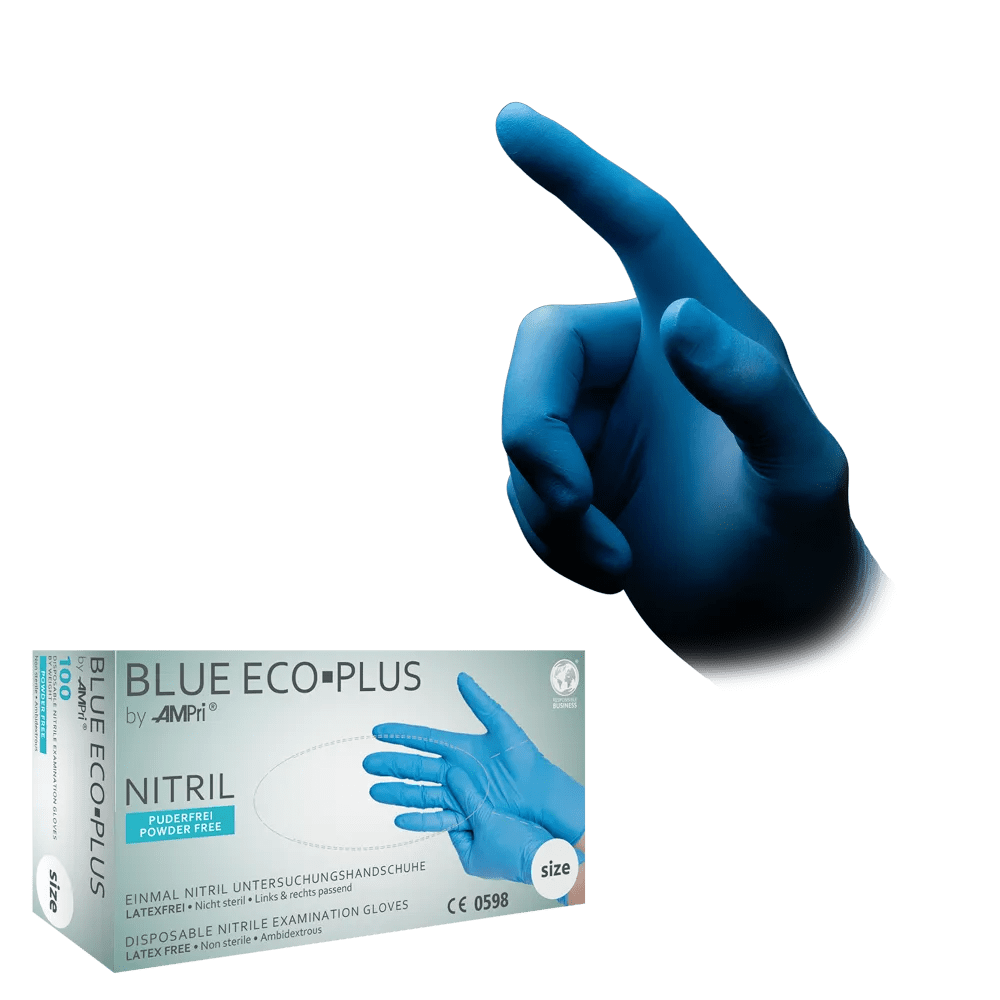

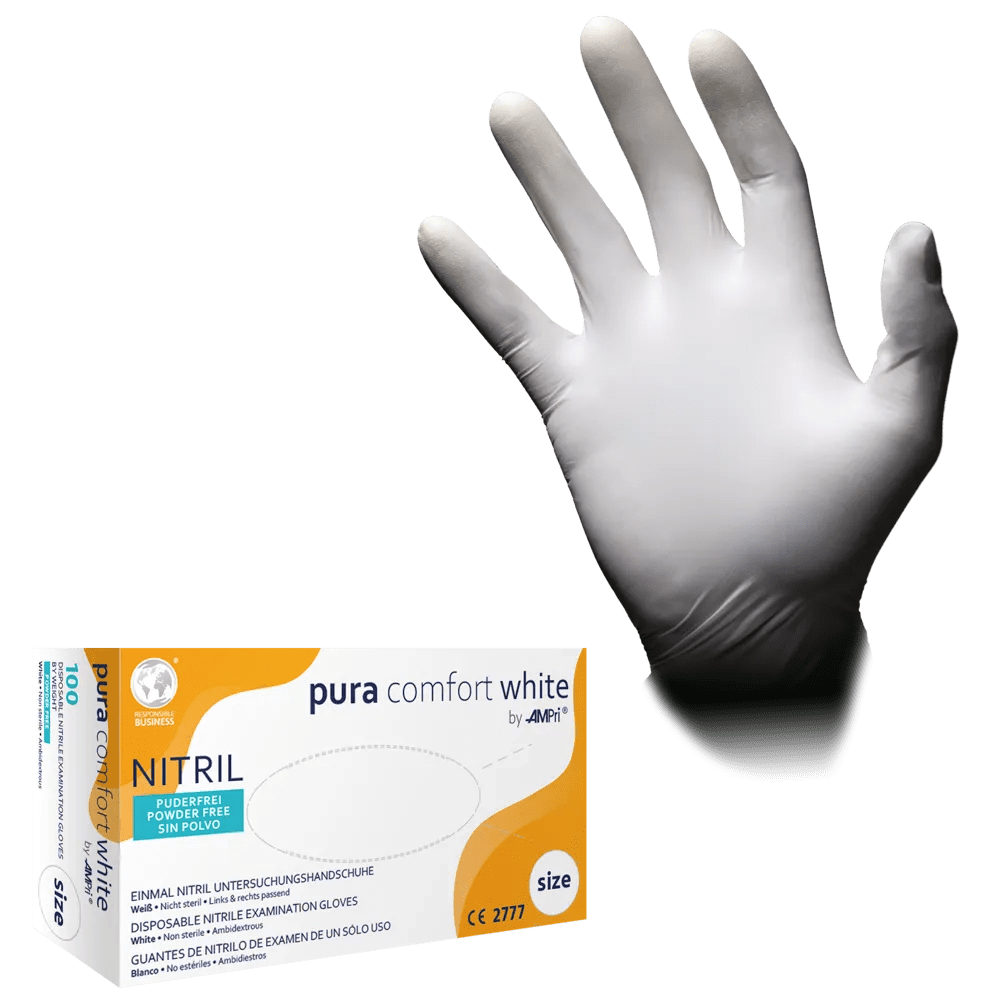
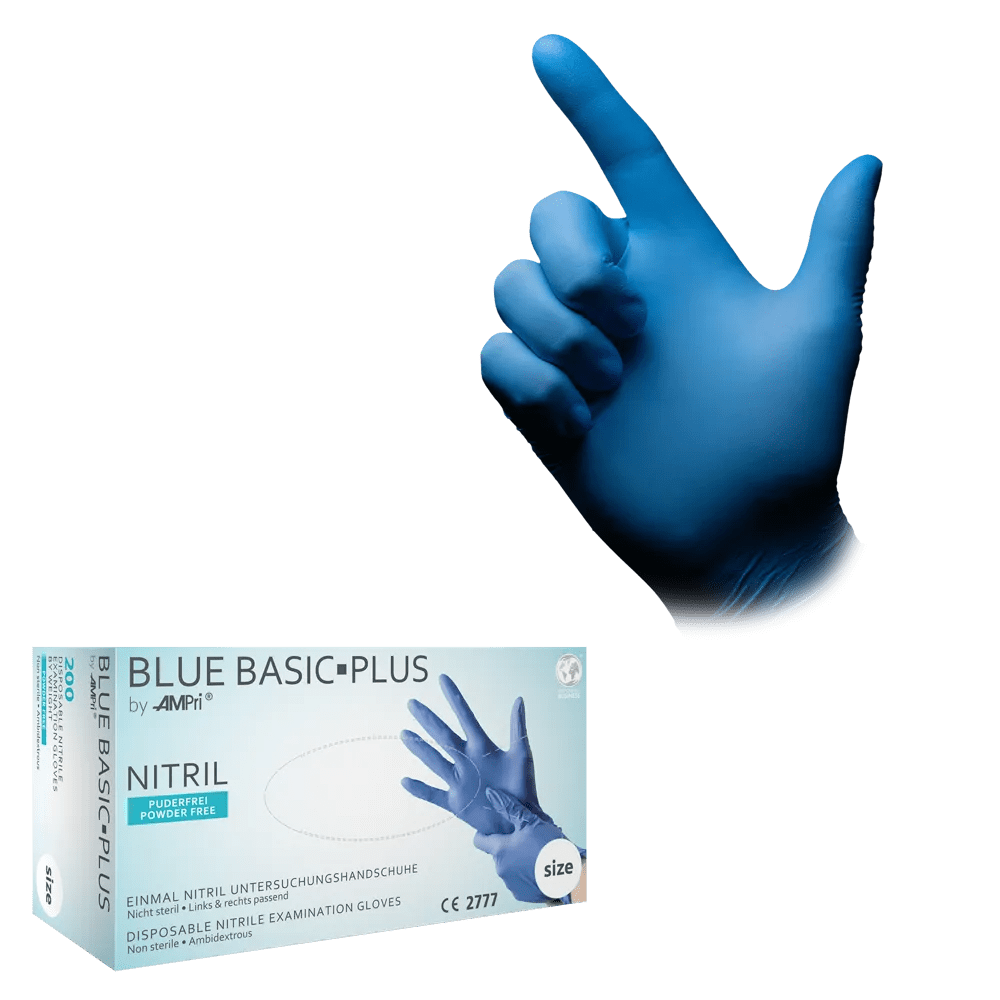
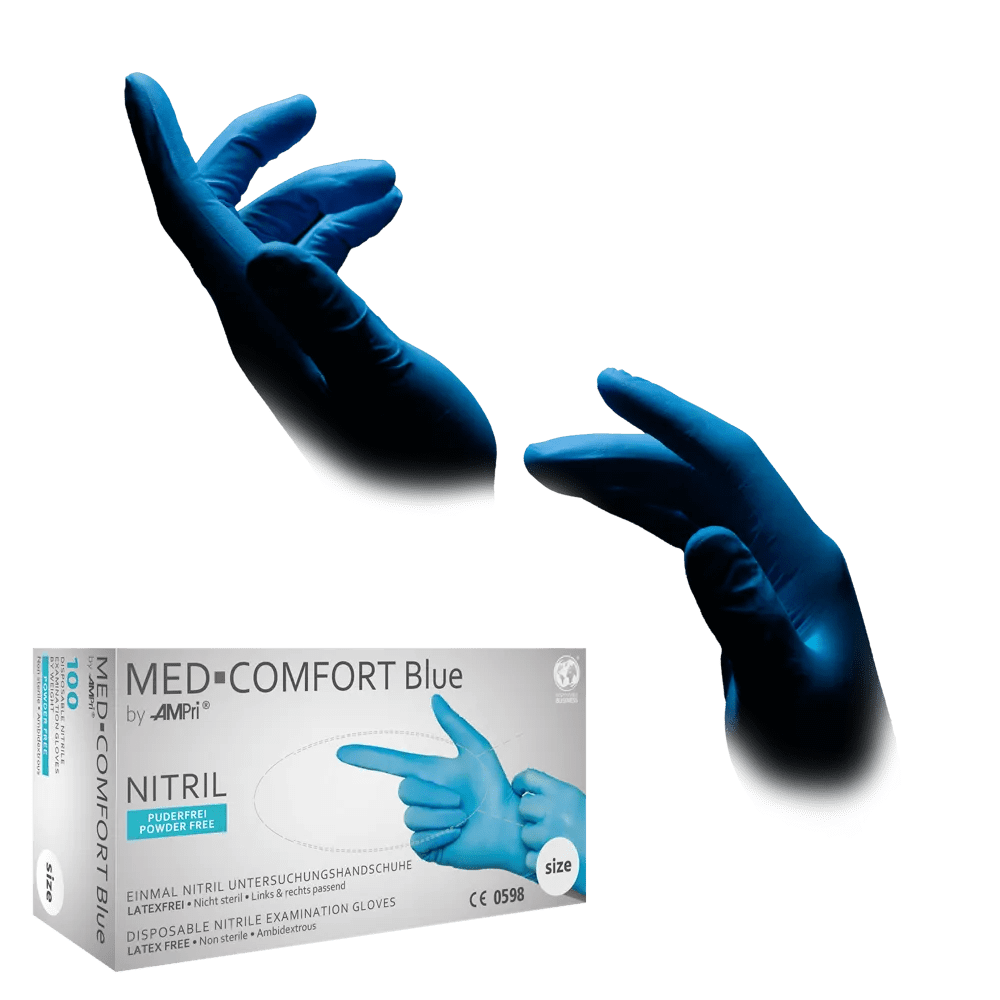
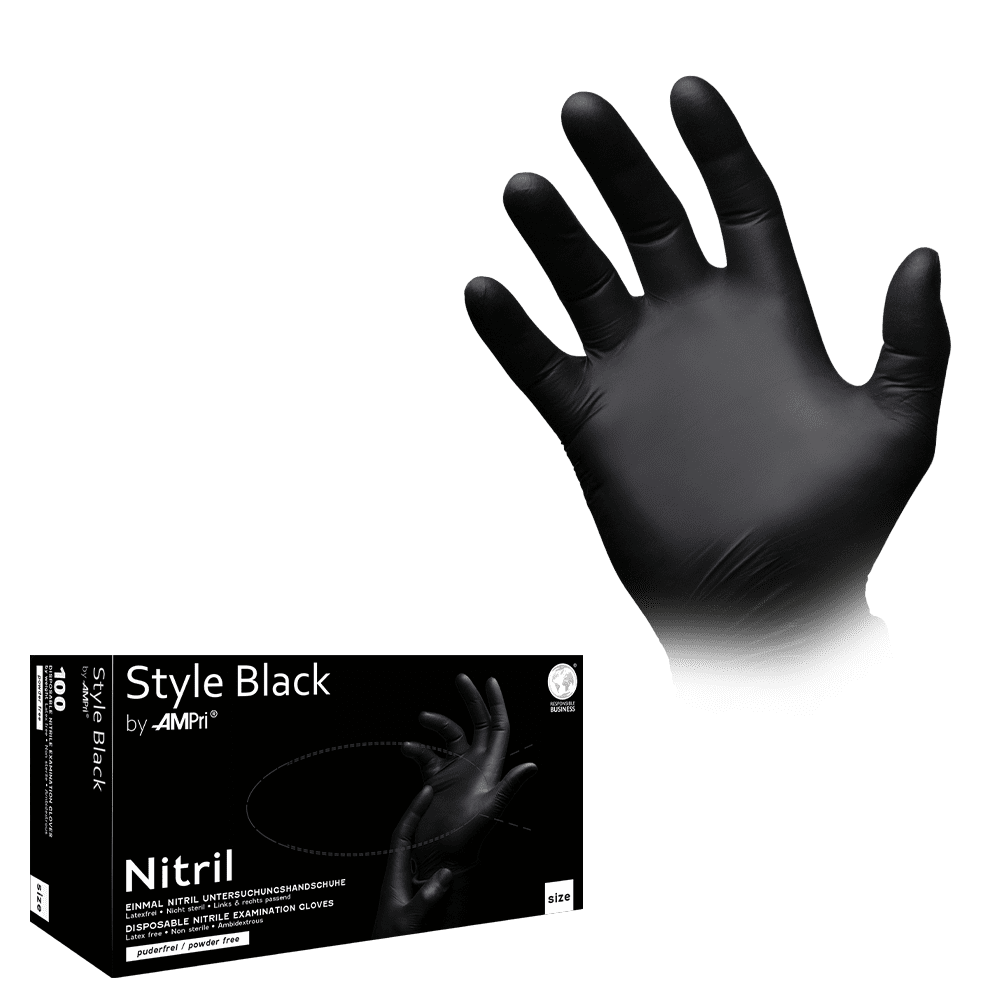
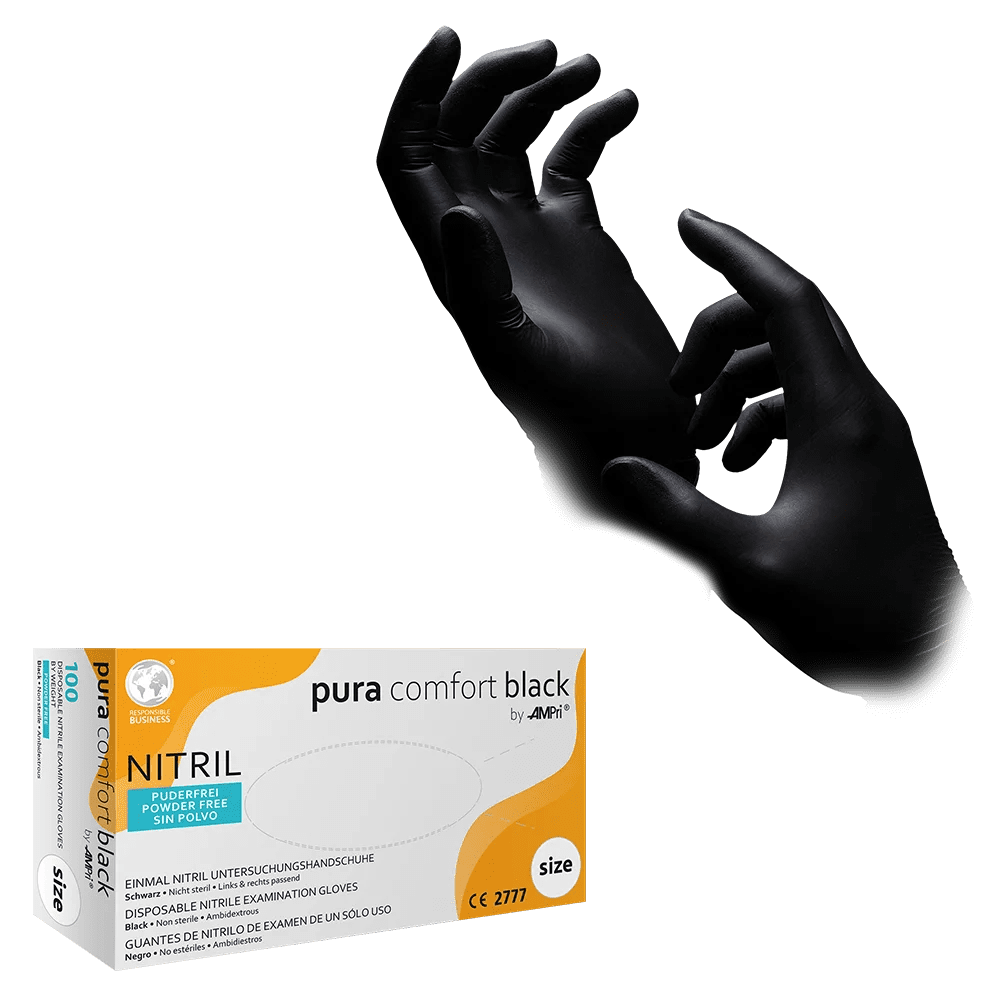

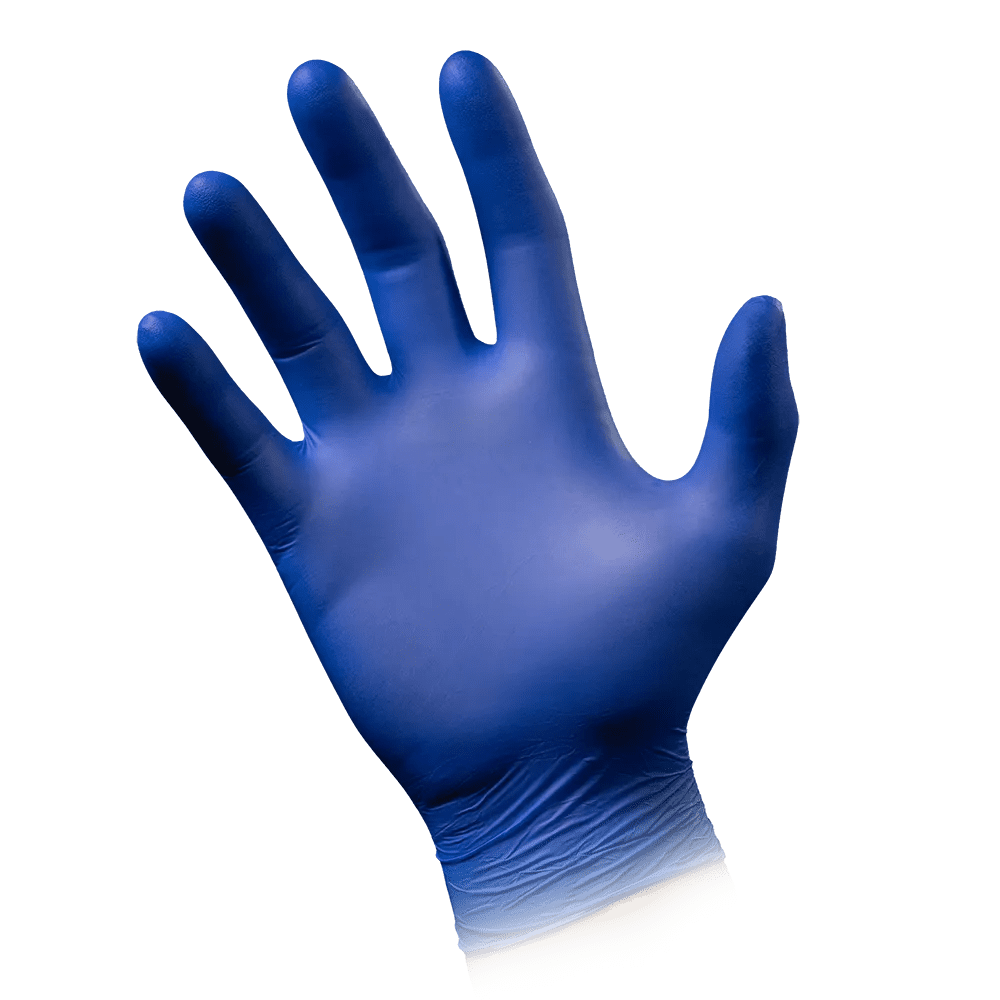


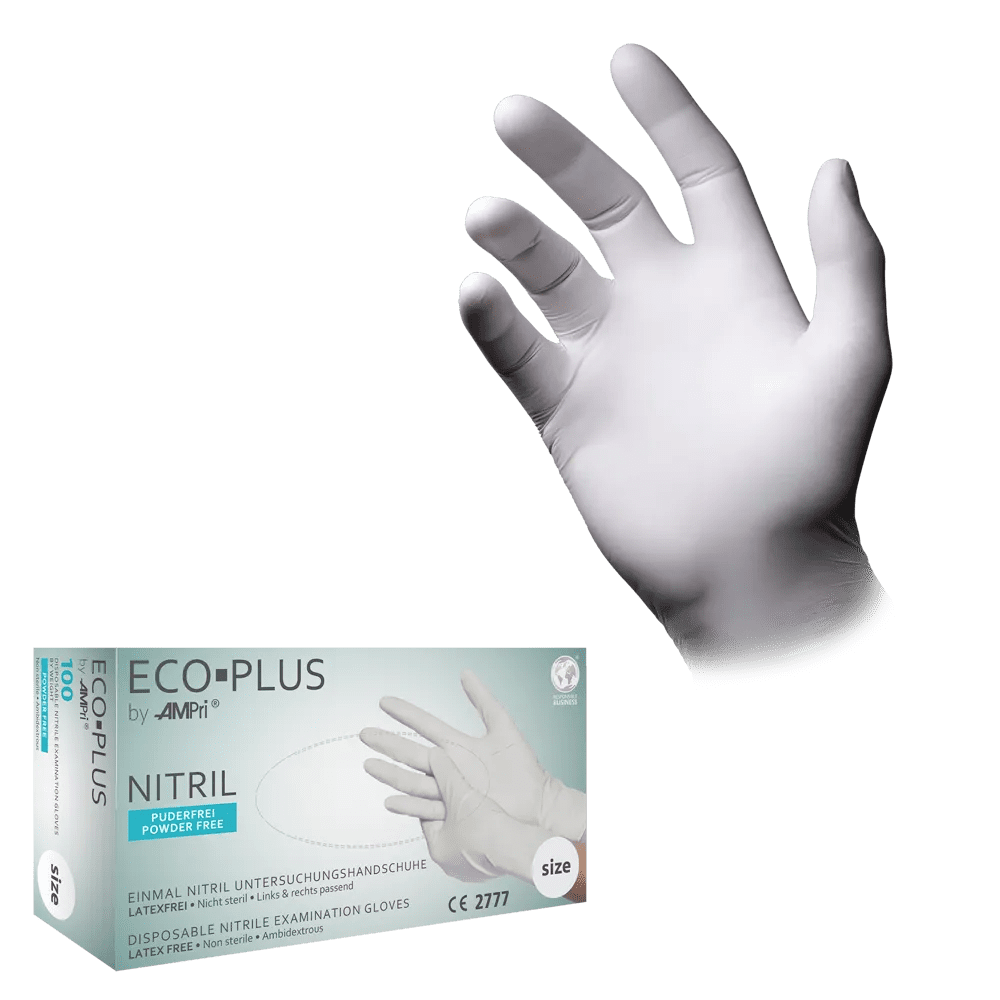

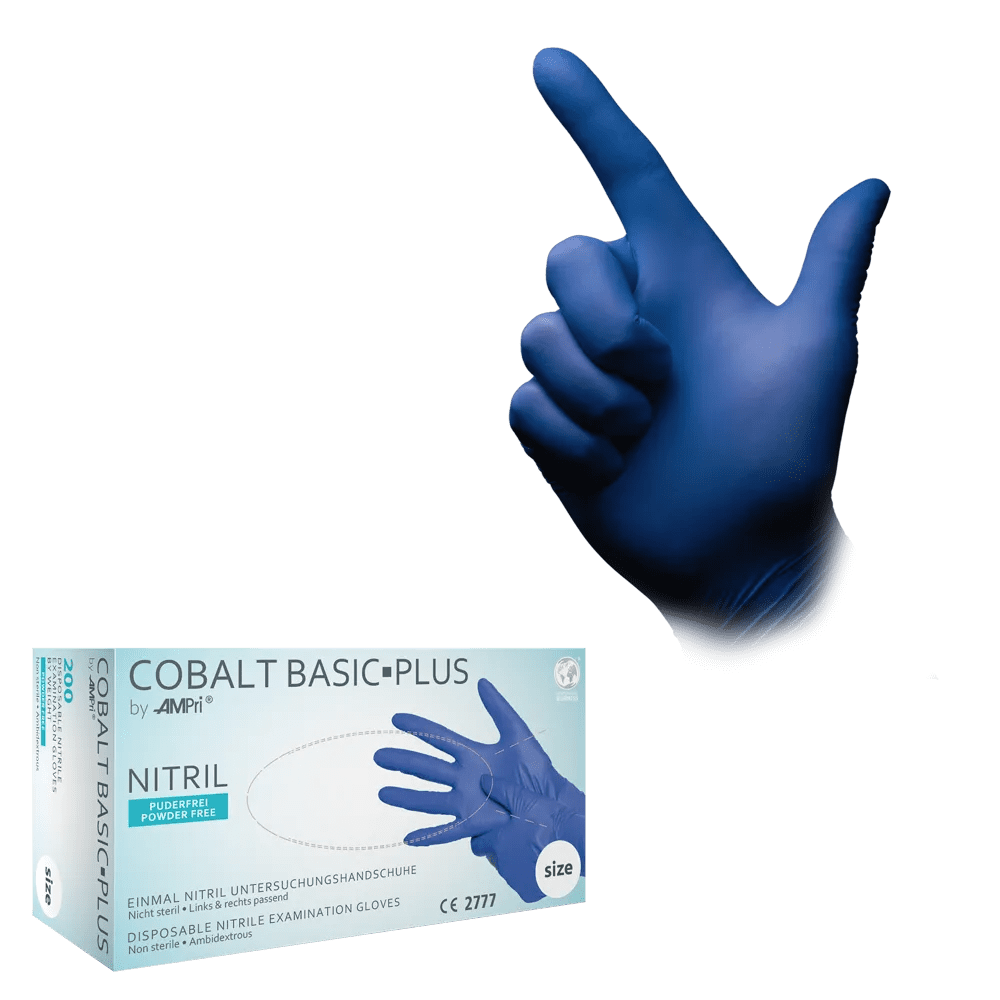

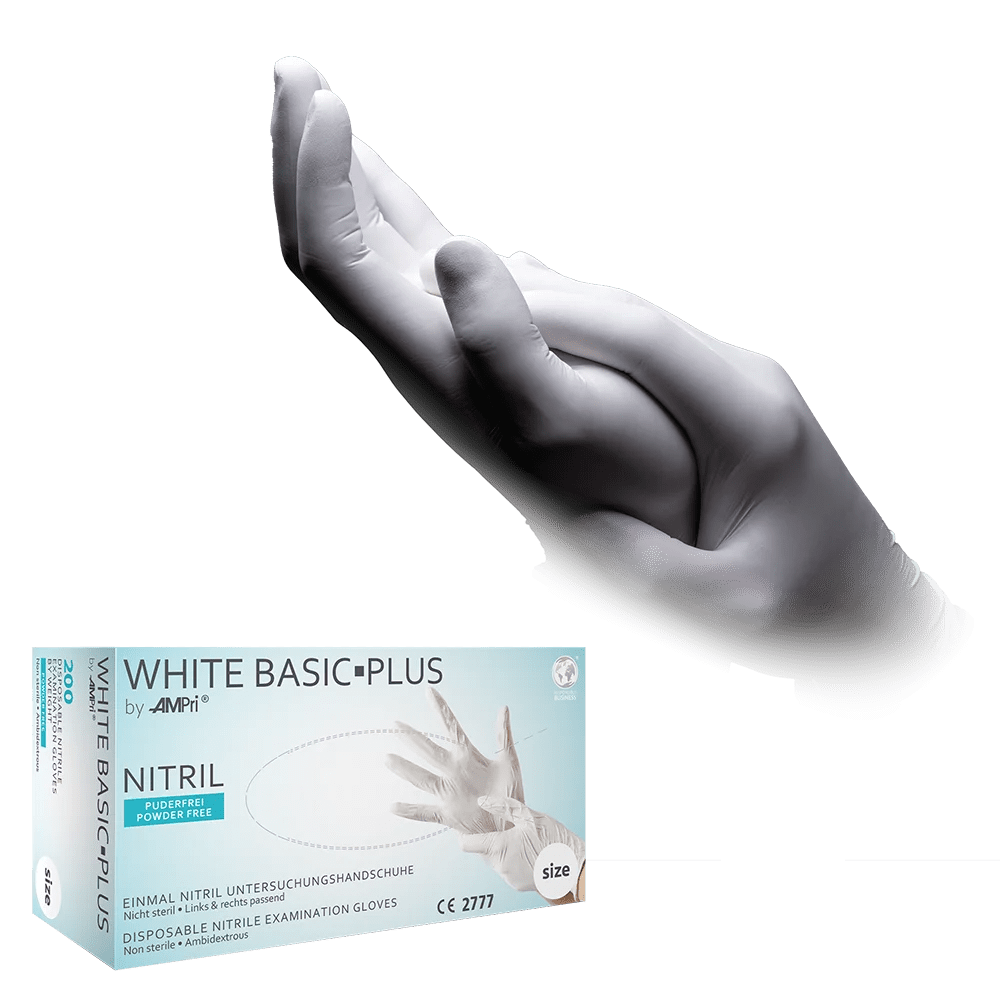
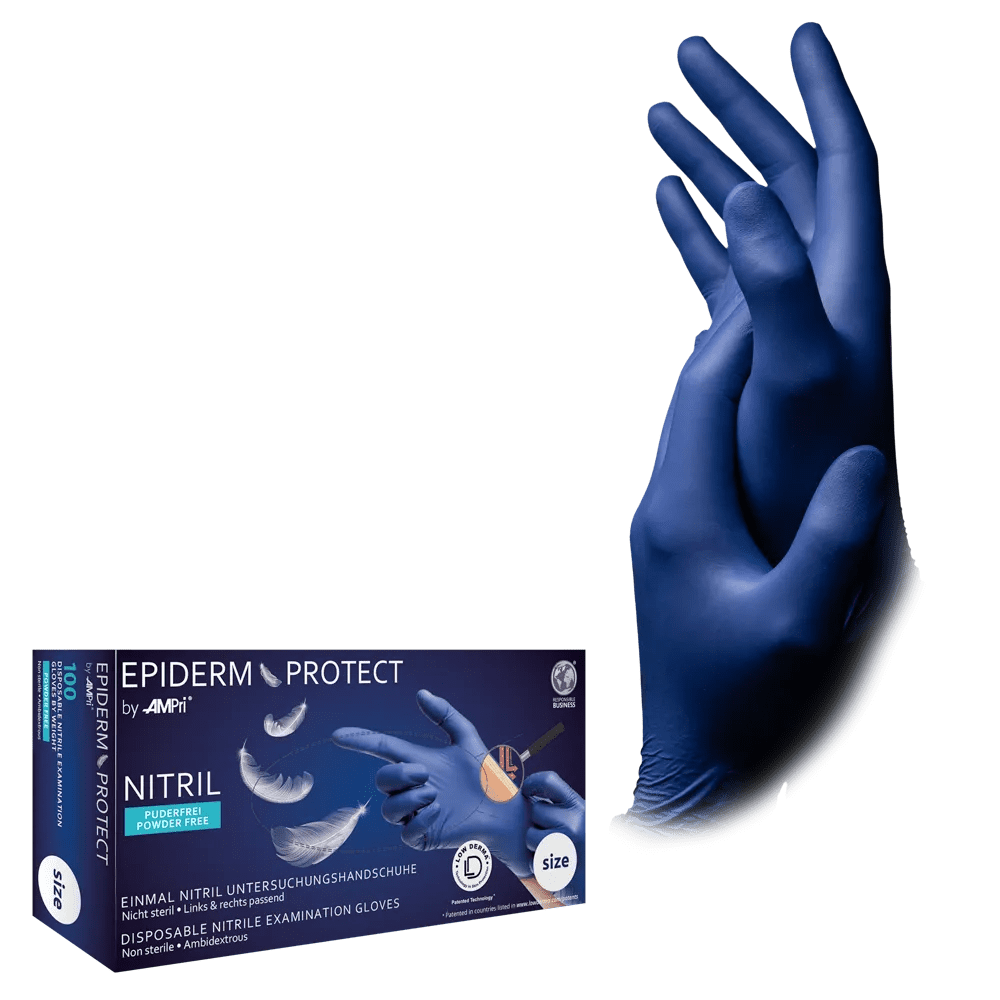
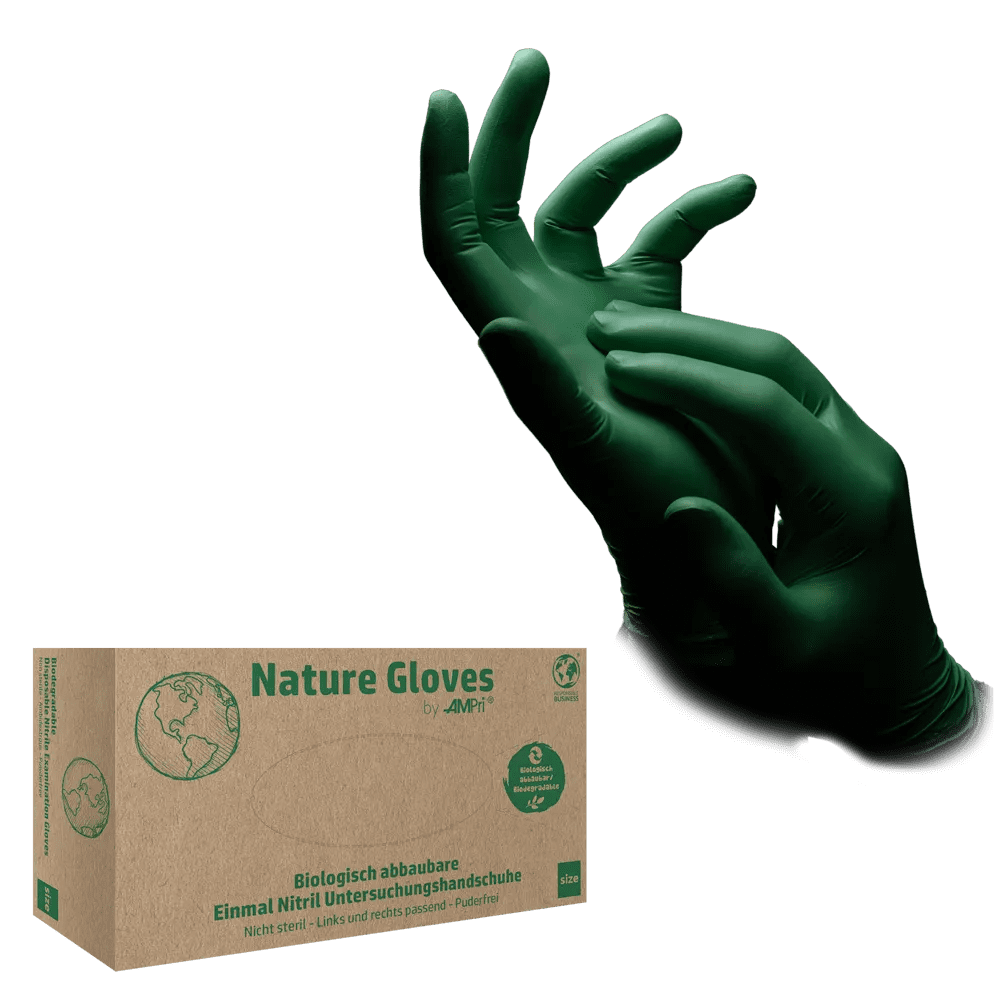
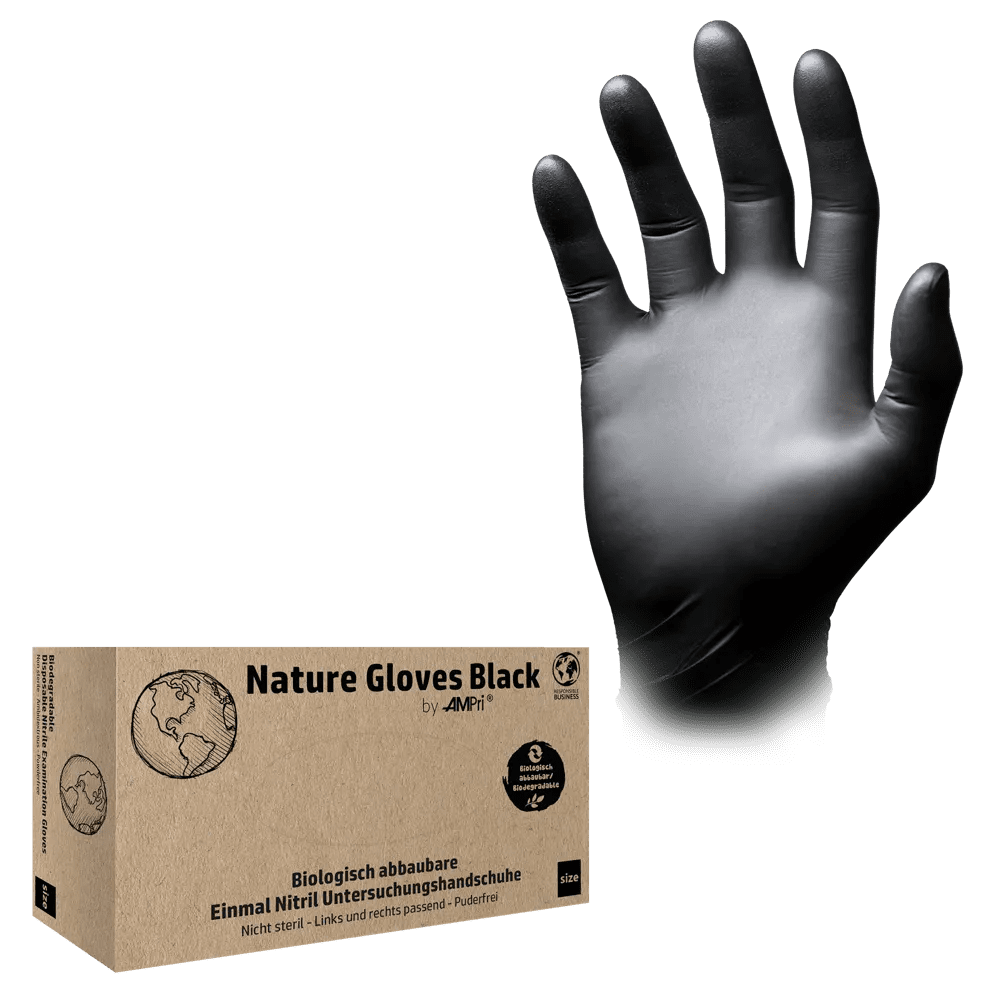
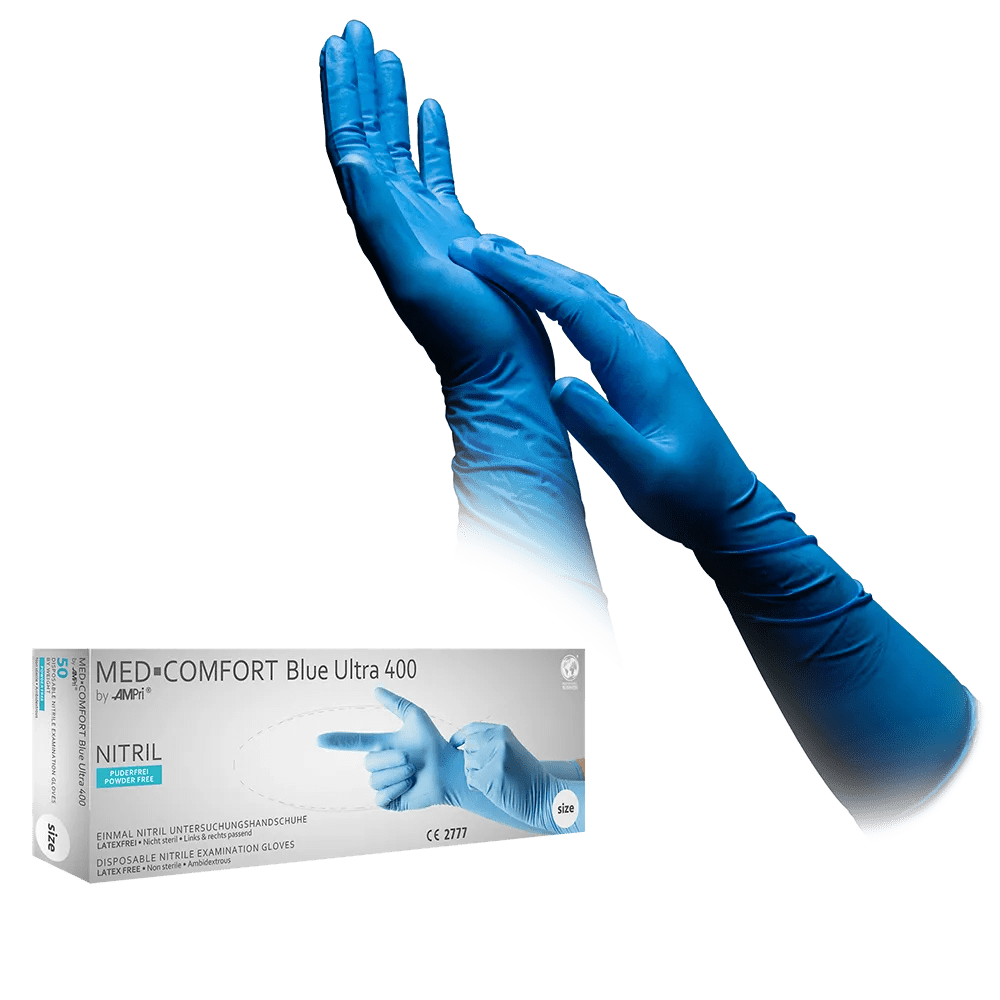


Buy Nitrile Gloves – Your reliable protection for healthcare, industry, food production & more
Table of contents
- Introduction
- What is nitrile? Manufacturing process & material properties
- Surface finishing & grip of nitrile gloves
- Applications for nitrile gloves
- Coloured nitrile gloves & colour coding
- Standards & quality specific to nitrile gloves
- EN 374 test chemicals
- Nature Gloves – more sustainable nitrile gloves
- FAQ – frequently asked questions about nitrile gloves
1. Introduction
Nitrile gloves – also referred to as nitrile disposable gloves, nitrile examination gloves or simply nitrile gloves – are now among the most essential single-use products across healthcare, nursing, laboratories, industry, food processing, beauty and tattoo. They are tear-resistant, chemically resistant, completely latex-free, and therefore an ideal solution for professional users and consumers alike.
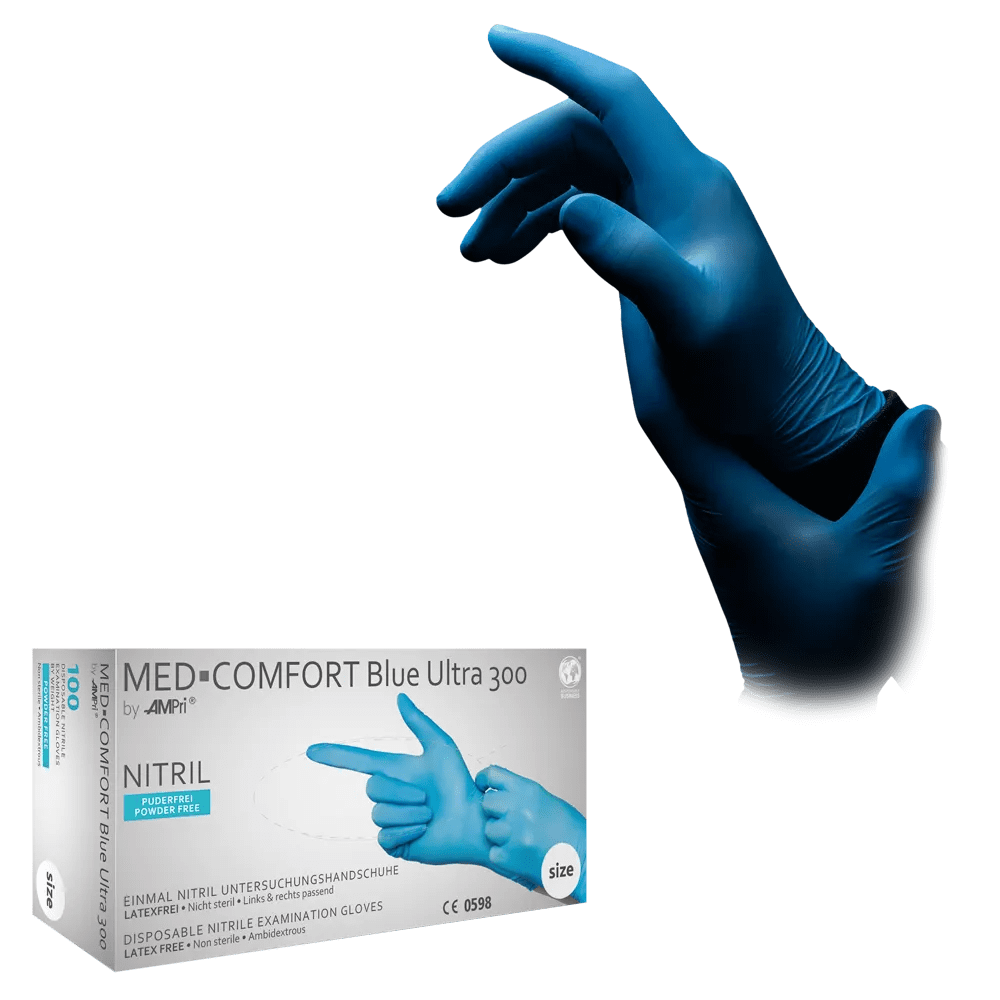
A particular highlight in our range is the MED-COMFORT nitrile glove 01198, a true all-rounder for everyday use. Since 2015, more than 11 million boxes have been sold (as of 06/2025) – clear proof of quality, comfort and reliability:
➡️ View bestseller 01198
Our nitrile range covers a broad spectrum: from lightweight nitrile disposable gloves for care settings and coloured Style variants for dental and beauty, through to particularly robust high-risk nitrile examination gloves for laboratories, chemicals and industry. As complementary materials, we also offer latex gloves, vinyl gloves, PE gloves as well as vitrile gloves. For users with particularly sensitive skin, our Low Derma™ nitrile gloves are an ideal solution.
2. What is nitrile? Manufacturing process & material properties
2.1 What exactly is NBR?
Nitrile gloves are made from nitrile butadiene rubber (NBR), a synthetic rubber produced by copolymerising the monomers acrylonitrile and butadiene. This combination delivers an ideal balance of:
- Acrylonitrile (ACN) – for resistance to oils, fats, many chemicals and solvents
- Butadiene – for elasticity, stretch and high wearing comfort
Depending on the mixing ratio, the material characteristics can be tailored precisely:
- Higher ACN content → stronger chemical protection
- Lower ACN content → softer, more stretchable and more skin-friendly formulations
The NBR formulations used by AMPri are specifically designed to combine long wearing times with high protection and excellent mechanical performance.
2.2 Why is nitrile latex-free – and why does that matter?
Unlike natural rubber latex, NBR contains no natural latex proteins that can trigger immediate allergic reactions (Type I allergies). Nitrile gloves are therefore:
- 100% latex-free
- ideal for latex allergy sufferers
- skin-friendly and low odour
- safe for use in all medical facilities
This makes nitrile disposable gloves the global standard for medical examination gloves and professional disposable gloves in critical environments.
2.3 Manufacturing process for nitrile gloves
Manufacturing modern nitrile gloves is a highly precise, multi-stage process. In simplified terms, it works as follows:
2.3.1 Cleaning & preparation of hand formers
Ceramic hand formers are:
- cleaned and degreased
- partly pre-heated
- coated with a coagulant film (usually a calcium salt solution)
This film ensures that the NBR dispersion later adheres reliably and forms an even layer.
2.3.2 Dipping process (“dipping”)
The prepared formers are dipped into a liquid NBR latex dispersion. The resulting wall thickness of the nitrile disposable glove is controlled by:
- dip time
- solids content of the dispersion
- line speed
- number of dips (single or multiple dipping)
High-risk nitrile gloves, for example, receive a thicker material layer through longer and/or double dipping times.
2.3.3 Gelation
The coated formers are then heated so that the NBR “gels” on the coagulant film:
- the nitrile layer is consolidated
- adhesion to the former is stabilised
- an even wall thickness is ensured
2.3.4 Vulcanisation – the decisive step
During vulcanisation, temperature and vulcanising chemicals create sulphur cross-links between the polymer chains. This is what gives the nitrile glove:
- its typical elasticity
- high tear resistance
- shape stability
- temperature resistance
AMPri uses precisely coordinated temperature profiles and formulations to achieve an optimum combination of protection, flexibility and wearing comfort.
2.3.5 Surface finishing
After vulcanisation, the surface is refined, e.g. via:
- polymer coating
- chlorination
- double chlorination
This has a major impact on donning behaviour, grip and skin feel (see Section 3: Surface finishing & grip).
2.3.6 Stripping, rinsing & drying
The gloves are then:
- removed from the hand formers fully automatically (“stripping”)
- washed to remove residual chemicals
- gently dried
2.3.7 Quality inspection & packaging
Before packaging, comprehensive testing takes place, including:
- AQL leak testing in accordance with EN 455-1
- tensile strength and elongation testing in accordance with EN 455-2
Only then are the nitrile gloves packaged under hygienically controlled conditions and placed on the market as a medical device and/or PPE.
2.4 Material properties of nitrile gloves
- Tear-resistant & elastic: Nitrile has “material memory”, adapts to the shape of the hand and remains stable even during prolonged use.
- High chemical resistance: very good resistance to oils, fats, many solvents, acids and alkalis.
- Excellent barrier performance: reliable protection against viruses, bacteria, fungi and body fluids.
- High wearing comfort: modern NBR formulations provide soft, flexible nitrile disposable gloves with pleasant donning behaviour.
- Allergy-friendly: completely latex-free, and in special variants also available as Low Derma™.
3. Surface finishing & grip of nitrile gloves
Surface finishing is a key factor in how nitrile gloves feel and perform in day-to-day use. It influences:
- donning comfort
- skin feel
- grip on dry, wet or oily surfaces
- suitable applications
- wearing comfort over longer periods
AMPri uses a range of technologies to tailor nitrile disposable gloves precisely to the requirements of each sector.
3.1 Polymer coating
A polymer coating is the most modern and skin-friendly type of surface finishing for nitrile disposable gloves.
Benefits:
- very pleasant, soft feel
- makes gloves easier to don
- reduced friction between skin and glove
- powder-free solution → high skin compatibility
Typical areas of use:
- hospitals & GP practices
- care facilities
- dental
- food processing
Many popular AMPri lines – such as the bestseller 01198 or various Style by AMPri models – use polymer coatings for maximum comfort.
3.2 Chlorination & double chlorination
3.2.1 Chlorination
With chlorination, the glove is passed through a mild chlorine solution, which purposefully modifies the nitrile’s surface structure.
Benefits:
- smoother donning
- reduced tackiness on the inner surface
- comfortable wear, particularly when changing gloves frequently
Chlorinated nitrile gloves are commonly used in:
- food businesses
- kitchens & catering
- cleaning & building services
- tattoo and beauty studios
3.2.2 Double chlorination
Double chlorination is a premium process used particularly for high-risk nitrile gloves.
Benefits:
- extremely smooth inner surface → especially quick donning
- very comfortable wear, even during prolonged use
- reduction of residual chemicals on the glove surface
Typical areas of use:
- laboratories & chemicals
- pharmaceutical production
- ambulance services & emergency medicine
- high-risk areas involving hazardous substances
Example: SolidSafety High Risk Pro 081307
➡️ https://www.ampri.de/081307
3.3 Grip & texturing
Surface texturing determines how securely an object sits in the hand – whether dry, wet or oily. Nitrile gloves offer a wide range of options:
3.3.1 Smooth (non-textured)
Characteristics:
- maximum tactile sensitivity
- very good fine touch
Areas of use:
- dental
- cosmetics & fine work
- medical examinations
- laboratory work without strong liquid chemicals
3.3.2 Finger-textured
The most common texture for medical nitrile disposable gloves.
Benefits:
- improved grip at the fingertips
- secure handling of instruments, needles and devices
- good balance between grip and tactile sensitivity
Areas of use:
- healthcare & care
- tattoo
- dental
- food processing
- all-round applications
This texture can be found, among others, on: 01198 and many Style by AMPri models.
3.3.3 Fully textured (“High Grip”)
Benefits:
- maximum grip even with oil, grease or moisture
- robust handling of tools
- ideal for heavy mechanical work
Typical applications:
- car and commercial vehicle workshops
- metalworking
- industry & assembly
- areas with oily or greasy surfaces
Fully textured gloves include 081307 and 01196.
Top product with diamond texture: ALPHA High Grip AL-001
➡️ https://www.ampri.de/AL-001
3.4 The right texture for your sector
| Sector / activity | Recommended texture |
|---|---|
| Healthcare / care | Finger-textured |
| Dental | Smooth or finger-textured |
| Tattoo / beauty | Finger-textured |
| Food production | Finger-textured |
| Workshop / industry | Fully textured |
| Laboratory / chemicals | Finger-textured or fully textured |
| Cleaning / building services | Finger-textured |
4. Applications for nitrile gloves
Nitrile gloves, nitrile disposable gloves and nitrile examination gloves are among the most versatile single-use products available. Thanks to high tear resistance, very good chemical resistance and allergy-friendly properties, they are now the standard in many sectors.
4.1 Healthcare, care & health services
In medical environments, nitrile examination gloves are indispensable. They protect against blood, secretions and infectious agents, and provide a reliable barrier against micro-organisms.
Typical areas of use:
- hospitals & clinics
- GP practices & medical centres
- outpatient & inpatient care
- accident & emergency departments & ambulance services
- care homes & retirement residences
Benefits of nitrile:
- high barrier performance against viruses, bacteria & fungi
- excellent fit & tactile feel
- latex-free and therefore ideal for allergy sufferers
- powder-free variants for optimal skin compatibility
Product recommendations:
- MED-COMFORT High Risk 01196
➡️ https://www.ampri.de/01196 - Bestseller 01198 – all-round nitrile glove for many applications
➡️ https://www.ampri.de/01198
4.2 Laboratory, chemicals & high-risk applications
In laboratories and chemical environments, nitrile disposable gloves are preferred due to their high resistance to many chemicals. EN ISO 374 defines exactly which test chemicals are assessed and what level of protection the glove provides.
Typical areas of use:
- pharmaceutical laboratories
- research & development
- analytical laboratories
- chemical production
- handling solvents, cytostatics and hormone preparations
Why nitrile?
- excellent chemical resistance
- high tear resistance
- suitable for long wearing times (model-dependent)
- no latex allergies
Product recommendation:
- SolidSafety High Risk Pro 081307
➡️ https://www.ampri.de/081307
4.3 Food industry & catering
For handling food, nitrile gloves are ideal because they are taste-neutral and low odour, and offer high resistance to fats and oils. All AMPri nitrile disposable gloves are approved for contact with food.
Typical areas of use:
- food manufacturing & food processing
- meat and fish processing
- bakeries & patisseries
- catering & hospitality
- commercial kitchens & chain catering
Benefits of nitrile in food settings:
- resistant to fats, oils and many spice extracts
- no latex proteins → no risk of allergic reactions for staff or customers
- high-visibility colours (e.g. blue, green, black) within HACCP concepts
4.4 Dental
In dental settings, coloured nitrile disposable gloves are standard. They combine hygiene with a professional, modern appearance.
Typical applications:
- prophylaxis & professional dental cleaning
- chairside assistance
- preparation and follow-up of treatment rooms
- laboratory work in the practice lab
Modern colours such as pink, Clean Ocean and Platinum are particularly popular.
➡️ View colour range: Coloured and bright nitrile gloves
4.5 Beauty, cosmetics & tattoo
In the beauty and tattoo sector, nitrile examination gloves are the first choice – for hygiene, appearance and comfort.
Typical areas of use:
- nail studios
- beauty salons
- lash & brow treatments
- tattoo studios & permanent make-up
- barbers & hair salons
Benefits:
- skin-friendly & latex-free
- good grip with oils, dyes and lotions
- attractive colours as part of brand identity
Beauty product recommendation:
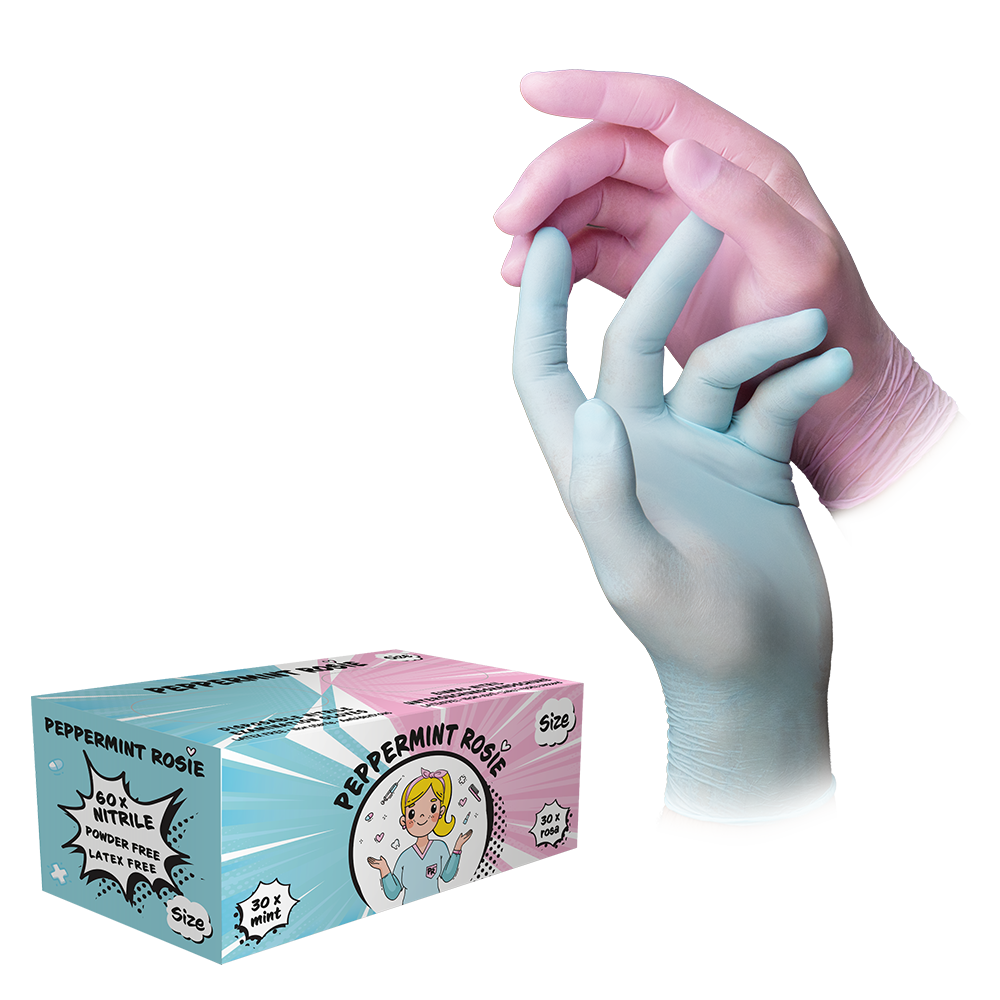
- Peppermint Rosie 118-300
➡️ https://www.ampri.de/118-300
4.6 Industry, trades & workshops
In workshops, trades and industry, nitrile disposable gloves stand out thanks to their durability and resistance to oils, lubricants and fuels.
Typical areas of use:
- car and commercial vehicle workshops
- metalworking
- mechanical engineering & plant construction
- assembly & maintenance
- paint shops (depending on model)
Benefits of nitrile:
- high stability when exposed to oil, grease and chemicals
- abrasion-resistant & robust
- excellent grip with the right texture
Product recommendation:
- ALPHA High Grip AL-001
➡️ https://www.ampri.de/AL-001
4.7 Cleaning & building services
In professional cleaning, nitrile gloves protect against cleaning and disinfecting agents and help reduce skin irritation.
Typical areas of use:
- building cleaning
- hotel and property cleaning
- sanitary cleaning
- kitchen and commercial kitchen cleaning
Benefits:
- good resistance to commonly used cleaning agents
- high tear resistance, even under mechanical stress
- easy implementation of hygienic single-use concepts
5. Coloured nitrile gloves & colour coding
Coloured nitrile gloves – i.e. coloured nitrile disposable gloves and nitrile examination gloves – are long since more than just a visual detail. They support modern hygiene concepts, streamline workflows and reinforce a professional appearance for practices, studios and businesses.
5.1 Why choose coloured nitrile gloves?
Visual hygiene structures:
- Red – sanitary or disinfection areas
- Blue – food areas
- Yellow – prophylaxis & assistance
- Black – tattoo & workshop
- Pink / Clean Ocean – dental & beauty
Professionalism & corporate identity:
- colours support the practice concept
- match interior design and brand presence
- visibly differentiate your business from competitors
Psychological effect: Friendly colours such as pink, Clean Ocean or yellow feel welcoming and can reduce anxiety – especially for children.
HACCP support: Blue and green are highly visible in food environments and help implement hygiene concepts reliably.
➡️ Full range: Coloured gloves
5.2 Sector solutions for coloured nitrile gloves
Dental
The dental sector is increasingly using coloured nitrile gloves to combine hygiene, professionalism and practice design. Popular colours include:
- pink
- Clean Ocean
- Platinum
➡️ View colour range: Coloured nitrile gloves
Beauty, cosmetics & nail studios
In the beauty sector, colours are part of brand identity. Depending on the studio design, commonly selected options include:
- pink
- turquoise / Clean Ocean
- black
- purple
Product recommendation:
- Peppermint Rosie 118-300
➡️ https://www.ampri.de/118-300
Tattoo & PMU
Black nitrile gloves have become established in tattoo studios:
- they look professional and clean
- they mask ink, colour and blood
- they perfectly match studio aesthetics
Food industry & HACCP
Food businesses typically prefer:
- blue
- green
because these colours are easy to spot in the product and support HACCP concepts.
Workshops & industry
In workshops and industry, the dominant choices are:
- black nitrile gloves
- fully textured high-grip models
Recommendation: ALPHA High Grip AL-001
➡️ https://www.ampri.de/AL-001
5.3 The Style by AMPri colour palette
The Style by AMPri range offers a broad spectrum of modern colours:
- pink
- Clean Ocean (turquoise / aqua)
- Platinum (grey / silver)
- yellow
- purple
- blue
- green
- black
➡️ All variants: Coloured gloves
5.4 NEW: Style by AMPri White Plus – comfort redefined
Style by AMPri White Plus is more than a classic white nitrile glove – it represents a completely new wearing experience. Developed for professionals who deliver at their best every day, without compromising on comfort.
Exceptionally soft & flexible:
- innovative material additives make the glove especially soft
- feels like a second skin
- ideal for sensitive hands
- offers excellent fingertip sensitivity, even for precise tasks
Around 20% more material thickness than classic 3 g nitrile gloves:
- higher tear resistance
- improved barrier performance
- yet still surprisingly soft and flexible
Many thicker nitrile gloves can quickly cause hand fatigue and an uncomfortable wearing sensation – White Plus has been designed to solve exactly this. It provides the protection of a stronger glove combined with the comfort of lighter models.
For every sector. For every hand. For every day.
Whether in healthcare, care, cosmetics, food processing or industry – Style by AMPri White Plus is the smart choice for anyone who values safety and noticeable comfort.
5.5 Matching surgical masks in the colour system
For a consistent overall look, coloured nitrile gloves can be combined with matching surgical masks.
Example:
- Yellow surgical mask – matching yellow nitrile gloves
➡️ Type IIR surgical mask Yellow (02201-Y)
5.6 Benefits of coloured nitrile gloves at a glance
| Benefit | Value |
|---|---|
| Visual hygiene separation | Clear allocation of areas & tasks |
| Modern appearance | Professional presence in dental, beauty, tattoo |
| HACCP support | Blue/green clearly visible in food environments |
| Corporate identity | Colours support brand and practice design |
| Allergy-friendly | All variants are latex-free |
6. Standards & quality specific to nitrile gloves
In Europe, the quality and safety of nitrile gloves are regulated through several standards and testing procedures. These ensure that nitrile disposable gloves perform reliably in healthcare, laboratories, industry and food processing.
AMPri works with certified production partners in accordance with ISO 13485 (medical devices) and ISO 9001 (quality management) to ensure consistently high quality.
6.1 EN 455 – standard for medical nitrile gloves
EN 455 consists of four parts and defines the requirements for medical disposable gloves:
- EN 455-1 – Freedom from holes: testing for microscopic holes using a watertightness test.
- EN 455-2 – Physical properties: minimum requirements for tensile strength, elongation and wall thickness.
- EN 455-3 – Biological evaluation: skin compatibility, allergen and residue testing.
- EN 455-4 – Shelf life: definition of minimum shelf life and ageing tests.
- EN 455-5: Extractable chemical residues
Example model:
MED-COMFORT High Risk 01196
➡️ https://www.ampri.de/01196
6.2 EN ISO 374 – protection against chemicals & micro-organisms
EN ISO 374 defines the chemical and micro-organism protection of nitrile gloves. Three types are distinguished:
- Type A: protection against at least 6 test chemicals with breakthrough time ≥ 30 minutes.
- Type B: protection against at least 3 test chemicals.
- Type C: protection against at least 1 test chemical.
Examples:
- SolidSafety High Risk Pro 081307 – Type A
➡️ https://www.ampri.de/081307 - MED-COMFORT High Risk 01196 – Type A
➡️ https://www.ampri.de/01196
You can find details of the individual test chemicals (code letters A–T) in the next section.
6.3 AQL – acceptable quality level
The AQL value (“Acceptable Quality Level”) describes the glove’s leak tightness. The lower the value, the tighter the glove.
- AQL 1.5 – standard for medical nitrile gloves
- AQL 0.65 – high-risk quality with particularly high leak tightness
- AQL 4.0 – only for basic applications without high protection requirements
AMPri primarily offers nitrile disposable gloves with AQL 1.5, as well as high-risk nitrile gloves with AQL 0.65.
6.4 Wall thickness & material thickness
The wall thickness of a nitrile glove influences protection, tear resistance and dexterity.
| Glove type | Typical thickness | Area of use |
|---|---|---|
| Standard (approx. 2.5–3 g) | 0.05–0.07 mm | All-round, healthcare, care, food, beauty |
| Heavy-duty (approx. 4–6 g) | 0.09–0.12 mm | Workshops, cleaning, industrial applications |
| High-risk (7–12 g) | 0.13–0.20 mm | Laboratories, chemicals, emergency medicine, hazardous materials |
Examples:
- 01198 – approx. 3 g, ideal all-round nitrile disposable glove
- ALPHA High Grip AL-001 – approx. 6 g, robust for industry & workshops
- 081307 – high-risk class, particularly thick and stable
6.5 Glove length – 240 mm, 300 mm, 400 mm
- 240 mm (standard length): suitable for healthcare, care, beauty, tattoo and many all-round applications.
- 300 mm (extended cuff): provides additional forearm protection, e.g. in food production, cleaning or wet areas.
- 400 mm (extra-long): ideal for high-risk chemical work, commercial kitchens and laboratory areas with a high risk of splashes or immersion.
6.6 Batch-by-batch quality control at AMPri
Each glove batch undergoes comprehensive testing:
- leak testing in accordance with EN 455
- tensile strength and elongation values
- dimensional accuracy & material defect control
This ensures that nitrile gloves from AMPri remain reliably safe and consistently high quality.
7. EN 374 test chemicals
EN ISO 374 is the key standard for chemical protection in nitrile gloves. It defines which test chemicals a glove has been tested against and how long the breakthrough times are. This is crucial when selecting the right nitrile disposable glove for laboratory, chemical, cleaning or industrial applications.
7.1 How EN 374 testing works
EN 374 testing measures how long a chemical takes to fully permeate the glove layer – the so-called breakthrough time.
- ≥ 30 minutes: minimum requirement for Type A (at least 6 test chemicals)
- ≥ 30 minutes: minimum requirement for Type B (at least 3 test chemicals)
- ≥ 10 minutes: minimum requirement for Type C (at least 1 test chemical)
The longer the breakthrough time, the higher the protection. AMPri uses specialised NBR formulations to achieve particularly strong breakthrough times against many chemicals.
7.2 Table of EN 374 test chemicals (A–T)
| Code letter | Test chemical | CAS no. | Chemical class |
|---|---|---|---|
| A | Methanol | 67-56-1 | Primary alcohol |
| B | Acetone | 67-64-1 | Ketone |
| C | Acetonitrile | 75-05-8 | Nitrile |
| D | Dichloromethane | 75-09-2 | Chlorinated hydrocarbon |
| E | Carbon disulphide | 75-15-0 | Organosulphur compound |
| F | Toluene | 108-88-3 | Aromatic hydrocarbon |
| G | Diethylamine | 109-89-7 | Amine |
| H | Tetrahydrofuran | 109-99-9 | Heterocycle |
| I | Ethyl acetate | 141-78-6 | Ester |
| J | n-Heptane | 142-82-5 | Aliphatic hydrocarbon |
| K | Sodium hydroxide 40% | 1310-73-2 | Inorganic base |
| L | Sulphuric acid 96% | 7664-93-9 | Inorganic acid |
| M | Nitric acid 65% | 7698-37-2 | Inorganic acid |
| N | Acetic acid 99% | 64-19-7 | Organic acid |
| O | Ammonia solution 25% | 1336-21-6 | Inorganic base |
| P | Hydrogen peroxide 30% | 7722-84-1 | Peroxide |
| S | Hydrofluoric acid 40% | 7664-39-3 | Inorganic acid |
| T | Formaldehyde 37% | 50-00-0 | Aldehyde |
7.3 Which AMPri models meet which protection types?
| Product | Type (EN ISO 374) | Recommended area of use |
|---|---|---|
| 081307 SolidSafety High Risk Pro | Type A | Laboratories, industry, chemicals, hazardous substances |
| 01196 MED-COMFORT High Risk | Type A | Healthcare, care, ambulance services |
| 01198 All-round nitrile glove | Type B | Healthcare, food, beauty, tattoo |
| 118-069 Nature Gloves | Type C | Personal services |
8. Nature Gloves – nitrile gloves from AMPri
With Nature Gloves, AMPri offers an innovative alternative to classic nitrile gloves. These nitrile disposable gloves are made from a biologically optimised nitrile rubber and, under certain conditions, break down significantly faster than conventional nitrile gloves – without compromising on protection.
8.1 What sets Nature Gloves apart?
- Biologically optimised NBR: special additives make it easier for micro-organisms to break down the material.
- Up to approx. 30 % faster biodegradation (under defined conditions compared with standard nitrile).
- Full protective performance: tear resistance, barrier effect and standard compliance remain at the usual high level.
- Latex-free & allergy-friendly: like all nitrile gloves.
8.2 Sectors where Nature Gloves are ideal
Nature Gloves are suitable for anyone looking to combine protection and safety:
- healthcare & care
- beauty, cosmetics & tattoo
- food processing & catering
- cleaning & building services
- laboratories & industry
- private use
8.3 Nature Gloves variants
- Nature Gloves Green 118-069
✔ environmentally conscious
✔ modern & friendly
✔ ideal for food, cleaning & care
➡️ Nature Gloves Green 118-069 - Nature Gloves Black 118-108
✔ stylish & professional
✔ popular in tattoo, cosmetics & industry
➡️ Nature Gloves Black 118-108
8.4 Environmental benefits at a glance
| Environmental benefit | Meaning |
|---|---|
| Optimised biodegradation | Reduced long-term environmental impact |
| Latex-free & allergy-friendly | Safe for users and patients |
| Standards compliance | Meets relevant standards such as EN 455 and EN ISO 374 |
| Improved CO₂ footprint | Lower lifecycle environmental impact |
9. FAQ – frequently asked questions about nitrile gloves
Nitrile gloves are made from nitrile butadiene rubber (NBR), a synthetic rubber based on acrylonitrile and butadiene. This material is particularly tear-resistant, elastic, chemically resistant and completely latex-free. Today, NBR is the most important material for medical examination gloves and high-quality nitrile single-use gloves in many professional fields.
Nitrile gloves are genuine all-rounders and are suitable for:
- healthcare, care & medical sector
- laboratories, chemical industry & research
- food processing & gastronomy
- beauty, cosmetics, tattoo & hairdressing
- industry, trades & workshop
- cleaning & building services
- private users
Yes. Nitrile gloves are completely latex-free and contain no natural latex proteins that can trigger immediate allergic reactions (type I). They are therefore a very good alternative for users with latex allergy or sensitive skin. For particularly sensitive individuals, AMPri additionally offers Low Derma™ nitrile gloves .
Nitrile: Very good combination of tear resistance, chemical resistance, barrier performance and allergy safety – ideal for healthcare, laboratories, food sector, industry and many other fields.
Latex: Very elastic and pleasant to wear, but with the risk of latex allergies and in some cases lower resistance to oils and chemicals.
Vinyl: Low cost and soft, but significantly less tear-resistant, less elastic and less tight. Vinyl gloves are not suitable for demanding medical and chemical applications.
For these reasons, nitrile disposable gloves have become the standard in many areas.
EN 455 defines the requirements for medical single-use gloves – including tightness, tear resistance, biological safety and shelf life. EN ISO 374 defines protection against chemicals and micro-organisms and specifies which test chemicals a glove has been tested against.
Depending on the model, AMPri nitrile gloves comply with both standards and thus offer high safety in healthcare, laboratories and industry.
The AQL value (“acceptable quality level”) indicates how likely it is that microscopic holes occur in a tested batch. The lower the value, the greater the tightness.
- AQL 1.5 → standard in the medical sector
- AQL 0.65 → high-risk applications with particularly high safety requirements
- AQL 4.0 → for simple tasks without high protection requirements only
Yes. With Nature Gloves, AMPri offers nitrile disposable gloves made from biologically optimised nitrile rubber that degrades more quickly than classic nitrile gloves under certain conditions – while providing the same level of protection.
There are three common variants:
- Smooth: maximum tactile sensitivity, ideal for dental, beauty and precision work.
- Finger textured: better grip at the fingertips, standard in healthcare, care, food, tattoo.
- Fully textured: maximum grip with oil, grease and moisture, ideal for industry and workshop.
Many nitrile gloves from AMPri are approved for contact with food. They are taste- and odour-neutral and resistant to fats and oils. When using nitrile single-use gloves in the food industry or gastronomy, please check the relevant labelling on the packaging and in the product description.
The correct size is based on the circumference of the hand (measured across the knuckles, without the thumb – not across the back of the hand):
| Size | Hand width | Description |
|---|---|---|
| XS | ≤ 80 mm | very small hands |
| S | 80 mm ± 10 mm | small hands |
| M | 95 mm ± 10 mm | medium hands |
| L | 110 mm ± 10 mm | large hands |
| XL | ≥ 110 mm | very large hands |
| XXL* | > 125 mm | very, very large hands |
| XXXL* | > 135 mm | ultra-large hands |
*AMPri values
A well-fitting nitrile glove fits closely without cutting in and allows unrestricted movement. Many of our nitrile disposable gloves – such as the bestseller 01198 – feature a pronounced “material memory” and adapt optimally to the hand after a short wearing time.
The information provided here has been compiled with the utmost care and to the best of our knowledge, and has been reviewed by our quality management team. Nevertheless, errors or omissions cannot be entirely ruled out. Liability for any content-related errors, omissions, or damages resulting from the use of this information or from external links is excluded to the extent permitted by law.