























Buying Latex Gloves – Overview of Material, Applications & Sustainability
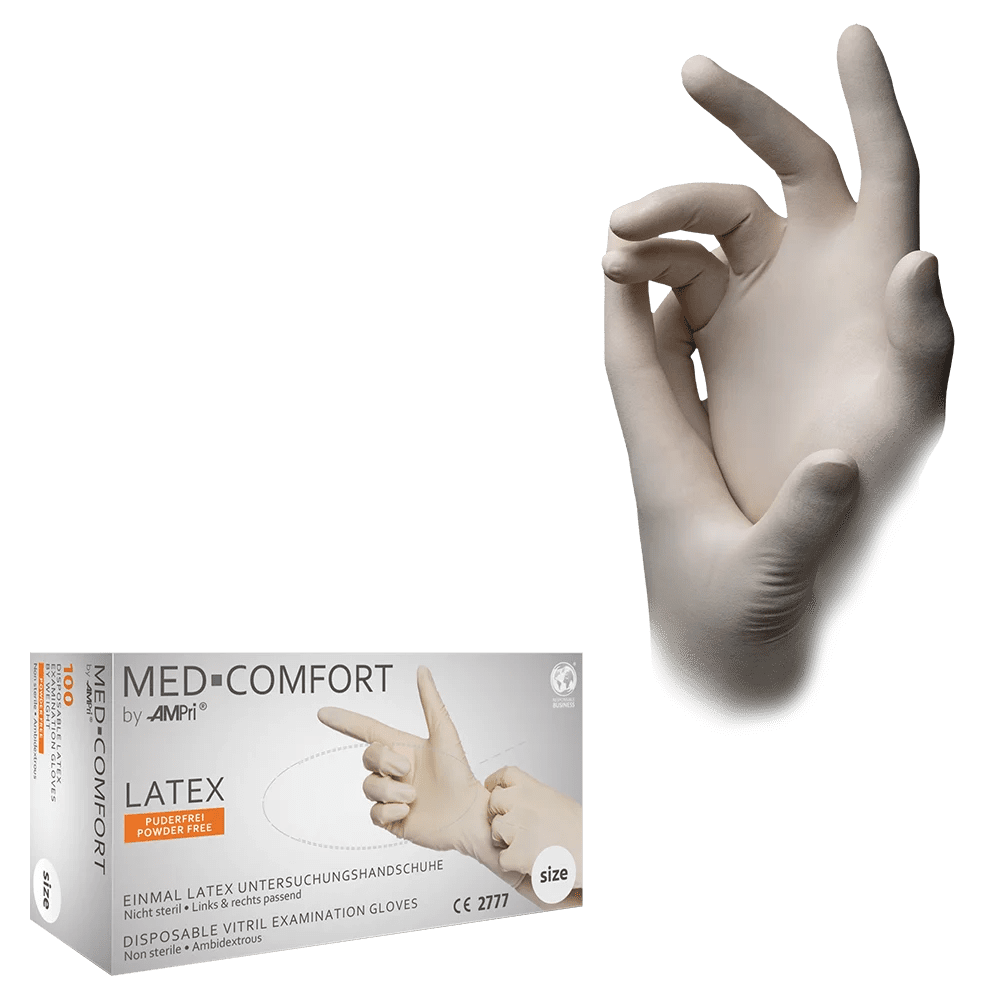
Latex gloves – whether referred to as disposable latex gloves, latex single-use gloves, latex protective gloves or latex examination gloves – are essential kit across many industries. They combine excellent tactile sensitivity with dependable protection and also play an important role in the wider context of standards and transparent supply chains.
On this page, you will find a comprehensive overview of the origin, properties, typical applications and product selection of latex gloves – including practical tips on choosing the right size, correct use and selecting the most suitable AMPri products.
Table of contents
- 1. What are latex gloves?
- 2. Manufacturing & origin – The rubber tree cycle
- 3. Sustainability & transparency at AMPri
- 4. What types of latex gloves are available?
- 5. Advantages of latex gloves compared with nitrile & vinyl
-
6. Which industries are latex gloves suitable for?
- 6.1 Healthcare, care, hospitals, theatre & dental
- 6.2 Laboratory & research
- 6.3 Food industry & catering
- 6.4 Building cleaning & hygiene services
- 6.5 Cosmetics, beauty salons & hairdressers
- 6.6 Tattoo & piercing studios
- 6.7 Veterinary & animal healthcare
- 6.8 Trades, assembly & industry
- 6.9 Private households
- 7. Standards & certifications explained simply
- 8. Fit, sizes & correct use
- 9. Product recommendations – latex gloves from AMPri
- 10. FAQ – Frequently asked questions about latex gloves
1. What are latex gloves?
Latex gloves are among the most widely used disposable gloves in healthcare, care, laboratories and many craft or hygiene-critical environments. Many users deliberately choose disposable latex gloves because they offer a particularly natural feel and adapt to the hand like a “second skin”.
Latex gloves are made from natural rubber latex – the milky sap of the rubber tree (Hevea brasiliensis). This natural material is not only elastic, but also especially resilient. That is why latex protective gloves have been a preferred choice for decades when safe and precise work is required.
The key properties of natural rubber
Compared with synthetic alternatives such as nitrile or vinyl gloves, latex disposable gloves offer several advantages: they are highly elastic and tear-resistant, conform ergonomically to the hand, and deliver outstanding tactile sensitivity and fingertip feel. This makes them ideal for precision tasks – for example in medical diagnostics, laboratory environments or cosmetics.
Why so many industries rely on latex gloves
Thanks to the combination of sensitivity, stretch and protection, latex gloves and latex disposable gloves are a standard product across many working environments. They seal reliably at the wrist, fit closely to the skin and therefore support safe handling – even during extended wear.
In brief
Latex gloves are disposable gloves made from natural rubber, offering high flexibility, excellent fit, outstanding tactile sensitivity and dependable protection. They are therefore an ideal choice wherever precision and safety are equally important.
2. Manufacturing & origin – The rubber tree cycle (natural latex)
The basis of all latex gloves – whether used as disposable latex gloves, latex protective gloves or latex single-use gloves – is natural rubber. It comes from the milky sap of the rubber tree (Hevea brasiliensis), which is grown predominantly in South East Asia. However, latex is not only a high-performing raw material; it is also part of a remarkable natural cycle, which AMPri documents as transparently as possible.
2.1 Sustainable cultivation instead of monoculture
Natural rubber production starts with the cultivation system. Alongside classic monocultures, more and more producers – and therefore AMPri partners too – are adopting agroforestry. Here, rubber trees are grown together with other crops. This increases biodiversity, improves soil quality, reduces erosion and makes the ecosystem more resilient. This approach forms the starting point for the entire latex cycle.
2.2 Resource-efficient harvesting over decades
A rubber tree produces the valuable milky sap for the first time after around five to seven years – the raw material that later becomes the base for latex gloves. Latex is harvested by gently scoring the bark, known as tapping. The tree is not felled and can often continue producing sap for 25 to 30 years. This harvesting method makes natural rubber one of the most renewable raw materials used in latex glove production.
2.3 From raw latex sap to a latex glove
After harvesting, the latex sap is filtered locally, stabilised and then processed into high-quality latex gloves. It passes through multiple steps: cleaning and filtration, compounding the latex mix, the dipping process using ceramic hand formers, drying, vulcanisation and curing. This is followed by strict quality controls, for example in accordance with EN 455 and EN ISO 374. The result is elastic, tight and tear-resistant disposable latex gloves that set the standard across many industries.
2.4 Extended life cycle – nothing goes to waste
When a rubber tree reaches the end of its productive life, it is not simply discarded. Within the production processes, it takes on a new function: the wood from end-of-life trees is used locally as biomass for energy generation. This creates a local cycle that replaces fossil fuels and reduces CO₂ emissions. The energy generated is often used for drying or vulcanising new latex products – an example of efficient resource use designed to minimise waste.
2.5 The closed-loop raw material cycle – the four core principles
The sustainable latex cycle is essentially based on four principles:
- Sustainable cultivation: agroforestry instead of pure monoculture.
- Resource-efficient harvesting: long-term latex tapping without felling trees.
- Extended life cycle: using the tree up to the end of its productive period.
- Energy recovery: using the wood as biomass rather than fossil fuels.
This system makes it possible to manufacture latex products such as latex gloves in a particularly responsible way – an aspect that is becoming increasingly important for many resellers and end users.
2.6 Responsibility and traceability – AMPri focuses on transparency
A sustainable latex cycle alone is no longer enough today. What matters is that every step is documented transparently. That is why AMPri works with suppliers who ensure traceable, deforestation-free latex production, meet regular audit requirements and comply with clearly verifiable standards. Exactly how AMPri meets the requirements of the EUDR (EU Deforestation Regulation) and the EcoVadis assessment is explained in more detail in section 3.
3. Sustainability & transparency at AMPri
At AMPri, responsibility is not an add-on – it is a core part of the company’s philosophy. Anyone using AMPri latex gloves receives products with clearly documented raw material origin and manufacturing processes that are assessed against international standards. Modern supply chains must not only be resilient, but also traceable, deforestation-free and transparent – and that is exactly what AMPri ensures throughout the entire latex cycle.
3.1 EUDR – What the EU Deforestation Regulation means
The EU Deforestation Regulation (EUDR) requires companies to ensure that products such as natural rubber – and therefore disposable latex gloves – do not contribute to deforestation or forest degradation. For natural rubber, this includes, among other requirements: geolocation of plantations, due diligence obligations, and fully traceable supply chains back to the cultivation area. This creates an unprecedented level of transparency in raw material sourcing.
3.2 How AMPri meets the EUDR requirements
AMPri works closely with production partners in the countries of origin (e.g. Malaysia) who use digital traceability systems. Every step – from the rubber tree to latex harvesting and on to the finished production of latex gloves – is documented. Plantation areas are identified using geodata. This ensures that natural rubber comes exclusively from deforestation-free areas and that the legal requirements of the EUDR are met.
3.3 ECOVADIS – Transparent sustainability at a global standard
In addition to legal requirements, AMPri relies on ECOVADIS, one of the world’s most widely recognised platforms for assessing sustainability in supply chains. ECOVADIS evaluates companies, among other criteria, across environment, labour and human rights, ethics, and procurement. AMPri is assessed regularly (EcoVadis) and uses the results to communicate its performance transparently and to drive continuous improvement.
3.4 What does this mean for resellers & end users?
For resellers, medical facilities, specialist retailers or industrial companies, this means: Latex gloves from AMPri offer not only high quality, but also legal certainty regarding EUDR-compliant supply chains. Evidence for tenders or internal quality audits can therefore be provided more easily. End users, in turn, benefit from using disposable latex gloves with a traceable and responsibly managed origin.
3.5 AMPri as a partner for single-use products
AMPri combines technical expertise, long-standing partnerships and modern procurement requirements. Through deforestation-free raw material supply chains, clear documentation obligations, independent assessments and a verified quality management system (e.g. ISO 9001 and ISO 13485), AMPri ensures that latex disposable gloves are not only safe and high-performing, but are also produced responsibly for people and the environment.
4. What types of latex gloves are available?
Latex gloves are available in different variants that vary by material characteristics, surface texture, length, thickness and certification. This makes it possible to tailor latex protective gloves precisely to different industries and requirements. While medical users need fine tactile sensitivity, cleaning services or laboratories often prefer particularly robust, grippy or longer designs.
4.1 Powdered or powder-free latex gloves?
Powdered latex gloves were long considered the standard because they were very easy to put on. Today, however, they play little role in healthcare, as powder can disperse latex proteins and therefore increase allergy risks. Powder-free latex gloves are now the standard: they feature a modern internal coating that makes donning easier without the risks associated with powder particles.
| Feature | Powdered | Powder-free |
|---|---|---|
| Ease of donning | very easy | easy – thanks to internal coating |
| Allergy risk | higher | significantly reduced |
| Medical use | now rarely used | standard |
4.2 Examination gloves for healthcare & care
Many disposable latex gloves from AMPri are certified as medical examination gloves to EN 455 (Parts 1–5). This standard ensures that leak tightness, material strength, biological compatibility and shelf life are rigorously tested. Such latex examination gloves are widely used in hospitals, care facilities, laboratories, GP practices and in tattoo/cosmetics settings, as they provide a very natural, precise sense of touch.
4.3 More robust options for household use
For more demanding tasks, AMPri offers latex gloves for household use, i.e. latex household gloves for light cleaning work. These models feature increased wall thickness, in some cases extended cuffs, and therefore provide additional protection against strain or splashes.
4.4 Surface texture: smooth, textured or micro-roughened
How well a latex glove grips depends heavily on its surface. Smooth models offer a particularly soft tactile feel and are often used in healthcare and cosmetics. Textured or micro-roughened variants are preferred where tools, instruments or wet surfaces must be gripped securely – for example in tattoo studios, laboratories or dental practices. Micro-textured fingertips are a popular middle ground, combining grip and fine touch.
4.5 Differences in length & material thickness
Standard latex gloves typically have a minimum length of 240 mm and offer maximum dexterity alongside excellent tactile sensitivity. Extended variants of around 300 mm or more also protect the forearm and are popular in laboratories, cleaning or tasks with increased splash risk. Wall thickness also varies: thinner gloves increase sensitivity, while thicker designs offer greater robustness.
| Variant | Length | Key feature | Typical benefit |
|---|---|---|---|
| Standard latex gloves | ≥ 240 mm | fine tactile sensitivity | healthcare, care, cosmetics |
| High Grip“ models | ≥ 240 mm | micro-textured | wet/slippery conditions |
4.6 Colours & specialist coatings
Latex gloves do not always have to be natural-coloured. In many industries, coloured variants have become established – for example for visual zoning within HACCP concepts or to create a modern look in dental and beauty practices. Internal coatings such as polymer films or aloe vera layers make gloves easier to put on, protect the skin and increase comfort – especially during prolonged wear.
5. Advantages of latex gloves compared with nitrile & vinyl
Latex gloves have been a benchmark for tactile, precise work for many years. Their natural origin, high elasticity and excellent tactile sensitivity make them a popular choice in healthcare, laboratories, cosmetics and many other areas. At the same time, nitrile and vinyl are two important alternatives. A direct comparison helps you choose the right material.
5.1 Tactile sensitivity & fit: why latex remains the leader
Latex provides an exceptionally natural feel that few other glove materials can match. The fine structure of natural rubber allows a close fit to the hand, making latex gloves feel almost like a second skin. This precise tactile sensitivity is a key advantage for medical tasks, work with delicate instruments, and in tattoo and cosmetic settings.
5.2 Protective performance & durability
The materials also differ in their protective strengths. Latex provides an excellent barrier against germs and microorganisms and is therefore a preferred material in healthcare environments. Nitrile excels when working with chemicals, oils or solvents, while vinyl is mainly suitable for simple, short-duration hygiene tasks.
5.3 Skin compatibility & allergy considerations
A frequently discussed topic is possible latex allergies. Modern manufacturing processes have significantly reduced the risk by lowering protein content; however, the following applies: people with a known latex allergy should choose latex-free alternatives such as nitrile or vinyl. Powder-free latex gloves are particularly skin-friendly because they do not contain irritating powder particles.
5.4 Environmental considerations & sustainability
A clear advantage of latex is its origin: as a natural material based on a renewable raw material, it has a better environmental footprint than many synthetic alternatives. The closed-loop latex cycle – from agroforestry and many years of harvesting through to the energy recovery of end-of-life trees – makes latex gloves a considered option.
5.5 Comparison table: latex vs. nitrile vs. vinyl
| Feature | Latex | Nitrile | Vinyl |
|---|---|---|---|
| Comfort / fit | ★★★★★ | ★★★★☆ | ★★★☆☆ |
| Tactile sensitivity | ★★★★★ | ★★★★☆ | ★★★☆☆ |
| Stretch / flexibility | ★★★★★ | ★★★★☆ | ★★☆☆☆ |
| Tear resistance | ★★★★☆ | ★★★★★ | ★★★☆☆ |
| Protection against germs | ★★★★★ | ★★★★☆ | ★★☆☆☆ |
| Chemical protection | ★★★☆☆ | ★★★★★ | ★☆☆☆☆ |
| Skin-friendliness* | ★★★☆☆ (latex proteins) | ★★★★☆ (latex-free) | ★★★★☆ (latex-free) |
| Price / cost efficiency | ★★★☆☆ | ★★★★☆ | ★★★★★ |
5.6 Conclusion: which material is the right choice?
Latex excels wherever fingertip sensitivity, dexterity and comfort are the priority. Nitrile is the right choice when chemical resistance or latex-free materials matter. Vinyl remains the most economical solution for very light tasks with low protection requirements. These clear differences enable resellers and professional users to decide precisely which material is best suited to each situation.
6. Which industries are latex gloves suitable for?
Latex gloves are among the most versatile disposable gloves available. Thanks to their excellent wearing comfort, high elasticity and fine tactile sensitivity, latex protective gloves are used across a wide range of sectors. Wherever precise manual work, reliable hygiene and good dexterity are required, latex is often the first choice.
6.1 Healthcare, care, hospitals, theatre & dental
Medical examinations & care
In GP practices, care homes, emergency departments and ambulance services, latex gloves prove their worth every day. The flexible material adapts ergonomically to the hand and enables precise work during blood draws, wound care or diagnostic examinations.
Product recommendation:
MED-COMFORT Latex blue (powder-free) – Art.-No. 01113
Hospital & operating theatre areas (sterile latex gloves)
In surgical settings, sterile latex gloves remain the standard. Their anatomical fit, high tear resistance and particularly sensitive grip support clinicians during precision procedures. Sterile latex gloves are supplied individually packaged, paired with right/left orientation, and meet the highest safety requirements.
Product recommendations:
MED-COMFORT OP Latex (unpowdered, sterile) – Art.-No. 01144
MED-COMFORT OP Latex (powdered, sterile) – Art.-No. 01134
Dental, dentistry & orthodontics
In dental care, visibility matters alongside grip and tactile sensitivity. Many practices use coloured latex gloves because they are easier to see in the oral cavity. The micro-roughened fingertips on many models provide optimal grip on mirrors, probes and tools – even in wet conditions.
Product recommendations:
MED-COMFORT Premium Grip (latex) – Art.-No. 01037
Coloured latex examination gloves (e.g. blue)
6.2 Laboratory & research
For laboratory work where accurate handling and sensitive grip are essential, latex gloves are an excellent choice. They allow precise control of pipettes, test tubes and fine instruments. For microbiological work, latex disposable gloves provide an excellent barrier, while nitrile is often preferred for strong chemicals.
Product recommendation:
MED-COMFORT Premium Grip (latex) – Art.-No. 01037
6.3 Food industry & catering
In kitchens, catering businesses and food production, powder-free latex gloves are often used for fine work – for example portioning, decorating or handling delicate foods. Many models are approved for food contact, particularly with non-fatty foods.
Product recommendation:
MED-COMFORT Latex Premium (powder-free) – Art.-No. 01113
6.4 Building cleaning & hygiene services
Cleaning services value latex gloves for their high comfort and flexibility. With mild cleaning agents, the material remains pleasant and durable. For use involving splashes or where increased forearm protection is needed, extended latex gloves are particularly suitable.
6.5 Cosmetics, beauty salons & hairdressers
In the beauty sector, latex gloves are among the most popular disposable gloves. They enable precise steps when colouring, styling, microblading or performing cosmetic treatments. The close fit and natural dexterity of the material ensure comfortable, controlled handling.
Product recommendations:
MED-COMFORT Aloe Latex – Art.-No. 01036
MED-COMFORT Premium Grip (latex) – Art.-No. 01037
6.6 Tattoo & piercing studios
Tattoo artists and piercers need gloves that support precise work, strong grip and high elasticity. Latex gloves help ensure safe control of tattoo machines and piercing tools – even over longer sessions.
Product recommendation:
Style Black (latex) – Art.-No. 14-028
6.7 Veterinary & animal healthcare
In veterinary medicine, gloves must be not only precise but also particularly tear-resistant. Latex offers exactly this combination and is therefore ideal for examinations, treatments or near-surgical tasks in veterinary practices and clinics.
Product recommendation:
MED-COMFORT Latex Premium – Art.-No. 01113
6.8 Trades, assembly & light industrial work
Fine mechanical tasks, quality inspections or packing processes benefit from the high tactile sensitivity of latex gloves. They enable secure handling of small components without leaving residues and support fast, controlled work.
Product recommendation:
MED-COMFORT Premium Grip (latex) – Art.-No. 01037
6.9 Private households
Disposable latex gloves are also versatile at home – for cooking, cleaning, crafts or small repairs. Their familiar feel and good dexterity make them practical everyday helpers.
Product recommendation for household gloves:
CLEAN-COMFORT latex household gloves (yellow) – Art.-No. 01152
CLEAN-COMFORT latex household gloves (blue) – Art.-No. 01153
7. Standards & certifications explained simply
Standards provide clarity and assurance: they define the requirements a latex glove must meet to be used reliably in medical, hygiene or industrial environments. For latex gloves, disposable latex gloves and latex single-use gloves, several European standards are particularly relevant. AMPri works exclusively with manufacturers who consistently meet these standards to ensure consistently high product quality.
7.1 EN 455 – The key standard for medical examination gloves
EN 455 is the central standard for medical examination gloves. Among other things, it tests leak tightness against liquids and microorganisms, tear resistance and elasticity of the material, as well as biological compatibility. It also specifies how shelf life must be tested and labelled. For users, this means: a latex glove that meets EN 455 is approved for medical use and provides a high level of safety – for both staff and patients.
7.2 EN ISO 374 – Protection against chemicals & microorganisms
When it comes to protection against chemicals, viruses or other microorganisms, EN ISO 374 is the key standard. It describes different protection categories and defines how resistant a (latex) glove is to specific substances. This standard is especially important for areas such as laboratories, cleaning and certain activities in the food industry. Not every latex glove is automatically chemical-resistant – the relevant marking clearly indicates what the glove is suitable for.
7.3 EN ISO 21420 – Comfort, fit & basic safety
EN ISO 21420 defines basic requirements that every (latex) protective glove must meet – regardless of material. These include ergonomic design, safe and harmless materials, correct size information and clear labelling. For latex gloves, this primarily means they fit comfortably, do not restrict hand movement and are free from relevant harmful substances. In everyday use, this standard is reflected in a glove that does not pinch or constrict, but supports natural working movements.
7.4 MDR – Medical Device Regulation 2017/745
The European Medical Device Regulation (MDR) ensures that medical products – including latex examination gloves – are strictly controlled. It requires detailed technical documentation, full traceability via the UDI system, and regular assessments of product safety. For buyers and resellers, this means: a medical latex glove approved under the MDR complies with the highest current European safety standards.
7.5 Food contact regulation (EU) 1935/2004
Many powder-free latex gloves are suitable for food contact. EU Regulation 1935/2004 requires that a glove must not release substances into food that could endanger consumers’ health. This regulation is crucial in catering and food production: it provides assurance that disposable latex gloves are hygienically safe and remain suitable for preparing, portioning or processing sensitive foods.
7.6 ISO 9001 & ISO 13485 – Quality standards in production
AMPri works with manufacturers certified to ISO 9001 and ISO 13485. While ISO 9001 describes general quality management, ISO 13485 is specific to medical devices and sets stricter requirements for production, documentation and risk analysis. The result is consistently audited processes, consistent quality and reliable products.
7.7 EUDR & ECOVADIS (quick overview)
These points were explained in detail in section 3. In summary, the EUDR (deforestation-free supply chains) and the ECOVADIS sustainability rating ensure that latex gloves are not only safe, but also produced responsibly. For resellers and organisations, this creates transparency and legal certainty across the entire supply chain.
8. Fit, sizes & correct use
Latex gloves provide full protection and comfort only when they fit properly and are used correctly. The right size prevents tearing and excessive stretching, ensuring disposable latex gloves and latex single-use gloves fit like a second skin. Because latex is highly elastic, choosing the correct size supports particularly precise, fatigue-free work.
8.1 Finding the right size
For optimal protection and comfort, latex gloves must fit correctly. The best way to determine the right size is by measuring hand width across the back of the hand at knuckle height (excluding the thumb).
| Size | Glove width | Description |
|---|---|---|
| XS | ≤ 80 mm | very small hands |
| S | 80 mm ± 10 mm | small hands |
| M | 95 mm ± 10 mm | medium hands |
| L | 110 mm ± 10 mm | large hands |
| XL | ≥ 110 mm | very large hands |
| XXL* | > 125 mm | very, very large hands |
| XXXL* | > 135 mm | ultra large hands |
*AMPri values
These finely graded sizes allow for a very precise fit. Especially during extended wear – for example in healthcare, care, tattoo, dental or beauty settings – the exact size makes a noticeable difference. Latex is highly elastic, but a well-fitting glove not only improves tactile sensitivity; it can also reduce unnecessary stress on the material.
8.2 Putting on latex gloves correctly
To ensure latex protective gloves reliably provide a barrier, they should be put on correctly. Key steps include: wash hands thoroughly and dry completely, remove jewellery such as rings or bracelets, hold the glove by the cuff (not the fingertips) and slide into the glove slowly. Then ensure the glove fits as smoothly as possible, particularly around the fingers.
Many powder-free models – such as MED-COMFORT Aloe Latex (Art.-No. 01036) – feature a special internal coating that makes donning even easier.
8.3 Correct removal
When removing disposable latex gloves, the priority is to avoid touching the outside surface as much as possible, so potential contamination does not transfer to the skin. First, grasp the outside of the first glove at the wrist and peel it off outwards so that it turns inside out. For the second glove, slide a finger under the inside of the cuff and pull it off as well, so both gloves can be disposed of together. This method is standard in healthcare and is also recommended for laboratories, hygiene services and food handling.
8.4 Shelf life & storage
Latex gloves have a limited shelf life, which is stated on every pack in accordance with EN 455-4. To keep them functional for as long as possible, they should be stored cool, dry and protected from light, and kept away from ozone sources (e.g. motors or certain UV devices). High temperatures or direct sunlight can cause latex to age faster, reducing tear resistance and protective performance.
8.5 How can you recognise high-quality latex gloves?
Regardless of industry, there are several factors that distinguish high-quality latex gloves: consistent wall thickness without material fluctuations, a cleanly rolled cuff, a comfortable internal coating (e.g. polymer or aloe), stable tear resistance under stretching, and compliance with relevant standards such as EN 455, EN ISO 374 and EN ISO 21420. Products such as MED-COMFORT Latex Premium (Art.-No. 01113) or MED-COMFORT Premium Grip (Art.-No. 01037) demonstrate clearly how these quality criteria are delivered in practice.
9. Product recommendations – latex gloves from AMPri
AMPri offers a comprehensive portfolio of high-quality latex gloves for professional users and end consumers. Whether in healthcare, laboratories, tattoo studios, food processing or cleaning: a specialised latex glove is available for every application. All models are powder-free or sterile, meet relevant standards, and come from transparent, documented supply chains.
9.1 All-round latex gloves for healthcare, care, food & everyday use
MED-COMFORT Latex Premium (powder-free)
Art.-No.: 01113
Universally applicable disposable latex glove with high elasticity and pleasant tactile sensitivity.
Suitable for healthcare, care, food environments (subject to approval) and many other applications.
Shop link:
https://ampri.de/01113
9.2 Premium grip for tattoo, laboratory, dental & trades
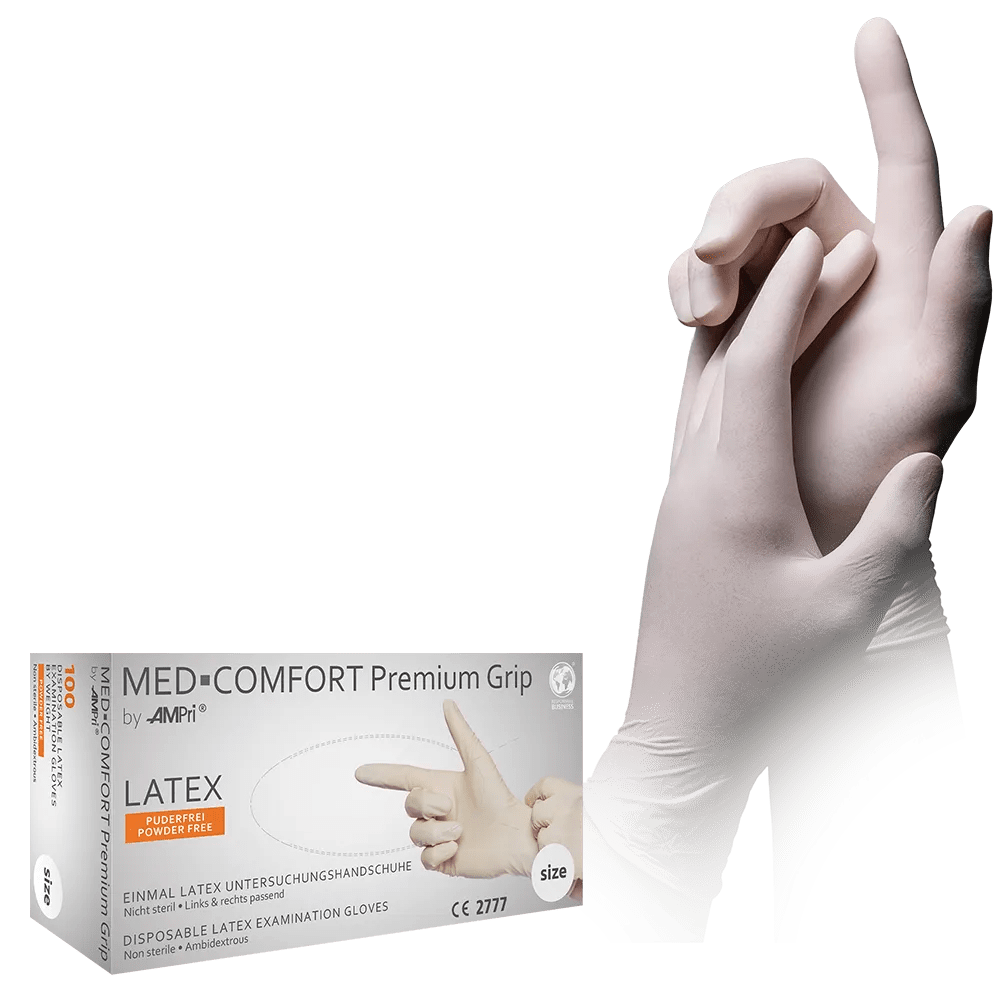
MED-COMFORT Premium Grip (latex)
Art.-No.: 01037
Micro-textured surface for secure grip, even in moist conditions.
Ideal for precision tasks in laboratories, tattoo and dental settings, and trade applications.
Shop link:
https://ampri.de/01037
9.3 Skin-friendly option for beauty, cosmetics & hairdressers
MED-COMFORT Aloe Latex (powder-free, aloe vera coating)
Art.-No.: 01036
With a caring aloe vera internal coating for an especially comfortable feel.
Ideal for beauty, cosmetics and wellness applications involving longer wear times.
Shop link:
https://ampri.de/01036
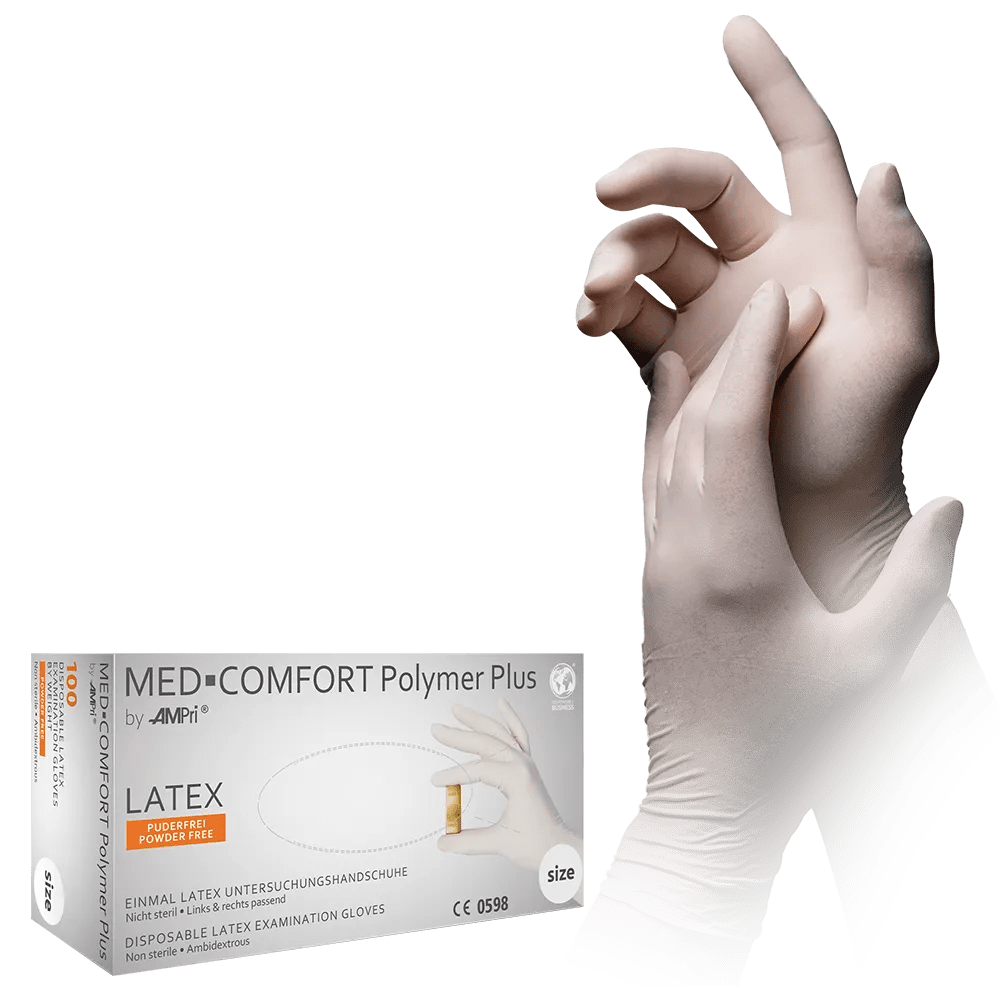
9.4 Polymer-coated latex glove for particularly easy donning
MED-COMFORT Polymer Plus (latex)
Art.-No.: 01034
Polymer-coated internal surface that noticeably simplifies donning.
Suitable for medical and hygiene applications where gloves are changed frequently.
Shop link:
https://ampri.de/01034
9.5 For dental practices & studios: coloured, grippy & precise
MED-COMFORT Latex (blue / colour variants)
Art.-No.: 01113-BL
A coloured counterpart to the premium latex glove – ideal for dental practices, studios and environments where visibility and a professional appearance are particularly important.
Shop link:
https://ampri.de/01113-BL
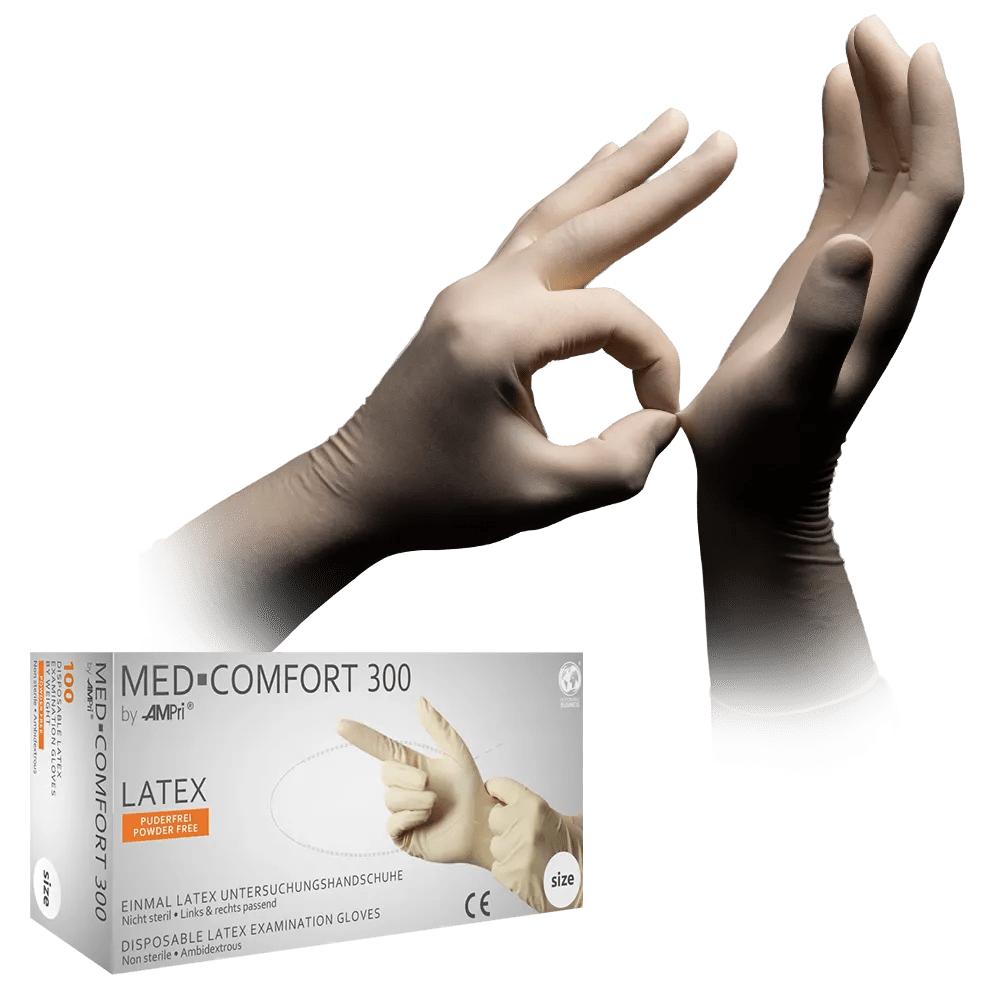
9.6 Extended latex gloves for cleaning, laboratories & medical settings
MED-COMFORT Latex 300 (long, approx. 300 mm)
Art.-No.: 01230
With an extended cuff for additional forearm protection.
Ideal for laboratories, cleaning, medical settings and wherever splashes (no chemical splashes!) or liquid contact are expected.
Shop link:
https://ampri.de/01230
9.7 Surgical & OP latex gloves
For surgical procedures, sterile latex gloves are indispensable. They are supplied in pairs, anatomically shaped for right/left hands, and provide maximum precision and safety.
MED-COMFORT OP Latex (unpowdered, sterile)
Art.-No.: 01144
Unpowdered, sterile OP latex gloves with an anatomical fit.
Ideal for users who prefer to avoid powder while still requiring the highest precision.
Shop link:
https://ampri.de/01144
MED-COMFORT OP Latex (powdered, sterile)
Art.-No.: 01134
Sterile powdered OP latex gloves for particularly easy donning.
Suitable for surgical procedures with long wear times and high precision requirements.
Shop link:
https://ampri.de/01134
10. FAQ – Frequently asked questions about latex gloves
The information provided here has been compiled with the utmost care and to the best of our knowledge, and has been reviewed by our quality management team. Nevertheless, errors or omissions cannot be entirely ruled out. Liability for any content-related errors, omissions, or damages resulting from the use of this information or from external links is excluded to the extent permitted by law.