
















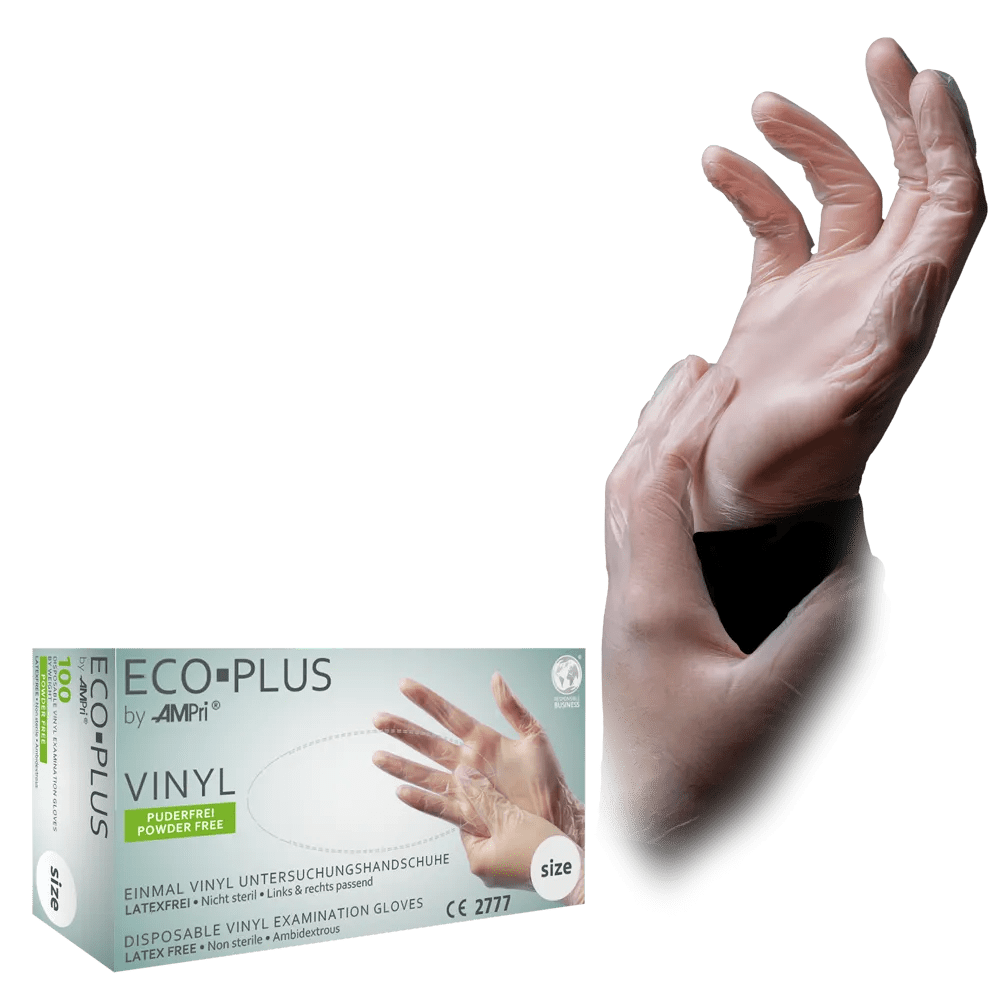

Vinyl Gloves – Properties, Areas of Use and Product Recommendation
- 1. Introduction: What are vinyl gloves?
- 2. Material & properties of vinyl
- 3. Vinyl gloves compared with nitrile & latex
- 4. Standards & certifications
- 5. Areas of use for vinyl gloves
- 6. Product recommendation: AMPri vinyl gloves
- 7. FAQ about vinyl gloves
1. Introduction: What are vinyl gloves?
Vinyl gloves are among the classic, economical disposable gloves. They are primarily used where short wearing times, basic hygiene and an attractive cost-performance ratio are key. Made from polyvinyl chloride (PVC), a latex-free material, they are particularly suitable for individuals who are sensitive to latex proteins. Thanks to their smooth surface, they offer a loose, comfortable fit and are easy to put on and remove. Vinyl gloves are considered allergy-friendly, cost-effective and suitable for handling diluted cleaning agents.
Typical applications include care and nursing, the food sector, cosmetics, retail and cleaning tasks where gloves need to be changed very frequently. In these environments, they score points for ease of use and basic protection against dirt, moisture and non-aggressive substances.
Where are vinyl gloves less suitable – and why?
To make a well-informed purchasing decision, it is important to understand the limitations of this material. Compared with nitrile or latex, vinyl offers lower elasticity and tear resistance, resulting in a less precise fit and reduced barrier performance under higher biological or chemical stress. Vinyl is less dimensionally stable, less elastic and only moderately resistant to chemicals.
Vinyl gloves are therefore less suitable for:
- Medical tasks with increased risk, e.g. blood contact or prolonged procedures
→ Reason: reduced barrier performance and lower material strength. - Handling more aggressive chemicals or oily substances
→ Reason: PVC can be affected more quickly by solvents and oils. - Tasks requiring high dexterity or a secure, close fit (laboratory, tattoo, dental, fine assembly)
→ Reason: less elastic and less form-fitting than latex or nitrile. - Extended wearing times
→ Reason: the material stiffens more quickly during prolonged use and offers less comfort.
With this knowledge, vinyl gloves can be assessed more clearly: they are a sensible choice for short-term hygienic applications with manageable risk, but not for demanding medical or chemical tasks. This transparency helps users select the glove material best suited to their specific application.
2. Material & properties of vinyl
2.1 What is vinyl (PVC)? Origin, development & relevance for disposable gloves
Vinyl – more precisely polyvinyl chloride (PVC) – is a plastic that was discovered by chance in the 19th century. In 1872, the German chemist Eugen Baumann first described the whitish, solid polymer that formed when vinyl chloride was exposed to sunlight. However, the material only became industrially usable in the 1920s, when researchers developed methods to make vinyl flexible, stable and mouldable through additives. With this advancement, PVC quickly established itself as a versatile industrial and hygiene material.
For vinyl disposable gloves, a plasticiser-containing, particularly flexible PVC is used. This so-called “soft vinyl” allows the production of thin, smooth-running vinyl single-use gloves – ideal for short tasks where the focus is on hygiene, rapid availability and cost efficiency. The AMPri catalogue aptly describes vinyl as a cost-effective, allergy-friendly alternative with good resistance to diluted cleaning agents and no latex proteins, helping to avoid allergic reactions.
The combination of simple manufacturing processes, stable global supply chains and versatile formability has made vinyl an established material for disposable gloves for decades – particularly in sectors with high consumption and clearly defined hygiene standards.
2.2 Advantages of vinyl gloves
Vinyl gloves offer a range of properties that make them an attractive choice for certain fields of application:
Allergy-friendly (latex-free)
PVC contains no latex proteins. For people with latex allergies and for facilities that must operate strictly latex-free, vinyl is therefore a safe option.
Attractive cost-performance ratio
Production is cost-effective, making vinyl gloves among the most economical disposable gloves. For high-consumption areas such as care, retail or basic cleaning tasks, this is a decisive advantage.
Comfortable, loose wearing feel
The smooth surface allows easy donning and removal. This is particularly practical for tasks where gloves need to be changed frequently.
Well suited for low-stress tasks
When handling diluted cleaning agents, water, saliva or food, vinyl gloves provide reliable basic protection.
Stable appearance and uncomplicated fit
Because vinyl fits less tightly, fewer pressure points occur, which is often perceived as comfortable for short-term use.
2.3 Limitations & risks of vinyl gloves
To decide whether vinyl is the right material choice, users should also be aware of its limitations. These are inherent to the material and result directly from the PVC structure.
Lower elasticity and fit
Compared with nitrile or latex, vinyl is less stretchable. As a result, the vinyl glove does not fit as snugly and can tear more easily under tension. This affects comfort during longer tasks as well as precision in fine motor work.
Weaker barrier performance
Due to its lower flexibility, micro-tears can form more quickly in the material, especially under heavy stress or during prolonged wear. This makes vinyl less suitable for tasks involving blood contact, infection risks or aggressive substances.
Limited chemical resistance
While diluted cleaning agents are generally unproblematic, oils, fats and solvents can destabilise PVC, reducing the glove’s protective performance.
Not ideal for high-fat foods
Oily and fatty foods can attack vinyl. As a result, use in professional kitchens is often limited to specific tasks.
Procurement aspects
Due to the plasticisers used and its overall material structure, PVC is considered less environmentally compatible than alternatives such as nitrile or PE. Users who place a strong emphasis on environmental aspects may find nitrile glove ranges more suitable.
3. Vinyl gloves compared with nitrile & latex
The choice of the right disposable glove depends largely on the specific requirements of daily work. Vinyl, nitrile and latex differ significantly in material properties, protection levels, fit and skin compatibility. Vinyl is regarded as an economical, allergy-friendly solution for simple applications, while nitrile and latex are designed for higher demands.
The following comparison provides clear, practical guidance.
Material comparison: vinyl vs. nitrile vs. latex
| Criterion | Vinyl | Nitrile | Latex |
|---|---|---|---|
| Material base | PVC (plasticiser-modified) | Synthetic rubber | Natural latex / natural rubber |
| Elasticity & fit | Low (looser fit) | High, very tear-resistant | Very high, extremely elastic |
| Tactile sensitivity | Basic, suitable for simple tasks | Good to very good | Excellent (best tactile feel) |
| Chemical resistance | Limited – mainly diluted agents | Very good, including oils & solvents | Moderate, substance-dependent |
| Allergy risk | Very low (latex- and accelerator-free) | Very low (latex-free) | Increased (possible latex protein allergies) |
| Food suitability | Limited for fatty foods | Very versatile | Good, product-dependent |
| Price level | Very low | Medium | Medium to higher |
| Typical duration of use | Short-term applications | Short- to long-term applications | Short- to medium-term applications |
When to choose vinyl, nitrile or latex – decision guidance
Vinyl – suitable when …
– a cost-effective, latex-free glove is required for simple, short tasks
– frequent glove changes are important
– the focus is on hygiene rather than durability
Nitrile – suitable when …
– tear resistance, chemical protection or precision are required
– the glove must remain comfortable during longer tasks
– a latex-free alternative with high protective performance is needed
Latex – suitable when …
– maximum tactile sensitivity and elasticity are crucial
– the working environment is free from latex allergies
– a close, snug fit is preferred
Practical conclusion
Vinyl gloves are a good choice for situations involving manageable risk and clearly defined hygiene steps. For more demanding tasks where mechanical stress, chemical protection or precision are required, nitrile or latex gloves are clearly the better option.
4. Standards & certifications
Vinyl gloves are subject to different legal requirements and quality standards depending on their intended use. To help users determine whether a product is suitable for their working environment, the most important standards are explained clearly and concisely. AMPri places great importance on transparent documentation, verified by certified quality management systems in accordance with ISO 9001 and ISO 13485.
4.1 Medical device – EN 455 (Parts 1–5)
If vinyl disposable gloves are placed on the market as a Class I medical device, they must comply with all five parts of EN 455. This standard defines requirements for use in medical care, such as in practices, care facilities or laboratories.
- EN 455-1 – Freedom from holes:
Barrier performance against microorganisms is assessed using AQL testing. - EN 455-2 – Physical properties:
Tests tear resistance, elongation and minimum dimensions. - EN 455-3 – Biological evaluation:
Ensures gloves do not release unacceptable quantities of substances harmful to the body. - EN 455-4 – Shelf life:
Defines requirements for minimum shelf life and ageing resistance. - EN 455-5:
Extractable chemical residues.
Vinyl gloves that comply with these standards are suitable for basic medical tasks, but not for higher-risk procedures, where nitrile or latex should be preferred due to their superior material strength.
4.2 PPE – EN ISO 21420 and, where applicable, EN ISO 374
When vinyl gloves are used as personal protective equipment (PPE), different regulatory requirements apply:
EN ISO 21420 – General requirements for protective gloves
This standard defines general requirements such as:
- Marking and labelling
- Material safety
- Ergonomics and fit
- Comfort and functionality
This standard is relevant for all AMPri vinyl gloves.
EN ISO 374 – Protection against chemicals and microorganisms
All AMPri vinyl gloves comply with EN ISO 374. In addition, all AMPri vinyl gloves are Type B vinyl gloves.
- EN ISO 374-5: Protection against microorganisms
- EN ISO 374-1 (Type B): Chemical breakthrough times for defined substances
For tasks involving more aggressive chemicals or oils, AMPri explicitly recommends nitrile or specialist protective gloves.
4.3 Food contact – EU Regulation (EC) 1935/2004
Vinyl gloves may be approved for use in the food sector. However, it is important to note:
- They are not unrestricted for use with fatty foods, as plasticisers can migrate from vinyl into oils and fats.
- Manufacturers must provide declarations of conformity.
AMPri provides the declaration of conformity on the product detail pages under Documents or in the download centre.
4.4 CE marking & legal requirements
The CE marking indicates that the product qualifies as a medical device in accordance with the MDR and/or as PPE in accordance with the PPE Regulation. Not every product subject to European legislation (e.g. food contact materials, the General Product Safety Regulation) bears a CE mark. PPE and medical devices must carry a CE mark to meet the minimum legal requirements.
Each product is assessed in a conformity assessment procedure in accordance with European legislation. The outcome is documented in the declaration of conformity.
4.5 Traceability, quality & sustainability
AMPri works with clearly defined quality standards and full documentation throughout the supply chain:
- Regular testing in independent laboratories
- Traceability via batch and production data
- Certified quality management (ISO 9001 & ISO 13485)
- Transparent sustainability assessments, including EcoVadis
For users, this means that every batch is traceable, legally compliant and consistently meets current European standards.
5. Areas of use for vinyl gloves
Vinyl gloves are used across many industries where basic hygienic protection is required and tasks are typically short-term with a manageable level of risk. Their material properties – a comfortable, loose fit, good skin compatibility and a very attractive price point – make them a preferred choice wherever gloves are changed frequently or where a permanent, high-strength barrier is not required.
Care and support services
In ambulatory and residential care, vinyl gloves are primarily used for basic care tasks: personal hygiene, making beds, handling clean aids or carrying out short cleaning tasks. These activities require hygiene and barrier protection, but not high mechanical durability. Thanks to their comfortable fit and easy donning and removal, they integrate well into workflows where disposable gloves are changed frequently. For care activities involving an increased risk of infection or contact with potentially infectious material, AMPri recommends nitrile gloves, as they offer more robust barrier performance.
Food processing and catering
In large kitchens, bakeries, canteens and retail food sales, vinyl gloves are also widely used – particularly for short hygiene contacts, such as portioning bread, fruit or baked goods, or for light interim cleaning tasks. They are well suited for non-fatty foods and activities where rapid glove changes and visible hygiene are key. However, for regular contact with oily or fatty foods, other materials should be preferred, as plasticisers from PVC can migrate into fats.
Cosmetics, nail studios & wellness
In cosmetic and nail studios, vinyl disposable gloves are a practical choice for tasks such as manicure, pedicure, epilation or the application of certain products. In these cases, basic protection is sufficient, and the lightweight wearing feel allows comfortable working across multiple applications. Where more aggressive liquids are used, for example intensive cleaners, nitrile is often the better alternative due to its superior material resistance.
Cleaning and facility services
For basic cleaning tasks – such as surface cleaning, sanitary maintenance or work in public areas – vinyl gloves provide uncomplicated protection against moisture and mild cleaning agents. As these tasks are typically carried out for short periods and fresh gloves are used regularly, vinyl gloves are both economical and functionally appropriate. For stronger chemicals, degreasers or longer contact times, nitrile remains the more robust choice.
Retail, warehousing & logistics
In retail environments, during product presentation or in warehouse tasks where light soiling or hygiene requirements occur, vinyl gloves are frequently used. They can be put on quickly, feel comfortable and enable staff to work in a clean, hygienic manner – particularly in areas with direct customer contact.
Short practical summary
Wherever short hygiene steps, light cleaning tasks or frequently changing activities are the priority, vinyl gloves are a reliable and cost-effective choice. Their limitations are clearly evident where mechanical durability, precise fit, prolonged skin contact or exposure to oils and more aggressive chemicals are required. For these tasks, AMPri recommends alternatives such as nitrile or latex. For many everyday workflows, however, vinyl gloves provide a sensible, practical solution with a well-balanced benefit-to-price ratio.
6. Product recommendation: AMPri vinyl gloves
For applications requiring an economical, comfortable and latex-free disposable glove, AMPri recommends the following vinyl glove. It combines solid basic performance with the easy handling typical of vinyl and is ideal for tasks in care, catering, cosmetics and cleaning.
AMPri ECO-PLUS Vinyl – powder-free
Art. no. 01260
- Latex-free disposable glove made from plasticiser-modified vinyl
- Pleasantly smooth inner and outer surface for easy donning and removal
- Suitable for light cleaning tasks and hygienic activities in care, catering, retail and cosmetics
- Comfortable, slightly looser fit for frequent glove changes
Shop link:
https://ampri.de/01260