

















Vitrile Gloves – Properties, Applications and Product Recommendations
- What are Vitrile Gloves?
- Material & Properties of Vitrile
- Comparison: Vitrile vs Nitrile vs Vinyl vs Latex
- Standards & Certifications
- Advantages & Limitations of Vitrile Gloves
- Industries & Areas of Application
- Product Recommendations
- FAQ on Vitrile Gloves
What are Vitrile Gloves?
Vitrile gloves – also referred to as vitrile disposable gloves, vitrile examination gloves or vitrile protective gloves – are made from a modern hybrid material combining vinyl and nitrile. This combination was developed to unite the advantages of both plastics: a soft feel and easy donning and doffing typical of vinyl, combined with improved tear resistance and durability known from nitrile.
Vitrile gloves therefore belong to the group of synthetic, latex-free disposable gloves and represent a practical alternative where classic vinyl gloves are insufficient, but full nitrile performance is not essential.
In professional environments, vitrile gloves are primarily used as medical examination gloves, hygiene gloves and for light protection in cleaning, care and food-related applications. They are odour-neutral, skin-friendly and free from latex proteins – a clear advantage for users with Type I latex allergy.
Although vitrile gloves do not offer the same elasticity and fit as nitrile or latex, they stand out for their excellent cost–performance ratio and practical durability. This makes them particularly suitable for applications with frequent glove changes, where comfort and functionality are required without compromising basic protection standards.
Material & Properties of Vitrile
Vitrile is a hybrid glove material combining the characteristics of two proven plastics: vinyl (PVC) and nitrile. This blend results in a synthetic disposable glove that feels noticeably higher quality than pure vinyl while remaining more economical than classic nitrile. For users, this means a balanced combination of comfort, flexibility and stability – ideal for applications involving frequent glove changes or where light protection is sufficient.
How is Vitrile Produced?
Vitrile gloves are manufactured by combining vinyl molecules with a proportion of nitrile polymers. This improves the material structure, making it more homogeneous, more durable and more flexible than pure vinyl. The result is a glove that feels smoother, more comfortable and less rigid, while also being significantly more tear-resistant.
Key Material Properties
Latex-free & allergy-friendly:
As vitrile contains no natural rubber proteins, it is suitable for users with Type I latex allergy.
Lower elasticity than nitrile or latex:
The fit is functional but not as close-fitting as nitrile or latex gloves.
Improved tear resistance compared to vinyl:
Vitrile provides solid stability, particularly for tasks involving moderate stress.
Easy donning and doffing:
The smooth, low-friction surface allows for quick glove changes – ideal for high turnover use.
Odour-neutral & low plasticiser emissions:
Modern vitrile compounds are skin-friendly and suitable for everyday professional use.
Food suitability (with limitations):
Suitable for many food products – however, not for fatty foods, as fats can dissolve plasticisers from the vitrile glove and transfer them to food.
Who Are Vitrile Gloves Suitable For?
Vitrile gloves are particularly popular:
- for tasks with short wearing times,
- where there is high glove consumption,
- as medical examination gloves,
- in hygiene-sensitive but not high-risk environments.
They therefore represent a cost-effective and practical solution positioned between vinyl and nitrile.
Comparison: Vitrile vs Nitrile vs Vinyl vs Latex
To clearly illustrate the differences between the most common glove materials, the following structured comparison is provided. The table is designed to be practice-oriented and is suitable for both professional users (medical, care, industrial) and end consumers seeking clear guidance.
Material Comparison at a Glance
| Criterion | Vitrile (Vinyl–Nitrile Blend) |
Nitrile | Vinyl | Latex |
|---|---|---|---|---|
| Material base | PVC + nitrile polymer | Synthetic rubber | PVC (polyvinyl chloride) | Natural rubber |
| Elasticity & fit | Medium – better than vinyl, not form-fitting | Very high – close-fitting | Low – relatively stiff | Very high – naturally elastic |
| Tactile sensitivity | Solid | Very good | Limited | Excellent |
| Tear resistance & stability | Good (better than vinyl) | Very good | Rather low | Good to very good |
| Chemical resistance | Limited | High (depending on type) | Low | Medium – substance-dependent |
| Comfort & feel | Soft, comfortable | Very comfortable | Firm, less flexible | Very comfortable, soft |
| Allergy risk | No risk (latex-free & accelerator-free) | No risk (latex-free) | No risk (latex-free & accelerator-free) | Possible (Type I protein allergies) |
| Food suitability | Yes – but not for fatty foods | Yes – very suitable | Limited – non-fatty only | Yes |
| Price level | Low to mid-range | Mid to premium | Very low | Mid-range |
Summary
Vitrile is the “middle-ground solution”: more economical than nitrile, stronger than vinyl, and without latex-related risks.
Nitrile remains the most versatile material – particularly for medical, laboratory, chemical and food applications.
Vinyl is suitable for short-term, simple tasks with minimal protection requirements.
Latex offers excellent comfort and tactile sensitivity but is limited due to allergy concerns.
Standards & Certifications
Vitrile gloves – including vitrile examination gloves, vitrile disposable gloves and vitrile protective gloves – may, depending on the specification, be classified either as a medical device or as personal protective equipment (PPE). Both categories are subject to strict European requirements to ensure the gloves are reliable, skin-compatible and hygienically safe.
Medical device (MDR) – EN 455 (Parts 1–5)
Where vitrile disposable gloves are used as medical examination gloves, they must comply with all four parts of EN 455:
- EN 455-1: Freedom from holes / AQL values
- EN 455-2: Physical properties such as tensile force & elongation
- EN 455-3: Biological evaluation (e.g. testing for allergenic substances)
- EN 455-4: Shelf life & labelling
- EN 455-5: Extractable chemical residues
This confirms that vitrile examination gloves provide dependable protection in everyday clinical practice.
General requirements for protective gloves – EN ISO 21420
This core standard defines key requirements for vitrile protective gloves, including:
- ergonomic requirements and wearer comfort
- safe and clear labelling
- material purity and skin compatibility
- requirements for fit and dexterity
It forms the framework for all further testing in the PPE area.
EN ISO 374 (Protection against chemicals & micro-organisms)
Some vitrile gloves also meet testing requirements within the EN ISO 374 series:
- EN ISO 374-1: Classification by protection level based on permeation (Type A/B/C)
- EN ISO 374-4: Material degradation by chemicals
- EN ISO 374-5: Protection against bacteria, fungi and viruses
As vitrile material is optimised for light to medium-duty tasks, many vitrile disposable gloves achieve protection levels that are ideal for care, cleaning and hygiene-related work.
Food contact – EU 1935/2004
Vitrile protective gloves can be used safely in food-handling environments.
Important: Both black vitrile gloves and blue vitrile gloves are not suitable for fatty foods, as fats may dissolve plasticisers, which can then migrate into the food.
Latex-free & allergy-friendly
Vitrile gloves are fully synthetic and contain:
- no latex proteins → no Type I latex allergy risks
- only low risks of Type IV contact allergy (material-dependent)
This makes vitrile examination gloves particularly skin-friendly and safe for sensitive users.
CE marking & traceability
All compliant vitrile disposable gloves must carry the following information:
- CE marking
- classification (medical device and/or PPE)
- manufacturer and batch details
- expiry date
- references to applicable standards (EN 455, EN ISO 21420, EN ISO 374, etc.)
This ensures full supply-chain transparency in line with the MDR and the PPE Regulation.
Advantages & Limitations of Vitrile Gloves
Vitrile gloves – whether used as vitrile disposable gloves, vitrile protective gloves or vitrile examination gloves – offer a balanced combination of comfort, functionality and cost efficiency. The vinyl–nitrile blend creates a glove that is ideal for many hygiene-related tasks. At the same time, users should be aware of the material’s limits to ensure safe and appropriate use.
Advantages of vitrile gloves
A cost-effective solution for high-volume use
Vitrile disposable gloves are more economical than pure nitrile or latex gloves and are ideal for areas with high glove consumption, such as care, cleaning, kitchens or hygiene services.
Latex-free & comfortable to wear
As a fully synthetic material, vitrile contains no latex proteins – a benefit for people with Type I latex allergy. The gloves are soft, odour-neutral and comfortable on the skin.
Better stability than vinyl
Thanks to the nitrile component, vitrile gloves are significantly more tear-resistant and shape-stable than pure vinyl gloves, providing increased safety for typical everyday hygiene tasks.
Good donning and doffing performance
The smooth, low-friction surface means vitrile protective gloves can be put on and removed quickly – a key advantage where gloves are changed frequently.
Hygienic and versatile
Suitable for many applications in medical and care environments – provided there is no high chemical or mechanical exposure.
Limitations of vitrile gloves
Lower elasticity compared to nitrile or latex
Vitrile examination gloves do not conform as closely to the hand and offer less tactile sensitivity than nitrile or latex products. For precision work, other materials are more suitable.
Limited chemical resistance
Vitrile gloves are not designed for aggressive chemicals or demanding laboratory applications. For these, specialised nitrile options are the better choice.
Not suitable for fatty foods
Fats can dissolve plasticisers from the vinyl component, which may then migrate into the food. For food processing, the rule therefore applies: use vitrile disposable gloves only for non-fatty foods.
Less durable under high mechanical stress
Vitrile protective gloves are not intended for abrasive tasks, trades, workshops or chemical protection – robust nitrile or latex variants are required in these environments.
Conclusion
Vitrile gloves are a smart, cost-effective solution for many hygiene and care-related tasks. They combine pleasant wearer comfort with solid stability and high user-friendliness. Their limitations are most apparent where maximum elasticity, high precision or intensive chemical protection is required.
Industries & Areas of Application
Vitrile gloves – including vitrile disposable gloves, vitrile protective gloves and vitrile examination gloves – are ideal for tasks where hygiene, light protection and comfortable wear are the priority. Thanks to their balanced cost–performance ratio, they are widely used across many professional sectors, particularly where gloves are changed frequently.
The following description is based on the text you provided and has been refined with technical accuracy and SEO focus:
Applications in healthcare & medicine
Vitril by Med-Comfort is used in many medical and care-related processes – primarily as a vitrile examination glove. It is suitable for:
- general medical examinations
- tasks in GP surgeries and clinics
- home care services and residential care facilities
- first-aid situations
- dentistry applications
Thanks to its latex-free, skin-friendly material structure, the glove is particularly suitable for users who are sensitive to latex or certain coatings.
Care, hygiene and cleaning tasks
Vitrile disposable gloves are frequently used in professional cleaning and hygiene services. They provide reliable protection against typical contamination and support controlled working practices for:
- surface cleaning
- sanitary cleaning
- cleaning services in buildings and facilities
- handling low-intensity disinfectants
The stable yet flexible material structure makes them ideal for routine tasks with regular glove changes.
Catering & commercial kitchens
In kitchens and catering, vitrile protective gloves are mainly used for hygiene-related tasks – e.g. during food preparation, service or when handling unpackaged items.
Important:
They are not suitable for contact with fatty foods, as fats may dissolve plasticisers from the vinyl component, which can then migrate into the food. For all other food areas, they are well suited and support safe, hygienic working practices.
Food industry
In production environments or for inspection and packaging of food, vitrile disposable gloves provide reliable basic protection. They are suitable for tasks such as:
- visual inspections
- packaging work
- sorting and portioning
- quality checks without fatty media
The smooth surface allows for fast glove changes – an important advantage on production lines.
Other industrial applications
In addition to healthcare and food-related environments, vitrile gloves are also suitable for product protection across various industrial applications, for example:
- precision assembly
- handling non-oily surfaces
- warehouse and logistics tasks
- light duties in workshops and production
They prevent fingerprints, reduce contamination and support clean process flows.
Product Recommendations
Within the vitrile glove category, AMPri offers two proven models that stand out for their comfortable feel, solid stability and high user-friendliness. Both variants are latex-free, skin-friendly and suitable for professional applications in healthcare, care, cleaning, catering and many other hygiene-relevant environments.
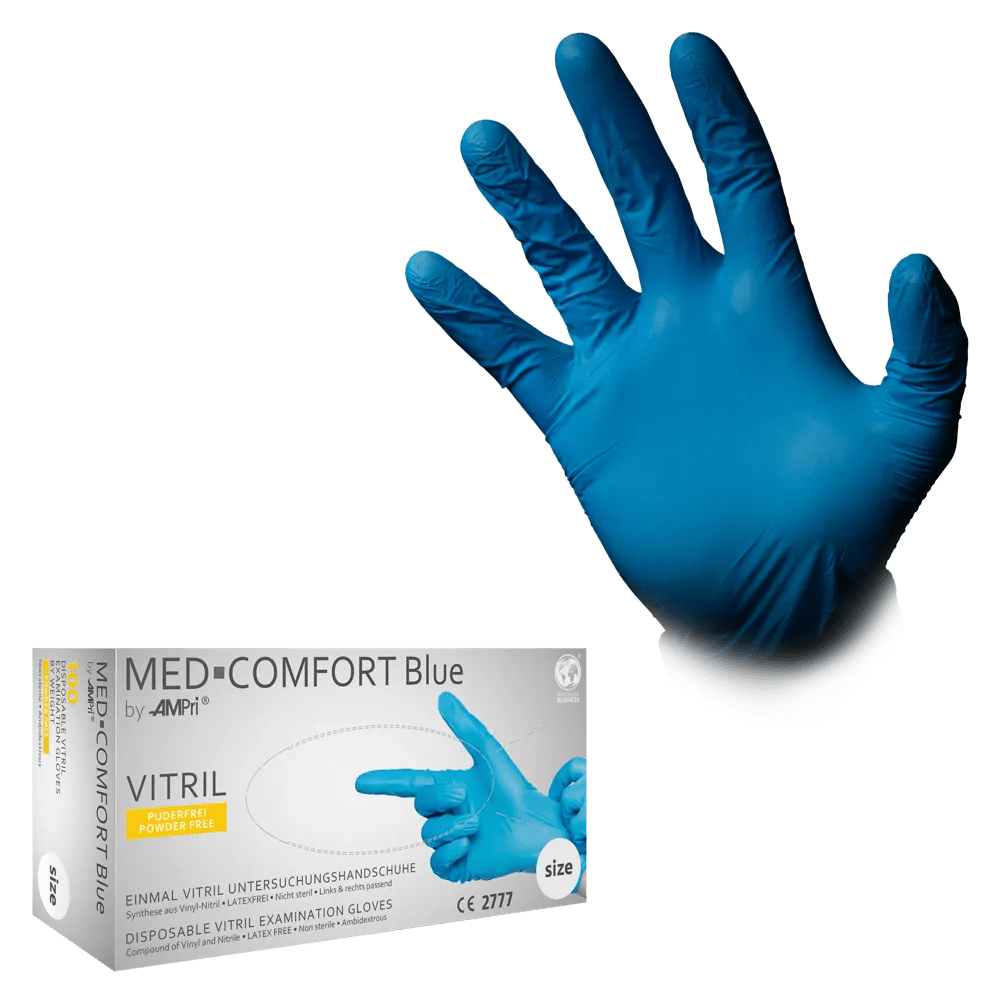
Blue Vitrile Glove – Med-Comfort
Item no. 01251
- latex-free vitrile glove for healthcare, care, cleaning and food-related applications (not suitable for fatty foods)
- pleasantly soft, with a good fit and reliable stability thanks to the vitrile material blend
- ideal for frequent glove changes thanks to a smooth surface and easy donning performance
- universally suitable as a vitrile disposable glove / vitrile examination glove
Shop link:
https://ampri.de/01251
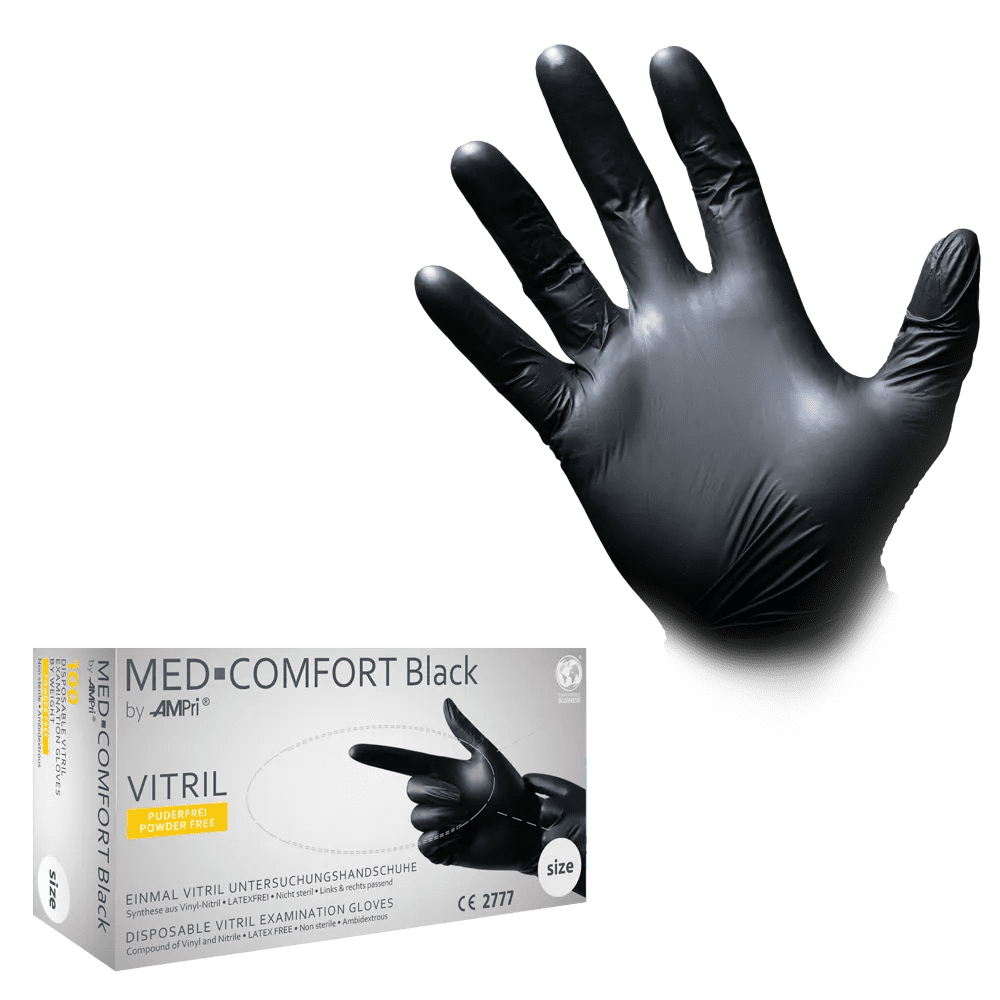
Black Vitrile Glove – Med-Comfort
Item no. 01252
- elegant black version – popular in catering, cosmetics, service, tattoo & hygiene
- latex-free and comfortable to wear, with a more stable material structure than pure vinyl
- well suited to everyday use for typical hygiene, care and cleaning tasks
- a versatile vitrile protective glove for professional environments
Shop link:
https://ampri.de/01252