















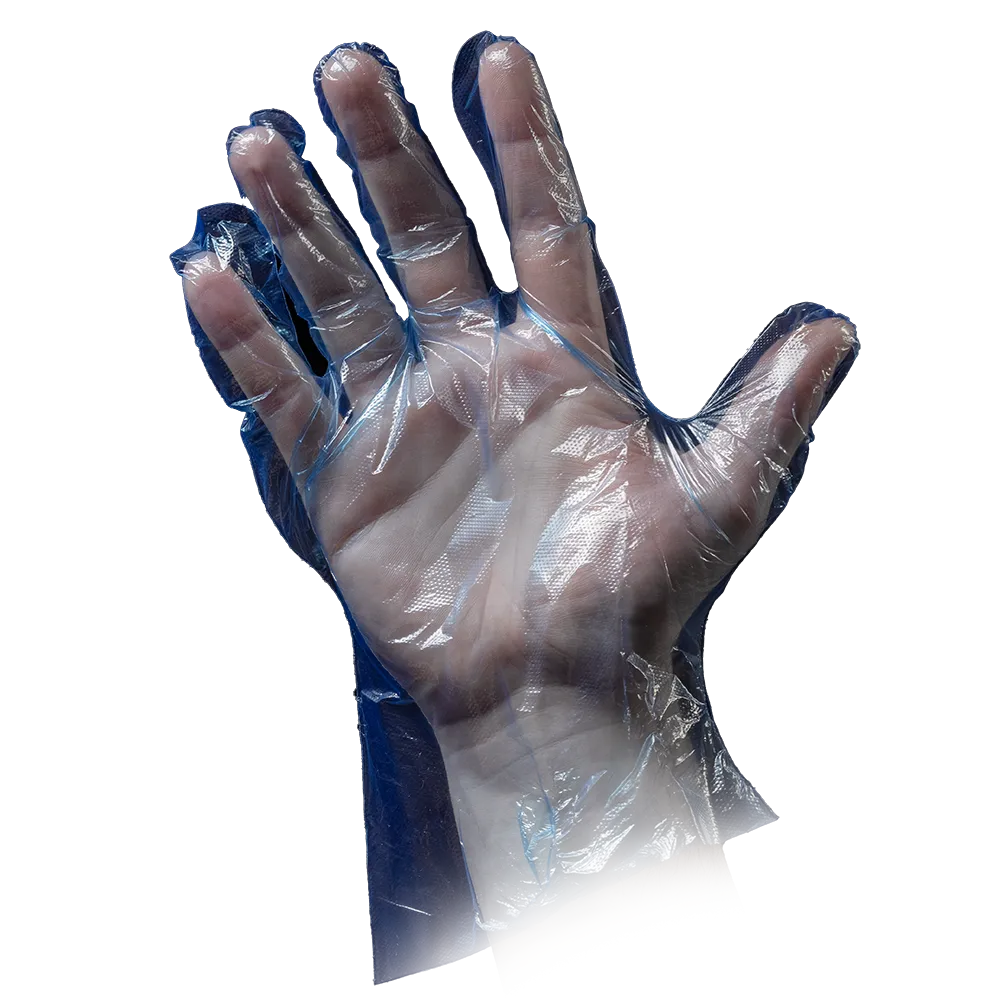


PE Disposable Gloves Made from Polyethylene (PE)
- What are PE disposable gloves?
- Material & properties of PE (LDPE & HDPE)
- Typical areas of application for PE gloves
- Standards, quality & safety of PE gloves
- Product recommendations from AMPri
- FAQ on PE disposable gloves
What are PE disposable gloves?
PE disposable gloves are made from polyethylene – a lightweight, durable and cost-efficient plastic that is ideally suited for short-term, hygiene-sensitive tasks. Thanks to their ease of use, attractive pricing and good skin compatibility, PE gloves are among the most widely used disposable gloves in the food industry, retail, kitchens and a wide range of service environments.
Unlike nitrile, latex or vinyl gloves, PE gloves do not offer an anatomical fit and have limited elasticity. They are therefore particularly suitable for applications where gloves need to be changed frequently or worn only for short periods. In hygiene-critical areas – such as handling unpackaged food or brief customer contact at checkouts or service counters – they allow fast donning and removal and help to effectively reduce the risk of cross-contamination.
Polyethylene is physiologically safe, virtually odourless and tasteless. In addition, the material is resistant to moisture, oils and fats, making it especially suitable for use in catering and food processing. Different material variants such as LDPE (soft PE) and HDPE (rigid PE) offer users a range of properties – from soft and flexible to particularly abrasion-resistant and stable. For specialised applications, such as veterinary medicine, AMPri also offers extra-long PE disposable gloves that provide additional protection beyond the forearm.
Material & properties of PE (LDPE & HDPE)
Polyethylene (PE) is a semi-crystalline, non-polar thermoplastic and one of the most widely used plastics worldwide. For disposable gloves, PE offers several functional advantages: the material is colour-neutral to milky white, physiologically safe, virtually odourless and skin-friendly. As PE can be produced very cost-efficiently, PE gloves are ideal for high-volume use in catering, retail and service environments.
Depending on the manufacturing process, two main variants are distinguished: LDPE (low-density polyethylene / soft PE) and HDPE (high-density polyethylene / rigid PE). These differ significantly in flexibility, feel and durability, offering distinct advantages for different applications.
LDPE / soft PE: flexible, softer version
LDPE (low-density polyethylene, also known as soft PE) is characterised by a softer, more flexible material structure. It feels comfortable to wear, is easy to pull on and can be reliably used even at low temperatures.
Properties of LDPE:
- Flexible and soft
- Cold-resistant down to –50 °C
- Heat-resistant up to +60 °C
- Well suited for frequent glove changes
- Pleasant tactile feel, low noise level (less “rustling” than HDPE)
LDPE gloves are commonly used in food processing, kitchens and light service tasks where short wearing times and comfort are key priorities.
HDPE / rigid PE: stable, abrasion-resistant version
HDPE (high-density polyethylene, also known as rigid PE) is the more robust and abrasion-resistant option. The material is stiffer, yet highly durable – particularly resistant to fats, oils and mechanical stress.
Properties of HDPE:
- Stiffer, shape-retaining and abrasion-resistant
- Cold-resistant down to –50 °C
- Heat-resistant up to +90 °C
- Excellent resistance to fats and oils
- Ideal for cost-efficient high-volume usage
- Typical “crinkling” material feel
HDPE is particularly suitable for sales counters, hygiene stations in retail environments and as an economical solution for areas with extremely high glove turnover.
Advantages & limitations of PE gloves
Advantages:
- Physiologically safe, virtually odourless
- Skin-friendly and latex-free
- Highly cost-effective to procure
- Oil- and fat-resistant (especially HDPE)
- Suitable for food contact
- Excellent for quick changes and short-term use
Limitations:
- Not elastic, therefore no anatomical fit
- Limited tactile sensitivity
- Not suitable for medical use
- No chemical protection compared to nitrile
This makes PE gloves ideal for standardised hygiene tasks – but not for precision work or safety-critical applications.
Material comparison: LDPE vs. HDPE (table)
| Property | LDPE (soft PE) | HDPE (rigid PE) |
|---|---|---|
| Flexibility | Soft, flexible | Stiff, shape-retaining |
| Abrasion resistance | Medium | High |
| Heat resistance | up to approx. +60 °C | up to approx. +90 °C |
| Cold resistance | down to –50 °C | down to –50 °C |
| Noise level | Low (“quiet”) | Higher (“crinkling”) |
| Oil & fat resistance | Good | Very good |
| Application | Kitchen, food, service | Retail, high-volume use |
| Price level | Low | Very low / highly economical |
Typical areas of application for PE gloves
PE disposable gloves are classic short-term gloves for hygiene tasks where fast and frequent changes are the main priority. They are ideal for environments where light, economical and straightforward hand protection is required. Thanks to their good skin compatibility, suitability for food contact and high availability, they are standard equipment across many industries.
Food industry & catering
In kitchens, canteens and production areas, PE gloves are mainly used whenever food is handled briefly or simple hygiene tasks are carried out. This includes:
- Handling unpackaged food
- Preparation of baked goods and dough products
- Buffet and counter service
- Cleaning of light surfaces or equipment
LDPE gloves are particularly popular here, as they are softer, more comfortable to wear and make less “rustling” noise. Their cost-efficiency also makes them ideal for businesses with high staff numbers or frequent glove changes.
Retail & service
In retail and service environments, hygiene and quick access are key. PE gloves are used here to make customer contact more hygienic and to keep work areas clean.
Typical applications:
- Customer contact at fresh food counters
- Checkout and service areas
- Self-service bakery stations
Especially for service areas: 19-001-L-B + holder 09053
PE glove 19-001-L-B
- Special format (300 × 255 mm)
- Made from robust HDPE
- Ideal for single use
- Compactly packaged
Stainless-steel holder 09053
- Matching wall holder
- Robust, weather-resistant design
- Including mounting material
- Designed for high frequency and quick single dispensing
This combination enables hygienic and user-friendly service that is particularly effective in high-traffic areas.
Veterinary medicine & agriculture
In veterinary medicine and agriculture, reliable protection is required that extends beyond the forearm without restricting the user too much. Standard gloves are often too short for these tasks – this is where extra-long PE disposable gloves are used.
Veterinary gloves 01080-L-90 – specifically for veterinary work
These extra-long gloves with a length of approx. 900 mm are designed for veterinary examinations and procedures.
Typical applications:
- Rectal examinations
- Obstetrics for large animals
- Hygienic protection during veterinary treatments
- Agricultural work with potential contamination
Professional benefits of these PE veterinary gloves:
- Lightweight, smooth-glide material
- Cold-resistant, therefore ideal for stable environments
- Stable enough for short-term veterinary use
- Highly economical when glove changes are frequent
Thanks to their length and material properties, they provide the necessary protection for the entire forearm up to the shoulder area – a key safety factor in veterinary medicine.
Standards, quality & safety of PE gloves
PE gloves are among the simpler disposable gloves and are generally classified as personal protective equipment, Category I (PPE Cat. I). They are intended to protect against minimal risks, such as superficial soiling or contact with non-hazardous substances. Even so, PE gloves must meet basic requirements regarding material quality, hygiene and food safety.
As PE is a physiologically safe plastic, many PE gloves are suitable for direct food contact. Especially in catering and retail, this conformity is a decisive criterion. Due to their resistance to fats and oils, HDPE variants provide additional reassurance when handling high-fat foods.
In addition, PE gloves are subject to the requirements of EN ISO 21420, which defines basic ergonomic, safety and health requirements for protective gloves.
For non-medical use, PE gloves are not classified as a medical device (MD), as their intended purpose is not designed for direct patient contact or invasive procedures.
At AMPri, all PE gloves undergo systematic quality control. This includes, among other things:
- Incoming goods inspection in line with internal quality standards
- Visual and material checks (thickness, homogeneity, workmanship)
- Packaging and piece-count checks
- Verification of standards-compliant labelling
This ensures reliable and consistent quality – even for very large consumption volumes in catering, retail or agriculture.
Product recommendations from AMPri
AMPri offers a wide range of PE gloves for different industries and requirements – from economical standard options and service gloves to extra-long veterinary gloves. Below you will find a curated selection of key products for professional use.
PE veterinary glove – for veterinary applications
01080-L-90 – PE veterinary glove, approx. 900 × 250 mm
- Specifically designed for veterinary examinations and obstetrics
- Extra-long design for forearm coverage and, where required, shoulder coverage
- Lightweight, smooth-glide PE material for hygienic applications
- Ideal for agriculture, veterinary practices and large-animal medicine
Shop link: https://ampri.de/01080-L-90
PE standard gloves – for food, kitchens & service
01080 – PE gloves (HDPE), sizes S & L
- Robust rigid-PE glove for reliable short-term use
- Highly economical for high-volume consumption
- Suitable for food contact, bakery stations and packaging
Shop link: https://ampri.de/01080
01090 – PE gloves (LDPE), sizes S & L
- Softer, more flexible soft PE for comfortable wear
- Ideal for tasks with frequent glove changes
- Good skin compatibility, virtually odourless
Shop link: https://ampri.de/01090
01080-HG – PE gloves, embossed, 370 × 300 mm
- Embossed surface for improved grip
- Robust quality for counters, self-service areas & light cleaning
- Universally applicable
Shop link: https://ampri.de/01080-HG
01080-L-53 – PE gloves, embossed, 530 × 193 mm
- Longer version for additional splash protection
- Ideal for food processing and counter areas
Shop link: https://ampri.de/01080-L-53
19-001-L-B – PE gloves, 300 × 255 mm
- Developed for service use
- Very easy to dispense, optimised for single use
- Made from HDPE: abrasion-resistant, economical
Shop link: https://ampri.de/19-001-L-B
09053 – stainless-steel holder for PE gloves
- Suitable for the service PE glove 19-001-L-B
- Including mounting material
- Weather-resistant, stable, designed for high-frequency use
- Clean single dispensing, ideal for service & hygiene stations
Shop link: https://ampri.de/09053