


















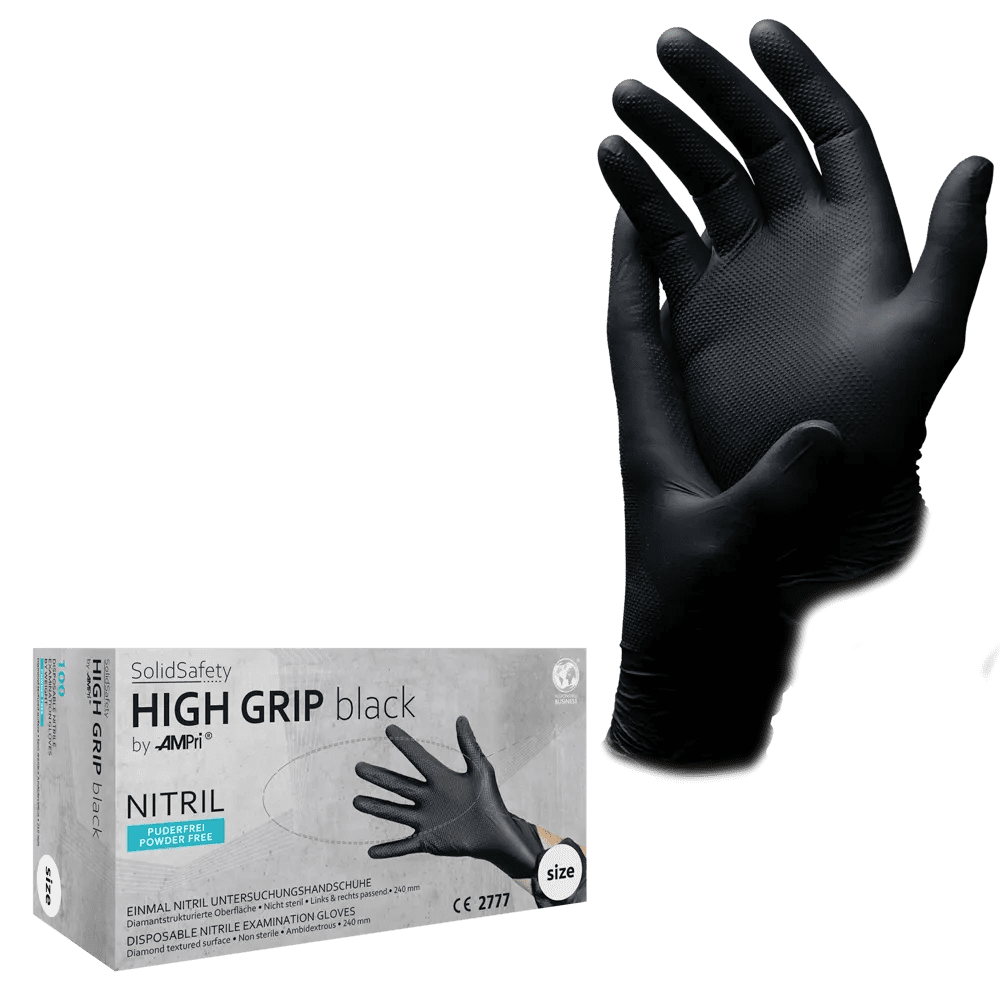





Chemical Protective Gloves – Reliable Protection Against Hazardous Substances
Chemical protective gloves are a key component of personal protective equipment (PPE) when employees work with hazardous liquids, solvents, acids, alkalis, or other chemical substances. They reliably protect the skin against direct contact reactions, chemical burns, irritation, and long-term health damage.
Whether in the chemical industry, in laboratories, in building cleaning, in trades, or in food production – wherever potentially hazardous substances are handled, suitable chemical protective gloves are indispensable.
A simple disposable glove is often not sufficient. What matters is that the glove:
- is resistant to the chemical used,
- meets the requirements of EN ISO 374,
- is assigned to the correct PPE category (Category III),
- is mechanically robust enough for the intended application.
A professional chemical protective glove not only prevents the visible ingress of liquids, but also protects against the invisible molecular permeation of the material. This is precisely the difference between a standard glove and a tested chemical protective glove.
For buyers and safety managers, this means: Selection should never be based solely on price, but on a technically sound assessment of material, standards, resistance data, and service life.
Modern chemical protective gloves – especially nitrile – now combine:
- high chemical resistance
- excellent tear resistance
- good tactile sensitivity
- ergonomic fit
- and reliable quality control (AQL value)
This results in hand protection that provides maximum safety both in continuous professional use and for short-term tasks.
- What are chemical protective gloves?
- Materials compared – which chemical protective glove is the right one?
- Nitrile chemical protective gloves – the all-rounder
- Testing chemical protective gloves: Permeation, Penetration & Degradation
- Disposable or reusable – which option makes sense?
- Industry suitability – where are chemical protective gloves used?
- What should you consider when purchasing chemical protective gloves?
- FAQ on chemical protective gloves
What are chemical protective gloves?
Chemical protective gloves are specialised protective gloves designed to protect hands against hazardous chemical substances. They are part of Personal Protective Equipment (PPE) and are subject – depending on the level of risk – to the European PPE Regulation (EU) 2016/425.
Unlike simple disposable gloves, the primary focus here is not hygiene protection or protection against microorganisms, but protection against hazardous chemicals that can be:
- skin-irritating
- corrosive
- toxic
- sensitising
- or systemically harmful to health
.
Typical substances handled include:
- strong acids (e.g. sulphuric acid, nitric acid)
- alkalis (e.g. sodium hydroxide)
- solvents (e.g. acetone, toluene)
- alcohols
- oxidising agents
- cleaning and disinfecting agents
- industrial chemicals
- plant protection products
Chemical protective gloves are assigned to PPE Category III. This category applies to risks with irreversible health damage or potentially fatal hazards and is subject to particularly strict EU type examination as well as ongoing production monitoring by a Notified Body.
Distinction from standard disposable gloves
Not every nitrile glove is automatically a chemical protective glove. It may have chemical resistance – but it does not have to prove this on a mandatory basis.
A genuine chemical protective glove, however:
- is tested according to EN ISO 374,
- bears the corresponding chemical protection pictogram,
- has defined breakthrough times against test chemicals,
- is regulated as PPE,
- protects against bacteria and fungi and, where applicable, also against viruses (virus testing is voluntary)
This means in practice:
A thin disposable glove as PPE Category I may be sufficient for short-term tasks with mild cleaners. However, for concentrated acids, solvents, or industrial chemicals, a chemically tested glove in accordance with standards is mandatory.
Relevant standards and certifications – EN ISO 374 in detail
The central standard for chemical protective gloves is EN ISO 374. It defines the requirements for gloves that protect against hazardous chemicals and microorganisms.
The standard is divided into:
- EN ISO 374-1 → Protection against hazardous chemicals
- EN ISO 374-4 → Determination of material degradation
- EN ISO 374-5 → Protection against microorganisms
The focus is on the permeation test, which measures how long a chemical takes to permeate the glove material at the molecular level.
The 18 standardised test chemicals according to EN ISO 374-1
For classification, gloves are tested against defined reference chemicals. These represent different chemical substance groups and enable a broad assessment of material resistance.
| Code | Chemical | Chemical group | CAS No. |
|---|---|---|---|
| A | Methanol | Alcohol | 67-56-1 |
| B | Acetone | Ketone | 67-64-1 |
| C | Acetonitrile | Nitrile | 75-05-8 |
| D | Dichloromethane | Solvent | 75-09-2 |
| E | Sulphuric acid (96%) | Acid | 7664-93-9 |
| F | Toluene | Aromatic hydrocarbon | 108-88-3 |
| G | Diethylamine | Amine | 109-89-7 |
| H | Tetrahydrofuran | Ether | 109-99-9 |
| I | Acetic acid (99%) | Acid | 64-19-7 |
| J | n-Heptane | Aliphatic hydrocarbon | 142-82-5 |
| K | Sodium hydroxide (40%) | Base / Alkali | 1310-73-2 |
| L | Sulphur dioxide (saturated) | Gas | 7446-09-5 |
| M | Nitric acid (65%) | Strong acid | 7697-37-2 |
| N | Ethyl acetate | Ester | 141-78-6 |
| O | Ammonia (anhydrous) | Base (gas) | 7664-41-7 |
| P | Hydrogen peroxide (30%) | Oxidising agent | 7722-84-1 |
| S | Hydrofluoric acid (40%) | Strong acid | 7664-39-3 |
| T | Formaldehyde (37%) | Aldehyde | 50-00-0 |
These substances cover:
- polar and non-polar solvents
- strong acids and bases
- oxidising substances
- organic compounds
- gases
and enable a differentiated assessment of the glove material.
Type classification according to EN ISO 374-1
Classification is based on the breakthrough times achieved against these test chemicals.
Meaning for glove protection:
Type A
Resistance to at least 6 chemicals for at least 30 minutes.
Type B
Resistance to at least 3 chemicals for at least 30 minutes.
Type C
Resistance to at least 1 chemical for at least 10 minutes.
Technical assessment
The 30-minute requirement corresponds to at least permeation Level 2.
Type A offers the broadest standard-tested protection range.
Type C is suitable for limited exposure or short-term tasks.
Important:
A Type A glove is not automatically resistant to every chemical. What matters are the letter codes under the pictogram, which indicate which substances were specifically tested against.
Example:
Marking A J K T
→ tested against:
- Methanol
- n-Heptane
- Sodium hydroxide
- Formaldehyde
each with a breakthrough time of at least 30 minutes.
Practical relevance for buyers and safety managers
For a technically correct selection, the following points should be considered:
- Matching the chemical used based on the CAS number
- Considering concentration and temperature
- Assessing mechanical loads
- Analysing permeation, penetration, and degradation
- Integrating into the company risk assessment
Only the combination of standard classification, resistance data, and the real use profile enables the selection of a suitable chemical protective glove.
Materials compared – which chemical protective glove is the right one?
The protective performance of a chemical protective glove is largely determined by its material. Behind the seemingly simple question “nitrile or latex?” lies, in practice, a differentiated assessment based on polymer structure, chemical interaction, and use profile. Chemicals do not attack materials at random – their effect depends on how well they can interact with the molecular structure of the glove polymer.
Simplified: The more chemically similar the substance and the material are, the higher the likelihood of permeation or degradation. That is precisely why each glove material has a characteristic resistance profile.
Materials comparison overview
| Material | Chemical resistance | Mechanical stability | Elasticity & wearing comfort | Allergy risk | Typical areas of use |
|---|---|---|---|---|---|
| Nitrile | Very good against oils, fats, many solvents, bases | High | Good | Very low | Industry, laboratory, cleaning |
| Latex | Good against acids, alkalis, water-based media | Very high | Very high | Possible (latex protein) | Laboratory, medicine, short-term applications |
| Neoprene | Very good against acids, oxidising agents, many chemicals | Very high | Good | Low | Chemical industry, laboratory, heavy-duty |
| Vinyl | Limited, more suitable for mild water-based media | Low | Medium | Very low | Hygiene, non-chemical applications |
Depending on the product, limitations may apply for strongly aromatic solvents such as toluene (Code F) or for ketones such as acetone (Code B). In such cases, it is essential to consult the product-specific resistance list.
Another advantage is that nitrile is latex-free. Nitrile does not cause Type I latex allergies and is therefore particularly suitable for sensitive working environments. Many high-quality nitrile chemical protective gloves achieve Type A classification according to EN ISO 374.
Latex – high elasticity with chemical limitations
Latex gloves are made from natural rubber and impress with exceptional elasticity and high elongation at break. They conform very well to the hand and provide precise tactile sensitivity.
Chemically, they show good resistance to many acids, alkalis, and water-based solutions. At certain concentrations of acetic acid (Code I) or alkaline media, latex can be suitable.
However, aromatic solvents such as toluene (Code F), esters such as ethyl acetate (Code N), or ketones such as acetone (Code B) are problematic. In these cases, rapid permeation or significant degradation may occur. For solvent-intensive applications, latex is therefore usually not the first choice.
In addition, the potential risk of latex allergy should be included in the risk assessment.
Neoprene – robust against strong acids and oxidising agents
Neoprene (polychloroprene) has a chemical structure that can resist both polar and certain non-polar substances. Particularly with strong acids such as sulphuric acid (Code E) or nitric acid (Code M), as well as with oxidising substances such as hydrogen peroxide (Code P), neoprene shows stable properties.
For this reason, it is often used in the chemical industry or in laboratories where aggressive media are handled. Compared with nitrile, oil resistance may be lower, while acid stability is often very good.
Vinyl – economical, but with a limited protection profile
Vinyl gloves are made of polyvinyl chloride (PVC) and contain plasticisers to provide flexibility. They are cost-effective and latex-free, but offer lower elasticity and mechanical load-bearing capacity.
Their chemical resistance is largely limited to mild, water-based substances. They are not sufficiently resistant to many organic solvents or strongly oxidising chemicals. They are therefore not suitable for demanding chemical applications.
Reusable and heavy-duty gloves
For intensive chemical exposure, thick-walled reusable gloves made of nitrile or neoprene are used. The greater material thickness significantly extends breakthrough time and, at the same time, increases mechanical stability.
Especially with substances such as dichloromethane (Code D), diethylamine (Code G), or concentrated acids, a thin disposable glove is often not sufficient. In such cases, a robust industrial version is required.
Conclusion on material selection
There is no universally “best” chemical protective glove. Selection must always be based on the specific chemical used, its concentration, the duration of exposure, and the mechanical stress involved.
Only the combination of material knowledge, standard testing to EN ISO 374, and the company risk assessment ensures appropriate and safe hand protection.
Nitrile chemical protective gloves – the all-rounder
Nitrile chemical protective gloves have become established in recent years as the standard solution in industry, laboratories, and professional cleaning. The reason lies in the combination of high chemical resistance, mechanical stability, and good skin compatibility.
The performance of a nitrile glove depends not only on the material type, but on several technical factors:
- Acrylonitrile content in the polymer
- Wall thickness
- Degree of cross-linking
- Inner and surface treatment
- Production quality (AQL value)
Modern nitrile chemical protective gloves often meet the requirements of EN ISO 374 Type A and therefore provide tested protection against several defined test chemicals.
Advantages of nitrile in detail
Chemically speaking, nitrile is a synthetic rubber made up of acrylonitrile and butadiene. The acrylonitrile content significantly influences chemical resistance: The higher this content, the better the resistance to oils and many organic solvents in most cases. At the same time, elasticity may decrease slightly – achieving the right balance is crucial.
In practice, high-quality nitrile gloves show stable resistance to:
- aliphatic hydrocarbons such as n-heptane (Code J)
- many alcohols such as methanol (Code A)
- bases such as sodium hydroxide (Code K)
- oxidising agents such as hydrogen peroxide (Code P)
- aldehydes such as formaldehyde (Code T)
Nitrile is also mechanically resilient. It has good puncture and tear resistance and is less prone to material fatigue than many vinyl variants. This makes it suitable both for short-term tasks with thin disposable variants and for more demanding applications with increased material thickness.
Another advantage is the low degradation when in contact with many industrial media. Even if a chemical attacks the material over the long term, mechanical integrity is often retained longer than with latex.
In everyday operations, this means:
Nitrile is often the first choice when different chemicals are handled and a broad protection spectrum is required.
Long chemical protective gloves (300 mm / 400 mm) and high-risk applications
In addition to the material, glove length plays a decisive role in overall protection. Standard disposable gloves often have a length of around 240 mm. However, for tasks with splash risk or work in liquid baths, this protection area is not sufficient.
Long chemical protective gloves with a length of 300 mm or 400 mm offer:
- extended protection beyond the wrist
- reduced risk of run-in
- better safety for overhead work or dipping applications
Long versions are particularly useful in the following areas:
- laboratory work with larger reaction vessels
- chemical production processes
Testing chemical protective gloves: Permeation, Penetration & Degradation
To properly assess the protective performance of a chemical protective glove, three different mechanisms of action must be distinguished:
- Permeation
- Penetration
- Degradation
These terms sound similar, but describe completely different processes – and each has its own test methods and safety relevance.
Permeation – molecular permeation
Permeation describes the molecular diffusion of a chemical through the glove material. The chemical does not pass through visibly as a liquid, but in the form of individual molecules. This process is particularly dangerous because it can occur without any recognisable warning signals.
Permeation testing is carried out in accordance with EN ISO 374-1. The result is the so-called breakthrough time. It describes the point in time at which a defined amount of chemical can be detected on the inside of the glove.
Important:
A long breakthrough time does not automatically mean the glove is safe for continuous use. It applies under laboratory conditions with defined concentration, temperature, and material thickness. In practice, factors such as movement, stretching, or heat exposure can significantly reduce the breakthrough time.
Penetration – ingress through microholes
Penetration describes the direct ingress of chemicals through material defects or leaks. These can include:
- microholes
- material inclusions
- tears
- damage due to mechanical loads
This is not about diffusion through the polymer, but direct penetration through leaks.
Testing is carried out using tightness and leak tests. The AQL value (Acceptable Quality Level) is decisive. This statistical parameter describes the maximum permissible defect rate within a production batch.
High-quality chemical protective gloves, especially in PPE Category III, often have low AQL values.
Penetration is particularly critical with thin disposable gloves or in applications subject to high mechanical stress.
Degradation – chemical change of the material
Degradation describes the change in the physical properties of a glove material due to chemical exposure. Unlike permeation, the focus here is not on penetration, but on the material change itself.
A glove can, due to a chemical:
- swell
- harden
- become soft
- become brittle
- lose tear resistance
At the molecular level, the following processes can occur:
- breaking of polymer chains
- changes in the cross-linking structure
- extraction of plasticisers
- swelling processes due to solvent absorption
Assessment is carried out in accordance with EN ISO 374-4. The percentage change in mechanical properties – usually tensile strength – is measured after defined chemical exposure.
A practical example:
A glove may have a breakthrough time of 60 minutes, but already swell significantly after 20 minutes. In this case, nominal permeation performance is present, but mechanical safety is restricted.
Interaction of the three mechanisms
A safe chemical protective glove must take all three aspects into account:
- low permeation
- no penetration
- minimal degradation
A material can perform very well in one area and show weaknesses in another. That is precisely why an isolated consideration of individual parameters is not sufficient.
For safety officers, this means:
Selection should always be based on the complete test data – including permeation level, degradation assessment, and AQL value – and aligned with the company risk assessment.
How do you correctly read a chemical protective gloves resistance list?
A resistance list is one of the most important documents when selecting chemical protective gloves – and at the same time one of the most frequently misunderstood. It does not provide a blanket approval, but standard-determined test results under precisely defined laboratory conditions.
In practice, actual wearing time should be significantly below the specified breakthrough time. Safety margins are common, especially in cases of:
- elevated temperature
- mechanical stretching
- continuous movement
- unknown substance mixture
Another important aspect is the degradation assessment. If a glove achieves a long breakthrough time but at the same time swells strongly or significantly loses tear resistance, the practical service life can be considerably reduced. High permeation performance therefore only makes sense if mechanical stability is also maintained.
Mixed chemicals pose a particular challenge as well. Many industrial cleaning or production media consist of mixtures of substances. This can lead to interactions that are not fully captured in single-substance testing. In such cases, a conservative selection or an individual material test is recommended.
A professional selection process therefore always follows this logic:
- Exact identification of the chemical (including CAS number)
- Comparison with tested reference substances
- Assessment of breakthrough time and permeation level
- Review of degradation values
- Consideration of temperature, concentration, and mechanical loads
- Integration into the company risk assessment
A resistance list is therefore not a simple “yes/no” document, but a technical decision-making tool. When read correctly, it enables a precise selection of suitable chemical protective gloves – when misinterpreted, it can lead to a false sense of security.
Disposable or reusable – which option makes sense?
The decision between disposable and reusable chemical protective gloves is not purely a cost issue, but a safety-related trade-off. Both variants have their place – depending on duration of exposure, type of chemical, mechanical stress, and operational processes.
In principle, disposable and reusable gloves differ in three key points: material thickness, reusability, and duration of protection.
Disposable chemical protective gloves are usually made of thinner nitrile or latex with wall thicknesses in the range of around 0.08 to 0.20 mm. They are designed for short-term tasks and are disposed of after a single use. Their advantages lie in high flexibility, good tactile sensitivity, and quick availability.
Reusable gloves, on the other hand – often made of thick-walled nitrile, neoprene, or special industrial elastomers – have material thicknesses of 0.3 to 0.7 mm or more. This significantly increases breakthrough time, while also increasing mechanical resistance to abrasion and puncture.
Disposable gloves – suitable for controlled short-term applications
Disposable chemical protective gloves are particularly useful for:
- short contact times
- frequent glove changes
- changing tasks
- low mechanical loads
Typical areas of use include laboratory work, sampling, cleaning tasks with defined cleaners, or activities where avoiding contamination is the priority.
Their advantage lies in the hygienic safety concept: The glove is disposed of after each work step, thereby minimising cross-contamination.
However, limits become apparent with:
- longer exposure to aggressive solvents
- work in liquid baths
- high mechanical stress
- sharp-edged workpieces
Here, the low material thickness can significantly reduce the duration of protection.
Reusable gloves – for increased chemical and mechanical loads
Reusable chemical protective gloves are designed for more demanding applications. Their greater material thickness significantly extends permeation time. At the same time, mechanical integrity remains more stable under load.
They are typically used in:
- chemical production
- surface treatment
- parts washing systems
- electroplating
- handling concentrated acids and bases
- cleaning with highly alkaline or solvent-containing media
However, reusable gloves require structured hygiene management. They must be:
- inspected regularly
- cleaned properly
- stored dry
- replaced if the material changes
.
A damaged reusable glove can pose a higher risk than an intact disposable glove. Visual inspection and regular replacement are therefore essential.
Cost-effectiveness and sustainability
Economic aspects also play a role. While disposable gloves cause higher unit consumption, cleaning and inspection processes are eliminated. Reusable gloves reduce waste volumes, but require organisational effort.
Within sustainable procurement strategies – especially for companies focusing on supply chain transparency or ESG criteria – the choice can also be relevant. Factors such as material use, service life, and disposal effort must be considered.
Decision support in practice
The choice between disposable and reusable should always be based on a risk assessment. Key factors are:
- specific chemical and concentration
- contact time
- temperature
- mechanical stress
- hygiene requirements
- organisational framework conditions
There is no universal recommendation – only a technically sound, application-specific decision.
Industry suitability – where are chemical protective gloves used?
Chemical protective gloves are used wherever employees may come into contact with potentially hazardous substances. However, requirements differ significantly depending on the industry. While laboratory work often focuses on precise handling of small quantities, industry is dominated by longer exposure times and higher concentrations.
A blanket recommendation for “the right chemical protective glove” is therefore not possible. Instead, selection must always be made in the context of the specific working environment.
Chemical industry and production
In the chemical industry, concentrated acids, alkalis, solvents, or substance mixtures are often the focus. Exposure can be both occasional and continuous, sometimes under elevated temperature or mechanical stress.
Here, PPE Category III gloves with tested resistance to EN ISO 374 are generally required. Thick-walled nitrile or neoprene gloves are often used, especially when working with strongly corrosive substances such as sulphuric acid, nitric acid, or organic solvents.
In addition to permeation performance, mechanical stability plays a key role. Abrasion, contact with edges, or continuous movement can significantly affect actual duration of protection. Accordingly, reusable or heavy-duty variants are often preferred.
Laboratory and research
In the laboratory, handling smaller quantities is common, but with a wide variety of different substances. Gloves are needed that provide good tactile sensitivity while also offering standard-tested chemical protection.
Disposable nitrile chemical protective gloves with EN ISO 374 marking are typical. Exact matching to the chemicals used is important here, as laboratory chemicals are often highly concentrated and exposure is not always predictable.
Building cleaning and professional hygiene
Cleaning often involves alkaline cleaners, disinfectants, acids for descaling, or solvent-containing special cleaners. What is particularly relevant here is that exposure is usually repeated and over longer periods.
Many standard disposable gloves are not sufficient for these applications. Tested nitrile or neoprene gloves should be used here, which are both chemically and mechanically robust.
Trades and automotive sector
In trades, in addition to cleaners, oils, fats, fuels, solvents, and paints also play a role. Nitrile is often the first choice here, as it offers good resistance to oils and fats.
Mechanical loads such as abrasion or contact with tools are also relevant. Therefore, stronger nitrile gloves or reusable variants are often used.
Food production
In the food industry, chemical protection is often required in combination with hygiene protection – for example when cleaning equipment or handling disinfectants.
Here, gloves must not only be chemically resistant, but also meet requirements for food contact suitability. A corresponding declaration of conformity is crucial.
Medicine and care
In medical settings, chemical protective gloves are mainly needed for cleaning and disinfection processes. Here too, the combination of protective performance and skin compatibility is important.
Conclusion on industry suitability
The selection of a chemical protective glove is always industry-specific. What matters is the combination of substances used, duration of exposure, mechanical stress, and the regulatory requirements of the respective working environment.
What should you consider when purchasing chemical protective gloves?
The purchase of chemical protective gloves should never be driven solely by price. Rather, it is a safety-relevant procurement decision that directly affects the health protection of employees. A systematic assessment is therefore essential.
It always starts with the company risk assessment. Which chemicals are used? At what concentration? How long does contact last? Is it only splash contact or full immersion? These questions form the basis of any technically sound selection.
A key criterion is compliance with standards. For genuine chemical protection, the glove must be tested to EN ISO 374 and bear the appropriate marking. Classification into Type A, B, or C provides information on how many defined test chemicals have achieved a minimum resistance.
Equally decisive is the breakthrough time against the specific chemical used. It is not sufficient to consider only the type classification. The detailed information from the resistance list is what matters. A safety margin should always be applied, as laboratory conditions cannot be transferred one-to-one to real working situations.
In addition to chemical resistance, material thickness plays a crucial role. Thin disposable gloves provide high tactile sensitivity, but are often not sufficient for long-lasting or highly demanding applications. Thicker variants increase permeation time, but can limit fine motor skills. Careful consideration is required here.
Glove length should also be considered. For tasks with splash risk or work in liquids, longer designs with 300 mm or 400 mm gauntlets are useful to extend the protection area beyond the wrist.
An often underestimated factor is the AQL value. This indicates the statistically permissible defect rate and is particularly relevant for disposable gloves. Lower AQL values mean higher production quality and a lower likelihood of microholes.
Other practical criteria include:
- Skin compatibility and allergy risk
- Grip on wet or oily surfaces
- Inner coating or chlorination for easier donning and doffing
- Food contact suitability for contact with food
- Compatibility with other personal protective equipment
For B2B buyers, supply stability, certification documentation, and, where applicable, sustainability aspects also come into play. Transparent supply chains, traceable quality testing, and documented declarations of conformity are important decision factors here.
In summary:
A suitable chemical protective glove not only meets a standard, but is precisely matched to the real application. The combination of tested resistance, suitable material selection, and a practice-oriented design determines the actual protective performance.