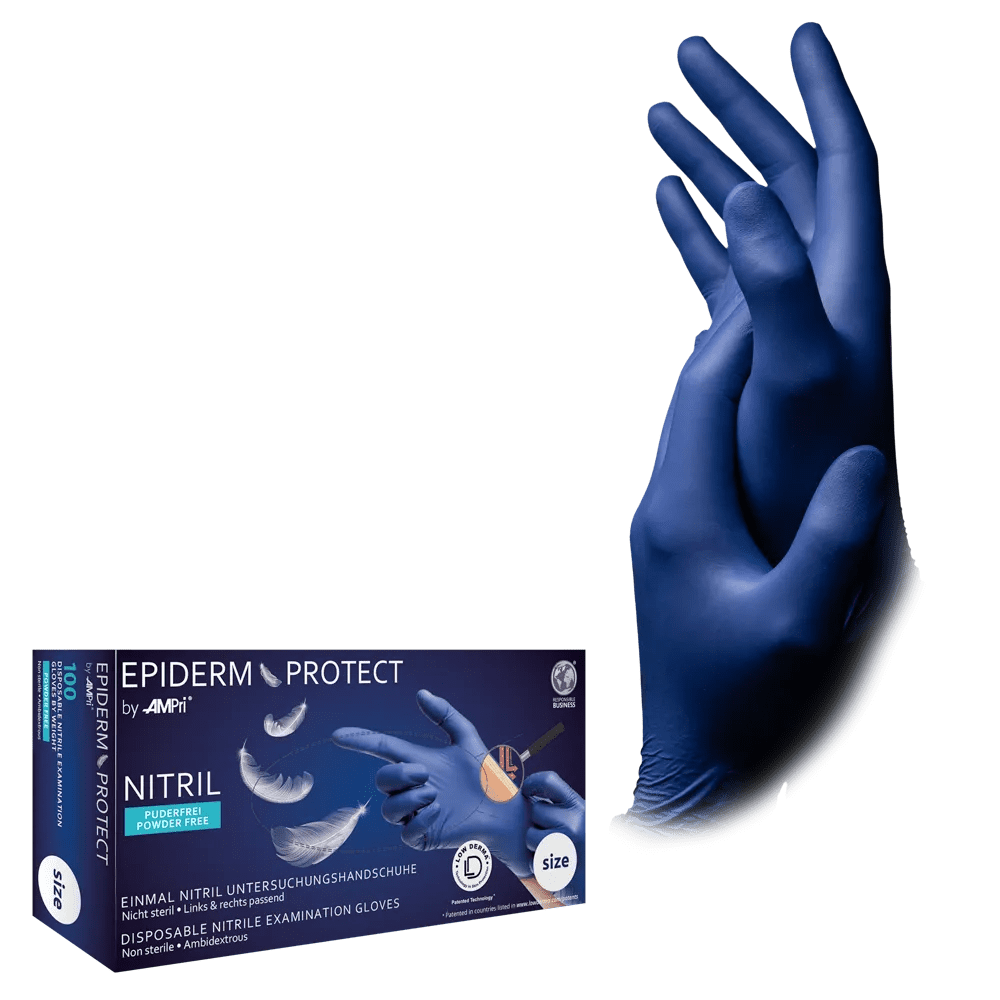













Low Derma Gloves
- XS
- S
- M
- L
- XL
Epiderm Protect Nitrile Gloves – exceptionally skin-friendly, accelerator-free and clinically validated
- Rethinking skin protection: when gloves become part of skin health
- Why disposable gloves can cause skin problems
- Epiderm Protect & Low Derma™ technology
- Wear comfort, fit & sensory perception
- Comparison: Epiderm Protect vs. standard nitrile vs. latex
- Who is Epiderm Protect the right choice for?
- Responsibility, environment & modern PPE strategy
Rethinking skin protection: when gloves become part of skin health
Frequent glove use is part of everyday working life in healthcare, nursing, laboratories and many other professions. At the same time, occupational skin diseases have been increasing for years. Dry, cracked skin, eczema and allergic reactions are no longer marginal issues, but represent a serious occupational health concern.
Epiderm Protect was developed precisely for this context: not as just another disposable glove, but as a preventive skin protection concept. The aim is not only to protect the skin from external influences, but to actively prevent sensitisation, irritation and long-term damage. The result is a nitrile glove that regards skin compatibility not as a “comfort feature”, but as a measurable safety factor.
Why disposable gloves can cause skin problems
The skin is a highly sensitive organ. Its protective function depends on an intact skin barrier. If this barrier is persistently disrupted – for example by occlusion (heat and moisture build-up), friction, perspiration or irritating substances – the risk of inflammation, eczema and allergies increases significantly.
Disposable gloves sit directly on the skin, often for hours at a time. This alters the microclimate of the hands: moisture increases, the stratum corneum swells more easily, and the skin becomes more permeable to substances that would otherwise be less problematic. At the same time, frequent donning and doffing increases mechanical stress. In practice, this creates a combination of occlusion, friction and contact with potentially sensitising substances – precisely the conditions under which glove-associated skin problems develop.
Type I allergy (immediate type) – latex proteins as triggers
Type I allergy is an IgE-mediated immediate reaction, typically triggered by natural latex proteins. Symptoms such as itching, wheals or, in rare cases, systemic reactions can occur immediately after contact. For this user group, latex-free materials such as nitrile are generally the appropriate alternative. However, “latex-free” does not automatically solve all problems, as many occupational glove allergies are not Type I but Type IV.
Type IV allergy (delayed type) – accelerators as the primary cause
Far more common – and often only after months or years – is the Type IV contact allergy. This is typically not caused by latex itself, but by certain vulcanisation accelerators that may be used in glove manufacturing. Known substance groups include thiurams, thiazoles and carbamates. These act as small chemical triggers (haptens) that can sensitise the immune system.
A key characteristic of Type IV is its delayed onset: the reaction occurs with a time lag, making it difficult in everyday practice to link cause and effect. This is precisely why a glove that consistently avoids these triggers is relevant not only for affected individuals, but especially for prevention in all areas with high glove usage frequency.
Epiderm Protect & Low Derma™ technology
At the core of Epiderm Protect is the patented Low Derma™ technology. This represents a targeted material and process strategy that does not merely “reduce” known allergological risk factors, but systematically eliminates them. Epiderm Protect is a nitrile glove that consistently avoids typical problem substances – addressing precisely where many standard products reach their limits.
Crucially, Epiderm Protect is not simply “formulated to be skin-friendly”, but is designed as an allergy-conscious and skin-preventive hand protection solution. This makes glove use significantly more predictable, safer and less burdensome in daily practice – particularly for users with sensitive or pre-damaged skin.
Accelerator-free nitrile formulation – a scientific approach
The production of accelerator-free nitrile gloves is technically demanding, as accelerators in conventional processes are used to efficiently control material properties. Low Derma™ demonstrates that protection, barrier performance and practical usability can be achieved without these sensitising substances. Epiderm Protect is therefore free from vulcanisation accelerators and also avoids sulphur as well as typical chemical activators that frequently appear as triggers in allergy diagnostics.
An additional safety aspect: when a glove is used under demanding conditions (e.g. extended wear times, frequent gripping, increased mechanical stress), the issue of substance release becomes critical. With Epiderm Protect, no accelerator can be released from the material – because these substances are not present at all. This not only reduces the risk of skin reactions, but also minimises the potential for unwanted transfer into sensitive working environments.
Clinically validated skin compatibility & prevention
Epiderm Protect is clinically validated and has been specifically developed for users whose skin is particularly challenged in their professional routine. This includes individuals with diagnosed Type IV sensitisation as well as those with sensitive skin, a tendency to irritation or recurring eczema. The glove is therefore not only an option “once problems have already occurred”, but above all a professional measure to counteract sensitisation and chronic skin stress at an early stage.
In modern occupational safety concepts, prevention is gaining importance: those who adopt skin-friendly glove solutions early on reduce downtime, improve wearer acceptance and support the long-term operational capability of teams – particularly in areas where gloves are indispensable.
Wear comfort, fit & sensory perception
Skin compatibility does not end with formulation. Fit, elasticity and surface behaviour also determine the extent to which the skin is stressed in everyday use. A glove that is too tight increases pressure and friction points. A glove that is too loose requires constant adjustment and increases mechanical strain on the skin. Epiderm Protect offers a balanced material performance: the nitrile adapts evenly without creating excessive pressure.
At the same time, tactile sensitivity is maintained – a crucial factor in healthcare, nursing, laboratory and dental applications. In practice, the better the sensory feedback, the calmer and more controlled the movements, which in turn reduces frictional stress. As a result, the glove not only feels “comfortable”, but also indirectly supports a more skin-friendly way of working.
Comparison: Epiderm Protect vs. standard nitrile vs. latex
| Property | Epiderm Protect (Low Derma™) | Standard nitrile glove | Latex glove |
|---|---|---|---|
| Type I allergy risk (immediate type) | ★★★★★ Latex-free – suitable for users who must avoid latex. |
★★★★★ Latex-free – generally very suitable. |
★☆☆☆☆ Latex proteins may trigger Type I reactions. |
| Type IV allergy risk (delayed type) | ★★★★★ Accelerator-free – specifically developed to minimise sensitisation risk. |
★★☆☆☆ Depending on formulation, accelerators may be present; risk depends on material and manufacturer. |
★★☆☆☆ Latex gloves may also contain accelerators; Type IV risk remains possible. |
| Skin compatibility during prolonged use | ★★★★★ Designed for sensitive and pre-damaged skin; preventive approach. |
★★★☆☆ Often adequate in daily use, but not always stable with high wearing frequency. |
★★★☆☆ Very comfortable, but not suitable for all from an allergological perspective. |
| Preventive skin protection | ★★★★★ Avoids typical triggers at material level – beneficial even without existing allergies. |
★★☆☆☆ Prevention is possible, but depends on ingredients and usage conditions. |
★★☆☆☆ High comfort, but allergy risk limits preventive suitability. |
| Wear comfort | ★★★★☆ Balanced, skin-calming feel – particularly for extended use. |
★★★☆☆ Solid, varying depending on quality and thickness. |
★★★★★ Highly elastic and often perceived as a “second skin”. |
| Fit & elasticity | ★★★★☆ Good adaptation, stable fit – without unnecessary pressure points. |
★★★★☆ Generally very good fit; depends on formulation and wall thickness. |
★★★★★ Maximum elasticity and very precise hand conformity. |
| Tactile sensitivity | ★★★★☆ Very good feedback for precise work, without a “plastic” feel. |
★★★★☆ Good to very good in many applications. |
★★★★★ Highly sensitive – often considered the benchmark for tactile feel. |
| Risk of cross-contamination (allergenic substances) | ★★★★★ No accelerators in the material – reduces potential transfer into sensitive environments. |
★★★☆☆ Depends on ingredients; theoretically possible if accelerators are present. |
★★★☆☆ Depends on proteins/accelerators; not ideal for highly sensitive settings. |
| Suitable for sensitive skin | ★★★★★ Consistently designed for skin compatibility. |
★★☆☆☆ Not always stable for sensitive skin, especially with frequent use. |
★★☆☆☆ High comfort, but allergy risk may be a limiting factor. |
| Uniqueness / market positioning | ★★★★★ Specialised, scientifically positioned glove – focus on skin and allergy prevention. |
★★★☆☆ Wide market range; differences mainly in quality and additives. |
★★★☆☆ Established, but partly limited in sensitive environments. |
Who is Epiderm Protect the right choice for?
Epiderm Protect is the consistent solution for anyone who does not view hand protection in isolation, but as part of overall skin health. Users with diagnosed Type IV sensitisation to vulcanisation accelerators benefit particularly, as these triggers are deliberately excluded in Epiderm Protect. At the same time, the glove is suitable for individuals with hypersensitive, dry or pre-damaged skin barriers that are prone to irritation in daily use.
In addition, Epiderm Protect is highly relevant for organisations aiming to take a preventive approach. In environments with high glove usage frequency, early adoption of skin-friendly, accelerator-free products can help prevent sensitisation, increase wearer acceptance and ensure the long-term resilience of teams. Epiderm Protect is therefore not merely a “specialised solution”, but a professional standard for demanding glove programmes.
Responsibility, environment & modern PPE strategy
The elimination of problematic chemical substances has an impact beyond the user. Optimised manufacturing processes and the reduction or elimination of potentially harmful ingredients support responsible procurement without compromising protective performance. Epiderm Protect therefore aligns with modern PPE strategies that consider safety and skin health as an integrated whole – while maintaining a focus on transparency and responsibility throughout the supply chain.
Anyone who uses gloves on a daily basis knows: the best glove is not only one that protects, but one that can be worn consistently over time. Epiderm Protect therefore combines professional protection with a scientifically grounded skin strategy – delivering greater safety in use and greater stability in everyday practice.